AGENTWALLETS · INDEPENDENT PERSPECTIVES
Biconomy: Nexus Accounts, MEE Workflows and the Limits of One Approval
Understand how Biconomy separates smart accounts, cross-chain execution and delegated sessions, with practical checks for agent-driven payment workflows.
 Project reference · Biconomy ↗
Quick answer
Biconomy combines Nexus modular smart accounts, the MEE orchestration layer and Smart Sessions for delegated execution. It can simplify a multi-step workflow, but an approval screen does not remove the need to inspect permissions, intermediate chain states, execution costs and recovery behavior.
A business keeps an operating balance on one network but needs to pay a supplier on another. An assistant could prepare the transfer, conversion and destination payment as one workflow. The appealing promise is fewer manual steps. The harder requirement is knowing what happens if the source transaction completes while the destination payment is still waiting.
Research boundary: Biconomy’s official documentation reviewed November 1, 2026. The supplier-payment example is hypothetical. We did not deploy Nexus, grant a session or run a cross-chain transfer.
The account, the executor and the permission are different pieces
Biconomy’s overview presents a stack rather than a single wallet interface. Nexus provides a modular smart account, MEE coordinates execution, and Smart Sessions supply a delegated-operation path. A REST-oriented Supertransaction API and the AbstractJS SDK offer different integration surfaces.
Nexus documentation identifies ERC-7579 modules and composable batching among the account’s capabilities. A modular account lets a team select account behavior, but each added module also becomes something to inventory and review. “Modular” is not a substitute for knowing the installed validator, session module and recovery mechanism.
For the supplier example, start with the existing account and signing model. Decide whether the product is creating a smart account or integrating an existing wallet through a supported path. Only then decide how the assistant will propose the workflow.
One workflow still contains intermediate states
The MEE documentation describes execution that can use prior outputs and coordinate dependencies across networks. That is useful when a later instruction cannot be fully determined until an earlier step finishes. It reduces orchestration work visible to the user; the application still needs to account for each stage.
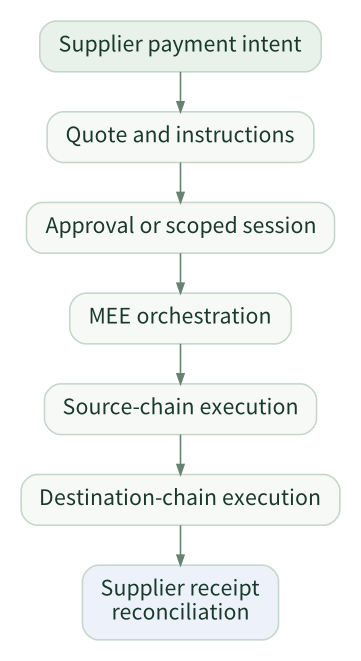
Conceptual cross-chain workflow, not a tested route. A shared approval does not by itself establish that every chain step can be rolled back together.
Our product recommendation is to show meaningful progress rather than a single spinner: approved, source submitted, funds in transit, destination executed and reconciled. The exact states depend on the chosen route. If the supplier address or destination network changes after a quote is approved, treat that as a changed payment instruction, not a harmless UI update.
Also separate a same-chain batch’s execution behavior from a cross-chain workflow’s recovery behavior. Ask which intermediate assets can remain, who can recover them, and whether a fresh authorization is required. Do not infer a universal all-or-nothing guarantee from the phrase “single signature.”
A session should describe the job it is allowed to do
Smart Sessions delegate selected capabilities to another signer, with constraints such as contracts, functions, amounts or timing. The documented setup distinguishes installing the session module from approving permissions; its example requires two user signatures. The exact onboarding experience depends on account state and integration path.
For recurring supplier payments, identify the recipient, accepted asset, permitted call and duration before designing the approval screen. Review the actual policy representation. A token allowance alone may not express the business rule “pay only this supplier after this invoice has been approved.” The invoice condition may still require an enforced application-side decision.
Protect the delegated signer as an operational credential. The useful question is not only whether the main wallet key stays private, but whether a stolen session credential can perform anything beyond the intended payment job. Include stopping future execution and handling already-submitted instructions in the runbook.
Evaluate the whole route, not the headline gas claim
| Area | Evidence to collect for the chosen integration |
|---|---|
| Account configuration | Chain, deployment mode, installed modules and recovery owner |
| Quote | Input asset, expected destination amount, fees and validity conditions |
| Session | Exact allowed actions, duration and signer identity |
| Partial progress | State after source success and destination delay or failure |
| Completion | Supplier receipt and mapping back to the invoice |
Biconomy’s product pages include comparative cost and performance claims. This article does not reproduce them as independent benchmarks. A team’s actual cost includes its chosen route, network conditions and transaction shape. Compare equivalent workflows using a stated environment before making a price or latency promise to users.
Where the stack earns its complexity
Biconomy is worth evaluating when the product genuinely needs coordinated, delegated or multi-step onchain execution. For a single transfer on one network, a simpler path may be easier to operate. The deciding factor should be whether orchestration removes work your application would otherwise have to build, without hiding the permission and recovery states your users need to understand.
Continue with the Biconomy reference and agent spending-limit design. The practical milestone is a fully explained workflow, including its failure path, rather than merely reducing the number of approval clicks.
FOLLOW THE SOURCES