AGENTWALLETS · INDEPENDENT PERSPECTIVES
Circle CCTP: Moving an Agent’s USDC to the Chain Where It Is Needed
Trace CCTP burn, attestation and destination mint, then review finality, fees, interrupted transfers and the distinction from Circle Gateway.
 Project reference · Circle CCTP ↗
Quick answer
Circle CCTP moves USDC between supported blockchains through a burn-and-mint process using Circle attestations. An agent application must track the source transaction, attested message and destination result separately. CCTP is a crosschain transfer building block, not a universal merchant checkout or a unified-balance account.
An agent has USDC on one network, but the service it needs accepts payment on another. Before paying the merchant, the application has to move funds to the right destination. That introduces a separate workflow, with its own authorization, fees and unfinished states.
CCTP can handle the crosschain transfer. A reliable integration must still explain where the funds are in that process and whether the intended merchant payment has happened.
Research boundary: Circle documentation reviewed November 1, 2026. This article focuses on a conceptual USDC transfer. No bridge transaction, timing measurement or fee quote was executed.
Follow the transfer through three stages
Circle’s technical guide describes source-chain message creation, an offchain attestation and destination-chain message processing. For USDC, the source operation burns tokens and the destination operation mints them. On supported EVM routes, the documented V2 contracts include TokenMessengerV2 and MessageTransmitterV2.
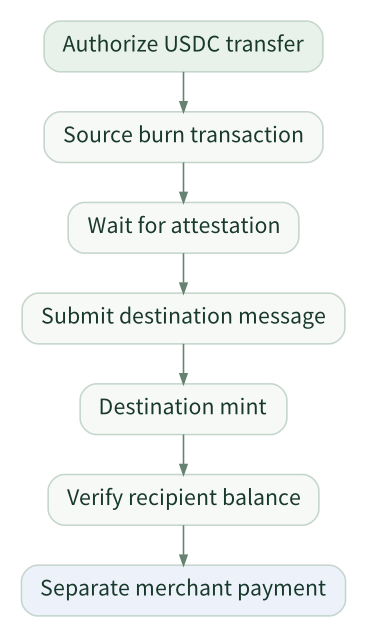
Conceptual USDC funding flow, not a completed transfer. A configured integration may combine later actions, but that behavior must be checked separately.
The attestation service is a real dependency in the architecture. Calling the flow non-custodial does not mean every component is independent of Circle, nor does a successful burn mean the recipient already has spendable funds on the destination.
Build a route record before signing
The supported-chain documentation assigns CCTP domain identifiers and distinguishes route capabilities. Use the current route information rather than assuming that an EVM chain ID is the required CCTP domain value, or that every source has the same transfer features.
A proposed preflight record should include the source network and token contract, CCTP version, destination domain, recipient encoding, amount and who will submit the destination transaction. Record the merchant’s required token separately. A familiar ticker alone is not enough to establish that the destination asset matches what the merchant accepts.
Circle’s overview now also describes EURC and configured third-party-asset support through a separate non-USDC path. Do not extend the USDC burn-and-mint walkthrough to every token bearing a similar name; inspect the asset-specific contracts and transfer model.
Choose finality and costs deliberately
The finality guide distinguishes Fast Transfer from Standard Transfer and documents differences by source network. Fast Transfer uses an earlier confirmation threshold and is subject to an allowance; Standard Transfer waits for the relevant stronger finality condition. Published timing figures are not a service-level guarantee for a particular payment.
For an agent purchasing a time-sensitive service, include transfer uncertainty in the purchasing decision. A quote may expire before funding is available. The application should know whether it can obtain a fresh quote or must ask for a new decision, instead of extending the user’s authorization silently.
The fee documentation provides route-fee lookup and maximum-fee controls. It also distinguishes fee deduction at mint from supported upfront-fee arrangements. Calculate what the recipient will receive under the selected route, and account for network execution costs separately. “Enough to burn” and “enough to pay the merchant” are different checks.
Recover the existing transfer, not a replacement purchase
A transfer worker may stop after the burn, after fetching an attestation or after submitting on the destination. Persist those milestones and their identifiers before reporting progress to the agent.
| Last known evidence | Recovery question |
|---|---|
| Source transaction submitted | Was this burn included and successful? |
| Burn confirmed, attestation pending | Is the original message ready for the next step? |
| Destination submission timed out | Was that message already processed? |
| Funds minted to the recipient | Has the merchant payment been separately submitted? |
The technical guide documents message nonces that can be consumed only once on the destination. That protocol property does not automatically prevent the application from initiating a second source burn. Business-level idempotency must cover the whole funding request.
These are proposed recovery checks, not an assertion that a stalled transfer can always be canceled or refunded. Escalate an unresolved state with the recorded identifiers rather than promising a reversal the integration has not established.
CCTP and Gateway solve different funding problems
Circle Gateway organizes deposited funds into a unified balance per asset across supported networks. CCTP is centered on a specific crosschain transfer. The appropriate design depends on whether the application needs occasional point-to-point funding or a persistent crosschain balance model.
Keep those products distinct in architecture and accounting. For this agent, first prove one complete funding-to-payment trace, including failure recovery, before adding more routes. Start with the CCTP directory reference and payment idempotency.
FOLLOW THE SOURCES