AGENTWALLETS · INDEPENDENT PERSPECTIVES
MCP for Payments: Designing a Tool Boundary an Agent Can Use
Learn where MCP connects an agent to payment tools, how transport authorization differs from spending approval, and how to separate quote, execute and status operations.
 Project reference · MCP ↗
Quick answer
MCP standardizes how AI applications connect to external tools, resources and prompts. A payment service can expose operations through MCP, but MCP itself does not settle payments or grant a universal spending mandate. The host, server and underlying payment system need explicit authorization and transaction controls.
A developer wants an assistant to find an unpaid invoice, show the user a quote and pay only after approval. Exposing the payment API as a tool can make the workflow available to the assistant. It does not settle the harder question: which part of the system decides that this particular invoice may be paid?
MCP is useful for the connection. The money-moving boundary still needs to be designed.
Research boundary: official MCP documentation reviewed November 1, 2026, using the 2026-07-28 documentation version. This is a proposed payment-tool design, not a tested server integration. No payment credentials were created or used.
Locate MCP in the application
The MCP introduction describes a standard for connecting AI applications to external systems. Its architecture documentation distinguishes the host application, its clients and connected servers. Servers expose capabilities such as tools and resources; the protocol does not choose the application’s business policy.
For a payment integration, think of MCP as the interface to a controlled service. Keep the actual signing or payment-processing authority behind a service boundary with explicit checks, instead of making every tool invocation a direct expression of the model’s wishes.
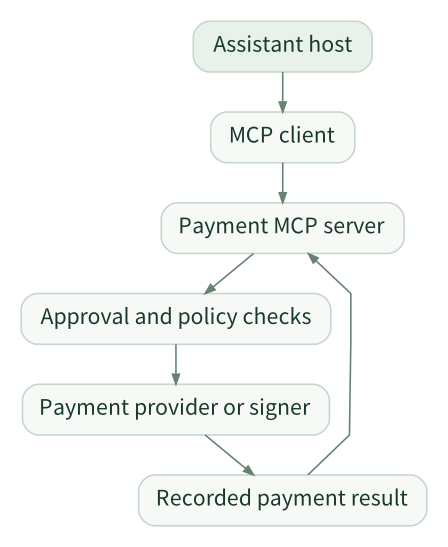
Conceptual payment-tool boundary, not a tested MCP server. The policy and payment components are application design choices, not components supplied by MCP.
Server access and payment approval are different
The authorization specification describes authorization for HTTP-based MCP transports, with the protected server acting as a resource server. It treats local STDIO credentials differently. A developer must identify which transport and authorization model the deployment actually uses.
An access token that permits a caller to reach the server should not be interpreted as unlimited authority over every underlying account. For our invoice flow, the service must still connect the authenticated caller to the correct customer, account, requested operation and approval record. “The assistant is connected” is an inadequate answer to “who approved this payment?”
The server may also call a downstream payment API. MCP’s security guidance warns about token passthrough and confused-deputy risks. Preserve the distinction between the token issued for the MCP server and credentials valid for another service. Avoid treating received bearer material as a universal credential bundle.
Give the assistant a small, legible workflow
Here is a conceptual tool split, not a standard MCP payment API:
| Tool role | Useful output | Authority boundary |
|---|---|---|
| Read invoice | Merchant, amount, currency, current status | Read access to the selected account |
| Prepare payment | Immutable quote/reference and expiry | No money movement |
| Execute approved payment | Attempt identifier and current result | Matching approval plus enforced policy |
| Inspect attempt | Pending, failed or completed state | Read-only reconciliation |
The execute operation should refer to a previously prepared action rather than letting the assistant silently replace the recipient or amount after approval. If a quote expires or changes, send the workflow back to the appropriate decision point.
This design also reduces ambiguity in model output. “Prepared” can mean a proposal exists; “submitted” can mean a payment attempt exists; neither needs to be described as “paid.”
Treat tool results as data, not permission
A supplier response could contain an invoice description and additional text addressed to the assistant. The application should use the invoice data for the task without letting that text redefine account permissions, change the approved recipient or request credentials.
For a review exercise, introduce a malicious instruction into a mock supplier response and confirm that it cannot reach the execution path as an authorization. Also test wrong-account references, expired approvals and retries after a timeout. These are suggested tests; we have not run them against a provider.
Keep correlation identifiers across the MCP call and downstream payment attempt. If the connection closes after submission, use the attempt-status path rather than automatically issuing a new purchase. A concise tool error should say whether no action was taken, a known attempt failed, or the result is still uncertain.
When MCP earns its place
MCP is useful when several AI applications should access a well-defined tool service without each needing a bespoke interface. For a single internal agent, evaluate that benefit against the additional client/server and authorization surface.
Our recommendation is to judge a payment MCP server by its operation boundaries, credential handling and reconciliation behavior, not by the number of tools it advertises. See the MCP directory reference, A2A’s separate task boundary and payment idempotency.
FOLLOW THE SOURCES