AGENTWALLETS · INDEPENDENT PERSPECTIVES
Quicknode Agentic Payments: Buying RPC Access Is Not the Same as Creating an Account
Understand Quicknode x402 and MPP access, payment-chain versus query-chain selection, and the extra authority created by an Agent Subscription.
Quick answer
Quicknode offers wallet-funded RPC access through x402 and MPP, plus a separate Agent Subscription flow that creates an account and returns a platform API key. The payment network can differ from the queried blockchain. Current agentic payment surfaces are documented as Alpha.
An agent checking a transaction needs one blockchain read. Giving it a full infrastructure account may be unnecessary. An agent deploying an application, however, may need persistent endpoints, webhooks and account management. Quicknode documents different entry points for these two jobs; confusing them creates an avoidable permission problem.
Evidence boundary: official documentation reviewed November 1, 2026. No account was created, API key issued or paid request executed for this article.
Start with the lifetime of the resource
Quicknode’s agentic payments overview presents x402 and MPP routes for wallet-funded requests. The same page separates one-shot RPC access from a subscription-backed account and currently labels the payment surfaces Alpha. Availability in documentation is not a production reliability guarantee.
For a short research task, ask whether the output alone is enough. If so, keep the authorization tied to that bounded request. If the agent needs infrastructure that survives the task, identify who will own it, pay for it and remove it. Purchasing a durable service should be treated as procurement, not disguised as another harmless read.
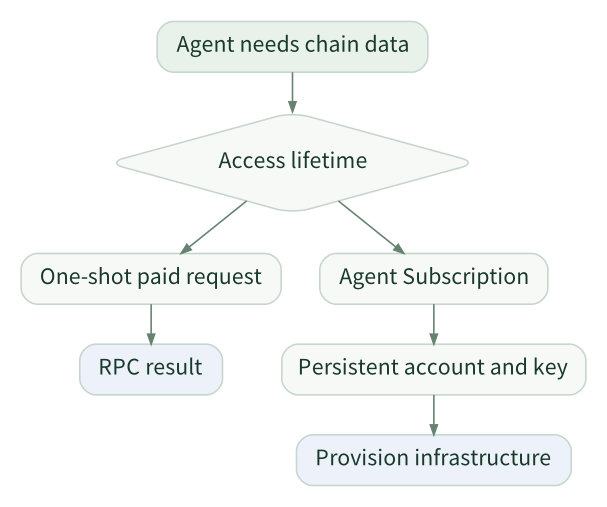
Conceptual access decision, not an account-creation or payment test. A subscription creates continuing operational responsibilities.
Two networks appear in the same request
The payment network funds access; the queried network supplies the requested blockchain data. Quicknode explicitly documents that these can differ. This matters when an interface shows a single ambiguous “network” selector.
Our recommendation is to display both values in logs and approval screens. A developer investigating an Ethereum transaction should not infer that the payment wallet must hold an Ethereum asset. Conversely, a successful payment on one chain does not establish that the requested RPC method or target-chain data was correct. Retain the RPC method, target network and request parameters separately from payment metadata.
This separation also prevents misleading cost comparisons. Compare the fee for the requested service, the payment rail’s costs and any recurring subscription obligation. Do not infer one from the chain being queried.
x402 and MPP are separate integrations
Both use HTTP 402 in Quicknode’s documentation, but share neither an identical wire format nor every billing behavior. Treat protocol selection as a capability negotiation, not a string replacement in the proxy URL. A buyer needs compatible payment software and an explicitly allowed charging mode.
For integration design, distinguish a single charge from a continuing session or credit balance. The safe question is not merely “did the first request fit the limit?” It is “what can later requests consume without another decision?” A session can improve repeated access while making lifecycle, revocation and reconciliation more important.
A subscription returns authority, not just a receipt
The Agent Subscription guide describes an API that creates an account and activates a paid plan. Its response includes a QN_* platform API key. That credential opens a different risk surface from the payment payload that bought the subscription.
Keep the key out of conversation transcripts and model-visible logs. Store it in the application’s secret system, expose only the tools needed for the job, and assign a human or service owner for account recovery. These are our operational recommendations, not a claim that every API operation is automatically constrained by the wallet’s original spending allowance.
| Before allowing the agent to buy | Decision the application must make |
|---|---|
| One-off data access | Which method, target network and maximum total expense? |
| Ongoing session | What ends the session and what happens to unused value? |
| Persistent subscription | Who owns the account, key, renewal and cancellation? |
| Infrastructure changes | Which resources can the resulting key create or modify? |
Review the exit path as carefully as entry
A useful evaluation should cover a declined payment, an accepted payment with a lost response, an exhausted allowance and a task ending while provisioned resources remain. Do not blindly repurchase a subscription after a timeout: first establish whether the account or key was already created.
Quicknode belongs in this directory as metered infrastructure and an agent-facing procurement surface, not as a new wallet standard. See the Quicknode reference for official entry points and the x402 protocol reference for the separate protocol layer.
FOLLOW THE SOURCES