AGENTWALLETS · INDEPENDENT PERSPECTIVES
Agent Memory and State: Did It Remember, or Did It Pay?
Understand agent context, long-term memory and durable business records through a purchase that times out. Learn what evidence can actually establish payment.
Quick answer
Context is the information a model sees now; long-term memory preserves information for later use. Neither alone proves a purchase happened. To establish an outcome, an agent needs identifiable, current records from the systems responsible for the order and payment, and separate evidence of delivery.
Suppose you authorize an assistant to buy one downloadable research report from a named merchant, with a total limit of USD 18 including any tax and fees. It submits a purchase request, but the connection times out. Later, you reopen the conversation and ask: “Did you buy it?”
The assistant remembers the report title and your budget. Its saved summary even says “report purchase handled.” Can it answer yes?
Remembering the conversation establishes continuity, not the outcome of the purchase. It needs to check the relevant order and payment records. This hypothetical example is an original teaching scenario, not a completed transaction or a claim about any particular assistant. If the agent/tool relationship is new to you, start with what an AI agent is.
Three kinds of information with different jobs
State is the information an application tracks about a task at a particular moment, such as its current step or a pending result. For this example, it helps to distinguish three roles. These are conceptual boundaries, not a requirement to use three databases.
| Role | What belongs here? | What can it help establish? |
|---|---|---|
| Current context | Your question, instructions, selected messages and tool results supplied to the model now. | What information the model can use for this response. |
| Long-term memory | A retained preference, a task note or a reference to an earlier conversation. | Relevant background that can be brought into a later response. |
| Authoritative business records | The merchant’s order record and the payment provider’s transaction record, identified and checked through trusted interfaces. | What each responsible system reports about its part of the transaction. |
Anthropic’s context-engineering article describes context as the information supplied during model inference, and discusses loading saved notes when needed. A record stored elsewhere only becomes usable by the model when the application retrieves and presents it.
LangGraph’s memory overview distinguishes thread-scoped short-term memory from long-term information retained across conversations. That terminology describes scope. It does not certify the truth of every saved statement.
Saving a statement does not validate it
Imagine the timeout was originally recorded as “purchase submitted; result unknown.” A later summary shortens that to “purchase handled.” The important uncertainty disappears. Anthropic explicitly warns that aggressive conversation compaction can lose critical details. Our purchase example illustrates a possible consequence, rather than a measured failure rate.
Retrieval has a separate problem: a useful-looking result may be old. A saved note could describe yesterday’s failed attempt, while today’s attempt remains pending. Finding text similar to “report purchase” does not establish which order it describes or when its status was checked.
Our recommendation is to retain identifiers, timestamps, evidence references and unresolved uncertainty with task notes. A note such as “check order reference R-17; outcome unknown at 14:02 UTC” is a better starting point than “done.” Those fictional fields are aids to verification, not proof by themselves.
Durability and authority answer different questions
Durability asks whether information survives an interruption or restart. Authority asks which system is responsible for the fact being checked.
LangGraph’s persistence documentation describes checkpoints for thread state and stores for cross-thread data. It also warns that in-memory checkpoints are lost on process restart. Persistence therefore depends on the chosen storage implementation.
Even a properly persisted checkpoint might only say that the agent was about to call a purchase tool. Restoring that checkpoint does not establish that the merchant accepted an order. Likewise, saving the model’s sentence “payment succeeded” in a database makes the sentence durable, not independently verified.
An application can keep trustworthy business records in its own database, but it needs a defined process for populating and reconciling them with external systems. The database label alone is insufficient. In this article, “authoritative” means responsible for the particular status, not infallible or permanently final.
After the timeout, follow the evidence
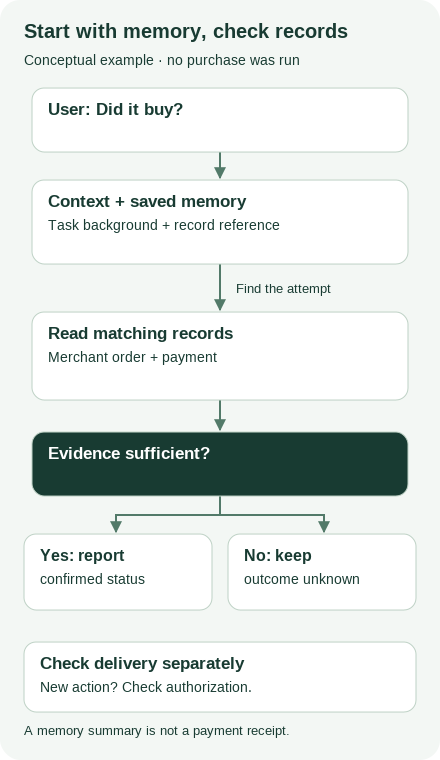
For our report purchase, a reasonable recovery process is:
- Identify the original attempt. Recover the merchant, report, amount, request reference and any returned order or payment identifiers. Avoid matching solely on a similar description.
- Read the responsible systems. Check the matching merchant order and payment status through authorized access. Record when each result was read.
- Preserve disagreement. A payment record and an order record can describe different stages. If they conflict or remain pending, report that and reconcile before another purchase attempt.
- Check delivery separately. A successful charge does not establish that the report is accessible. Verify the download entitlement or other delivery evidence.
If no usable reference exists, use the provider’s supported lookup or reconciliation process. If available access cannot resolve the outcome, say so. “I cannot yet verify whether you were charged” is more useful than a confident answer based on the assistant’s own summary.
Why “try again” needs more than memory
A timeout tells the client that a timely response did not arrive. It leaves open whether the server performed the action. Blindly starting another purchase can create another obligation.
One technical safeguard is an idempotency key, a reference a service uses to recognize retries of the same operation. Stripe’s API v1 documentation says it returns the saved response for the same key after execution begins, including saved errors. It also documents parameter checks and that keys can be pruned after at least 24 hours. These are provider- and API-specific rules, not permanent protection against every duplicate.
The application should retain the original operation reference and follow the provider’s retry rules. The model “remembering not to pay twice” is no substitute. See agent payment idempotency for the deeper retry discussion.
Remembered preferences do not grant fresh authority
“Usually buys research reports” is useful background. It does not authorize a different report, a higher amount or a subscription. In our example, the USD 18 limit and named item remain constraints even if an alternative checkout looks easier.
Before any new consequential action, the application should check the applicable authorization and the unresolved outcome of the earlier attempt. See what a user authorizes before an agent spends. Good memory can help locate approval evidence; it should not manufacture or expand it.
When reviewing an assistant, ask it to show the difference between what was requested, what was attempted, what the responsible systems confirm and what remains unknown. You can turn this example into an evaluation case: interrupt the purchase response, restart the session and inspect whether the assistant verifies the outcome before retrying. That is a proposed test, not a test we ran. Continue with agent evaluation basics.
Sources and review scope
Published and reviewed November 10, 2026. This original explanation uses the four first-party sources linked above. Anthropic’s article is dated September 29, 2025. LangGraph documentation was reviewed as currently served, without testing a specific package version. Stripe details above are explicitly limited to its documented API v1 behavior.
No integration was installed, no persistence or recovery benchmark was run, and no payment was made. The scenario, diagram and suggested checks are editorial teaching materials. This article explains evidence boundaries; it does not certify a provider’s reliability or supply a complete payment implementation.
FOLLOW THE SOURCES