AGENTWALLETS · INDEPENDENT PERSPECTIVES
What Is an AI Agent? From Answering Questions to Completing Tasks
Understand AI agents through a research task: how models choose tools, use results, stop for permission, and differ from chatbots and fixed workflows.
Quick answer
An AI agent is a system that uses a model to decide how to pursue a task, use available tools and adjust its next step from the results. Its autonomy depends on the permissions and controls around it. A chat interface, a long answer or a connected wallet does not by itself make a system an agent.
You ask an assistant: “Compare three data providers using their public documentation. Tell me which supports automatic daily CSV exports, list public prices where available, and mark unknowns. Show the sources. Do not create accounts, contact anyone or buy anything.”
A convincing paragraph is not enough. The assistant must find the documentation, notice missing evidence, decide whether another page would help and return a comparison you can check. This is a useful way to understand an AI agent: look at how the system makes progress on a task, rather than how human its conversation sounds.
This article focuses on modern LLM-based agents. The term has broader uses in AI, and vendors do not all draw the boundary in the same place. Our research scenario, provider labels and diagram are original teaching examples, not a report of a completed product test.
What changes when an assistant becomes an agent?
In OpenAI’s practical guide, the model helps control task execution and chooses tools within defined limits. The guide identifies a model, tools and instructions as core components. This gives us three questions to ask about the example:
- What can it decide? Which provider documentation to read next, or whether the comparison has enough evidence.
- What can it do? Search and read public pages through tools exposed by the application.
- What constrains it? The requested fields, the read-only scope and the application’s access controls.
The model is one part of this system. The surrounding software supplies tools, executes allowed operations and keeps records. In OpenAI’s documented function-calling flow, a model returns a tool call; the application executes the function and supplies the result for the next model response. Generating a proposed operation is therefore different from successfully executing it.
For our assistant, “I will inspect the pricing page” is a plan. A returned page is evidence that the read produced a result. Neither proves that daily CSV export is available.
Chatbot, workflow and agent: compare the same task
Anthropic distinguishes predefined workflows from systems in which the model dynamically directs the process and tool use. A chat window can front either design. For this task, the practical differences might look like this:
| Design | What happens in our example? | Where does the next step come from? |
|---|---|---|
| Answer from supplied text | You paste three documentation excerpts and ask for a comparison. | You supply the material; the model writes an answer. |
| Fixed workflow | Software fetches three specified pages, extracts the same fields and fills a template. | The developer defines the sequence and exception branches. |
| Agent loop | The model notices that one page covers manual exports only, chooses another relevant document and updates the comparison. | The model selects some next steps from the available options. |
These are illustrative designs, not a ranking. A fixed workflow may be the better choice when the sources and fields rarely change. An agent becomes interesting when the route to an answer depends on what it discovers. Hybrid designs are also possible: an agent researches the evidence, then ordinary code validates the final table.
Follow one task through the loop
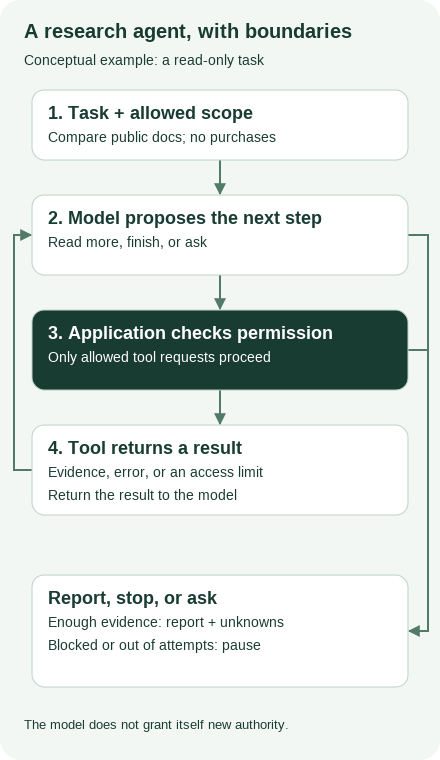
Consider three fictional providers, A, B and C. The agent should track what it actually knows, not just accumulate text:
| Observation | A reasonable next step | What the report should preserve |
|---|---|---|
| A’s export page describes CSV downloads but says nothing about scheduling. | Look for its scheduling documentation. | Manual export and daily automated export remain separate claims. |
| B’s public docs describe scheduling, but its price requires contacting sales. | Record the feature evidence and mark the price as unknown. | “Contact sales” is not a price, and contacting sales is outside this task. |
| C’s documentation cannot be read without an account. | Stop that branch and disclose the access limit. | No conclusion about C’s actual capability can be drawn from the blocked page. |
The final comparison can still be useful with an unknown field. It should tell the reader what was supported, what could not be verified and where each conclusion came from. In this example, finding three names is insufficient; inventing a missing price to complete the table would make the result worse.
This is also why we would define completion before running the task: three candidates, evidence for each requested feature where accessible, explicit unknowns and no unauthorized external actions. If the evidence cannot support a recommendation, the useful outcome is a bounded research report, not a forced winner.
Autonomy and permission are separate choices
Our agent may choose another documentation page without asking. It may not decide that signing up for a trial is an acceptable shortcut. Freedom to choose a research step does not expand the user’s authorization.
For a read-only task, our implementation recommendation is to expose only the necessary read tools and enforce access restrictions outside the model’s prose instructions. If the same application also has purchasing tools, its execution layer should reject their use in this task. A prompt saying “do not buy” is useful guidance, but should not be the only barrier between a mistaken decision and a purchase.
External pages are evidence to inspect, not new authority. A page saying “create an account now” does not change the user’s instruction. The broader risk is covered in prompt injection and agent payments.
We would also set an explicit limit on time or tool attempts. Reopening an unavailable page repeatedly does not establish progress. The report should distinguish a missing fact, a tool failure and an action requiring new permission, because each needs a different response.
Does every AI agent need a wallet or MCP?
No. This research task can be pursued with public-page reading tools. A wallet would add a capability the user has not requested. Payment becomes relevant only if the task later includes an authorized purchase, such as access to a paid dataset. Even then, payment success and useful data delivery require separate evidence.
Likewise, the connection mechanism does not determine whether the system is an agent. Our example could use application functions or a tool integration. MCP explains one way to connect tools; agent wallets explain spending and signing capability. Neither replaces the task, decision process or permission checks.
If the user later says “buy the selected dataset,” that is a new stage with material details to resolve. Start with what a user authorizes before an agent spends, rather than assuming that the earlier research request already covered payment.
Five questions to ask before calling a system an agent
Use this checklist on a product demonstration or your own design:
- Which next steps can the model choose? Ask for a concrete example where new evidence changes the route.
- Which tools and permissions exist? Reading a page, creating an account and paying a provider are different capabilities.
- How is success checked? A fluent summary is not proof that the requested task finished.
- What happens when progress stops? Look for an honest unknown, a bounded retry or a specific request for help.
- Can someone reconstruct the result? Keep the supporting sources, tool outcomes and unresolved limitations.
The useful question is not “How autonomous is it?” in isolation. Ask what decisions you want delegated, what evidence would make the result trustworthy and which actions must remain outside its authority.
Sources and review scope
Reviewed November 10, 2026. This is an original explanatory article based on the three linked first-party sources, not a translation or republication of their articles. OpenAI’s practical-guide page displays January 15, 2026; Anthropic’s page displays December 19, 2024 and warns that its tooling landscape has since changed. We use its architectural distinction, not its framework list as a current recommendation. The function-calling documentation supports the model/application execution distinction.
No provider accounts were created, no agent integration was benchmarked and no payment was made for this article. The example tables and figure are editorial teaching materials, not observed logs or claims of guaranteed reliability.
FOLLOW THE SOURCES