AGENTWALLETS · INDEPENDENT PERSPECTIVES
Agent Wallet Strategies: Seven Provider Paths
Trace Coinbase, Circle, Crossmint, MetaMask, Privy, Turnkey and Cobo from their original capabilities to agent wallets, with milestones and product tradeoffs.
Quick answer
Agent-wallet providers are extending different starting assets: packaged financial tools, USDC and service discovery, checkout execution, or configurable signing. Compare their documented evolution and remaining application responsibilities before treating them as interchangeable wallets.
A product team wants its assistant to buy a dataset, rebalance a crypto position and order a replacement laptop. All three tasks involve money. They do not require the same wallet product. The dataset may expose a payment API; the rebalance needs an authorized blockchain signature; the laptop needs a merchant checkout and an order that someone can support.
This is why the agent-wallet market is developing along several paths. Coinbase, Circle, Crossmint, MetaMask, Privy, Turnkey and Cobo bring different existing capabilities into the problem. This analysis follows their published product decisions, then separates our interpretation of those decisions from documented functionality. Sources were reviewed on November 6, 2026. The three tasks are hypothetical, not completed integrations or an assertion that every provider supports them.
Read the starting point before the feature list
An agent wallet gives software a controlled way to access spending or signing capability. That definition leaves room for very different products: an application ready to use through an agent client, an API from which developers build a wallet, or a broader stack that also finds services and completes purchases.
A company’s starting point shapes the next problem it can reasonably take on. Signing infrastructure can add policies without becoming a merchant checkout operator. A provider with payment and service-discovery tools can assemble a buying workflow, but still depends on the seller delivering useful output.
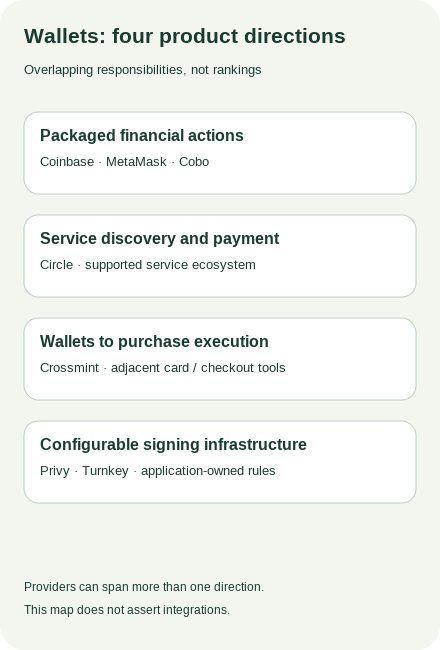
The diagram groups product directions rather than ranking companies. The sections below show the evidence and the tradeoff for each. Shared terminology is not evidence of shared architecture, compatible permissions or an actual partnership.
Coinbase: from a developer toolkit to a packaged agent interface
Coinbase introduced AgentKit on November 8, 2024, giving developers building blocks for onchain agent actions. Its February 11, 2026 Agentic Wallets release then packaged wallet capabilities and skills more directly around agents. The progression is from assembling tools inside an application toward equipping an existing agent with a financial interface.
The current product overview separates CLI and MCP entry points. Both support x402 service payments, while the MCP agent interface is for service discovery and payment rather than sending and trading. Our dataset assistant and trading assistant therefore cannot select an integration solely from the Coinbase brand name.
Our interpretation is that packaging reduces the distance from an agent task to an executable payment. The tradeoff is a more specific supported workflow. Developers still need to verify the selected interface’s controls and the seller’s refund behavior; they cannot inherit every AgentKit capability into MCP by association. The MCP FAQ also distinguishes per-call and per-session limits. A session cap is not evidence of a budget shared across all future sessions.
Circle: connect USDC, service discovery and execution
Circle’s May 11, 2026 Agent Stack announcement combined Agent Wallets, Marketplace, CLI, Gateway-powered Nanopayments and Skills. Its current product page continues to present discovery, programmable funds and command-based execution together.
The important product choice is to work on both sides of “I have money, but what can I buy?” A research assistant can need to discover a data service before requesting payment. Wallet and marketplace tooling can reduce that coordination work. Our interpretation is that this extends the usefulness of USDC into machine-selected services, rather than treating the wallet address as the whole product.
The dependency is service supply and quality. A marketplace can expose an endpoint and a price; it cannot by itself establish that a dataset is accurate, licensed for the intended use or worth buying. The application must decide what counts as acceptable output and retain a service reference when a payment succeeds but the response fails. More listed services would not alone prove more valuable purchases.
Crossmint: extend wallet infrastructure into completing a purchase
Crossmint’s September 17, 2026 vault announcement describes a path from agent wallets to cards and in-product card collection. On October 8, it announced Agent Commerce Toolkit, combining card handling, network credentials and merchant checkout choices.
This crosses an important product boundary. A laptop-shopping assistant needs more than an address or a signature. It needs the right item, a usable payment credential and a completed checkout. Our interpretation is that Crossmint is trying to absorb more of that integration work while letting the agent application retain its user experience.
The potential advantage is fewer separately operated components. The cost is reliance on a wider vendor-managed execution surface: credential availability, checkout routes and merchant interactions. A toolkit’s broad coverage claim must be narrowed to the actual retailer, card and purchase tested. This strategy is complementary to wallet infrastructure, but it is not proof that a successful transfer and a successful purchase are the same thing. The card-route analysis examines that acceptance problem in more detail.
MetaMask: carry user control into agent-driven onchain activity
MetaMask’s August 6, 2026 announcement frames Agent Wallet around traders and builders, with CLI access, user-defined boundaries and transaction checks. The current quickstart distinguishes wallet setup and operating modes. A named mode is a configuration choice; it should not be used as shorthand for the same controls in every wallet arrangement.
For our hypothetical trading assistant, a command such as “rebalance when conditions change” creates a harder problem than manually confirming one transfer. The user needs to define allowed actions before execution and understand when a person is brought back into the loop. Our interpretation is that MetaMask extends its user-facing wallet position toward delegated execution while trying to keep the user’s control experience visible.
The tradeoff is between interruption and the authority granted in advance. Fewer prompts are not a safety score. Procurement should inspect the exact mode, network, action type and approval exception. The launch page also mixes launch language with early-access qualifications, so its headline alone should not be treated as universal access today.
Privy: let application builders choose the control model
Privy’s January 8, 2026 policy-engine explanation describes programmable restrictions for wallet behavior. The current agent-wallet offering adds agent-facing provisioning and management interfaces, while its control reference distinguishes user, delegated, application-managed and shared configurations.
The product decision is to make the control model something the application can configure. A personal assistant and a business treasury service need not assign authority to the same party. Our interpretation is that Privy expands a wallet infrastructure relationship into agents without requiring every customer to adopt one consumer checkout experience.
That flexibility leaves work with the application team. Someone must design permission requests, recovery, revocation and the business meaning of a transaction. “Uses Privy” does not tell a customer whether the user or the service can approve movement of funds. For the research assistant, developers still need a service-selection and delivery workflow above the wallet’s permitted action.
Turnkey: make signing and policy reusable infrastructure
Turnkey’s March 21, 2023 introduction focused on private-key infrastructure for developers. Its current agentic-wallet page applies controlled signing to agents. This is a more direct extension of an existing primitive than a move into consumer shopping.
A signature is the cryptographic authorization for an action. Turnkey’s policy reference describes conditions and approval requirements for activities, including the special authority of a Root Quorum. A developer must account for that administrative path rather than examining only the ordinary agent’s rules.
Our interpretation is that Turnkey aims to remain useful underneath many wallet experiences. The application gains reusable signing and policy components, while retaining responsibility for the purchase decision, payment protocol and merchant relationship. For the laptop task, selecting a signing provider would still leave most checkout work to build. That is a scope decision, not a defect in a product designed for another layer.
Cobo: express a task as bounded authority
Cobo’s Agentic Wallet release connects its digital-asset infrastructure to MPC signing, task permissions called Pacts and reusable execution Recipes. The release body dates the launch to April 20, 2026, while the page header is May 28; these are not two separate product launches. Its current product page continues to emphasize Pacts, approvals and an agent/mobile-app combination.
Our interpretation is that Cobo makes the authorized task a prominent unit of control. For a hypothetical rebalance, the useful question becomes which actions belong to this task, how the user approves them and when the authority ends. Splitting signing material among participants does not itself establish that the proposed strategy is sensible or that every task can run without human participation.
The cost of this route is the need to map a real business task into permissions and supported execution patterns. Mode-specific availability and co-signing behavior need current verification; a mode described as planned in an older release cannot be promoted to live merely because time has passed.
The business differences are easier to see by asking who builds the rest
| Direction | Examples discussed here | Work emphasized | Work still needing an owner |
|---|---|---|---|
| Packaged agent financial interface | Coinbase, MetaMask | Make supported wallet actions available to agents | Task selection, permission fit and outcome checks |
| Money plus service workflow | Circle | Connect funds, discovery and execution tools | Service quality and commercial resolution |
| Wider purchase execution | Crossmint | Connect wallet/card capability to checkout | User intent and unresolved merchant exceptions |
| Configurable signing and authority | Privy, Turnkey, Cobo | Define who can authorize which action | Application experience and end-to-end purchase logic |
These are editorial groupings, not exclusive categories. Cobo has task tooling, Privy has a CLI, and a checkout product can use another provider’s infrastructure. A company can expand across rows without making the underlying layers identical.
Commercially, the routes create different opportunities: more use of a payment ecosystem, more demand for wallet infrastructure, or more purchase execution handled by a platform. Those are hypotheses about product incentives, not reported agent-wallet revenue. Comparing them requires an actual workload and current terms for accounts, signing, funding, conversion, network execution and support. We have not obtained comparable quotes or adoption data, so there is no price or market-share ranking here.
A concrete way to judge whether a route is working
Return to the three tasks. For the dataset, ask whether the assistant can find a suitable service, remain within budget and recover from an uncertain response. For the rebalance, trace the permission from the human decision to the actual signer, including administrators and revocation. For the laptop, retain the merchant order, payment result and support owner.
A useful evaluation record has three columns: what the provider documents, what the team actually observed, and what remains unknown. A future product announcement only fills the first column. Do not let a polished CLI demonstration fill the other two.
Use the wallet selection checklist for implementation questions and the comparison directory to open the actual products. Stripe Link’s path provides a contrasting consumer-payment entry point. The next meaningful milestone for any route is that a defined customer task completes under the promised authority, with a recoverable record when it does not.
FOLLOW THE SOURCES