AGENTWALLETS · INDEPENDENT PERSPECTIVES
Agent Card Strategies: Link, Crossmint, Reap and Ramp
Compare how Link, Crossmint, Reap and Ramp approach agent purchases, from consumer approval to corporate spend, with card-network roles and deployment limits.
Quick answer
Agent Card providers own different parts of a purchase: Link extends customer payment relationships, Crossmint coordinates checkout, Reap exposes purchase resources, and Ramp embeds agents in company spend controls. Visa and Mastercard supply network capabilities, not equivalent end-user wallets.
An agent can fill a card form and still fail to complete a useful purchase. It may buy under the wrong person’s authority, miss a changed total or leave finance without a receipt. The strategic question for Agent Cards is therefore: which part of buying does each provider take responsibility for?
This analysis compares Stripe Link, Crossmint, Reap and Ramp through that question. Visa and Mastercard appear as network infrastructure, rather than two more interchangeable wallets. Official materials were reviewed on 6 November 2026. Examples below are hypothetical; we did not execute purchases or measure conversion rates.
Start with the buyer, not the card number
Imagine an assistant buying a one-off research report. The listed price is USD 100, the total becomes USD 108 after tax, and the stated ceiling is USD 120. Those figures alone do not authorize payment. The buyer must also agree to the seller, item and funding source.
For a consumer, approval may come through a personal wallet. For an employee, the purchase may need an eligible company fund, an accountable sponsor and an expense record. A card credential helps pay; it does not automatically establish those surrounding decisions.
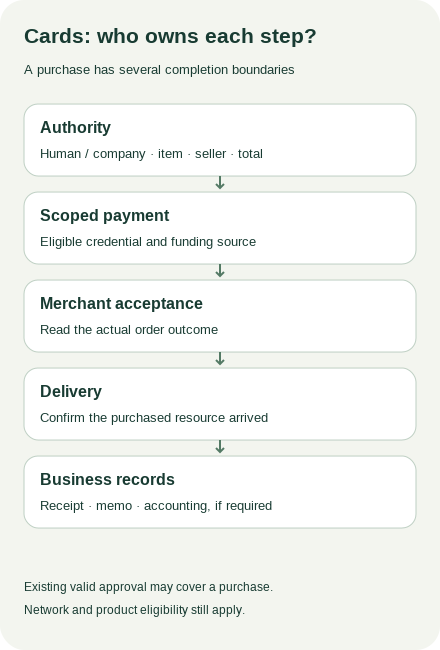
The figure separates responsibilities, not mandatory API calls. Some products combine steps, and a valid existing authorization may cover a purchase without another approval screen. A returned credential is not evidence that the merchant created an order, while an order reference is not evidence that the purchased report was usable.
Four product routes, with different starting advantages
| Route | Existing advantage | Direction of expansion | Main question for a builder |
|---|---|---|---|
| Stripe Link | Consumer checkout account and saved payment methods | Customer-approved spending across supported agent payment paths | Can this customer and checkout use the required credential? |
| Crossmint | Embedded wallets and developer payment tools | Card storage, credential selection and checkout execution | Which merchant path will execute this purchase, and how does it fail? |
| Reap | Card and payment infrastructure | Enrollment, authorization, quotation and merchant order completion | Which authorization and order state is authoritative? |
| Ramp | Corporate spending, budgets and accounting workflows | Agents acting within an existing business financial account | Whose company permissions and fund apply, and who closes the record? |
These are editorial interpretations of documented products, not a market-share ranking. A provider can cover more than one column of the purchase process.
Stripe Link: extend an existing customer payment relationship
Stripe’s 29 April 2026 announcement introduced agent spending through Link, using payment methods customers already have. The subsequent Meta Muse integration announcement on 8 September provides a concrete distribution example: approval inside a shopping experience backed by Link.
Current Link documentation distinguishes card credentials, shared payment tokens and Link pay tokens. The strategic asset is the customer’s relationship with Link; developers do not have to treat every purchase as a new wallet-funding exercise. That does not make all merchants, countries or credentials equivalent. Agent payments currently support eligible US and Canadian Link customers, and credential support depends on the payment path.
For our report purchase, the agent still needs authorization for the actual USD 108 transaction. Connecting an account is not permission to buy anything below USD 120. The product opportunity is to make that approval legible and reusable across supported experiences. The limitation is reliance on Link eligibility and the merchant’s checkout compatibility.
Our Stripe Link mechanism analysis covers the three credentials, recurring spending limits and payment-state handling. This route analysis does not reproduce those integration steps.
Crossmint: move from enabling payment to executing the purchase
The 17 September universal-vault announcement followed Crossmint’s wallet work with card storage for agents. The 8 October Agent Commerce Toolkit launch then combined storage, credential selection and checkout. That sequence matters: it expands the product boundary from holding a usable payment method to coordinating the merchant interaction.
The launch describes network credentials for eligible cards and a vault-based path for other cards, with checkout routing across supported embedded options, commerce protocols and browser automation. Crossmint calls the toolkit live and self-serve. Its broad merchant-reach claim should still be tested against the actual store: a login, changed form or bot challenge can interrupt a browser route.
Our interpretation is that Crossmint is trying to sell a completed purchasing capability to application builders. In the report example, evaluate whether the correct edition and final total reach the merchant, which path was chosen and what evidence returns after a timeout. Fewer integration surfaces can reduce coordination work, but they also make route visibility and failure support more important. The Crossmint product analysis examines the execution layer separately.
Reap: expose a purchase lifecycle over card infrastructure
Reap’s product overview positions its agentic offering around Visa Intelligent Commerce and programmable purchase permissions. The API overview makes the application boundary concrete: enrollment, mandate, product search, quote and checkout are separate resources. The developer supplies the agent’s buying logic; Reap handles defined card and merchant interactions.
This route puts useful structure around the gap between “we have a payment method” and “the merchant accepted an order.” A quote can expire; approval and checkout completion have different states. The lifecycle documentation also allows an active mandate that covers a purchase to affect whether fresh approval is needed. It would be misleading to promise either a new click for every possible purchase or unrestricted unattended buying.
For the report scenario, the integration must preserve the exact item, quote and authorized terms. If the quote changes, the application cannot infer consent from the old price. Reap’s current overview labels recurring purchases as coming soon and says production MCP/CLI connectors need approval from Visa and Reap. Those are deployment constraints, not details to postpone until launch.
Our interpretation is that Reap is expanding card infrastructure into an application-facing order workflow. Read the Reap purchase-lifecycle article for resource and state details; this comparison focuses on why that boundary differs from a wallet-only API.
Ramp: make the agent a governed actor in company spending
Ramp starts with a different buyer. Its 4 May identity design article explains why agent actions should remain attributable to a human sponsor rather than look like unexplained employee activity. Current identity documentation distinguishes acting for a connected user from standalone agent identities, which remain in limited early access.
For the employee buying our report, the key question becomes whether the connected user has an eligible company fund and the necessary authority. Ramp’s purchase skill describes checking the fund, confirming the purchase terms, obtaining a checkout credential, completing the merchant purchase and finishing the receipt, memo and accounting record. Existing explicit approval for the same terms can cover the purchase; changing the seller or amount is not a cosmetic update.
The strategic interpretation is that Ramp extends the company’s financial workflow to a new actor. The card transaction is one part of that workflow. A procurement assistant that pays successfully but leaves no usable expense record has not completed its business task.
One boundary needs particular care. Ramp’s payments guide describes Agent Card checkout, a compatible Stripe MPP path and x402 purchases separately. The x402 path uses a separately funded wallet: do not assume the company card’s fund rules automatically govern it. The MPP path is not browser checkout, and its public purchase skill was not yet linked as published in the reviewed guide.
Ramp’s directory profile connects these responsibilities to related entries. Ramp here is the corporate finance platform, not Ramp Network, the separately listed fiat–crypto on/off-ramp provider.
Visa and Mastercard sit at another layer
Visa’s 8 April Intelligent Commerce Connect announcement describes a network-, protocol- and vault-agnostic integration offering, initially piloted with selected partners. A network framework can help recognizable agent transactions move across participants; it does not supply every application’s shopping logic or expense policy.
Mastercard’s 20 October Agent Pay for Machines update describes pilots and developer early access, including signed vouchers for digital services and later redemption. That is a different interaction from filling a merchant’s ordinary card form. It should not be read as universal commercial availability of a consumer Agent Card.
Both networks can influence credentials, trust and distribution. Their announcements do not establish that every issuer, card or merchant can use a downstream product today. Compare the application provider and its network dependencies separately; the Wallet development analysis makes a similar distinction between packaged products and signing infrastructure.
How to compare the routes without a false leaderboard
Use the report example to request evidence across five checkpoints:
- Authority: identify the human or business owner and what permission covers USD 108 with this seller. Distinguish account connection, a purchase mandate and an organization policy.
- Credential and execution: record the actual route and eligibility. A card number, token and signed voucher are different artifacts; none alone proves order acceptance.
- Ambiguous completion: simulate a timeout after submission where a supported test environment permits it. Reconcile the existing attempt before requesting another credential or buying again.
- Business completion: retain the merchant reference and delivery evidence. For company spending, also verify the receipt and accounting destination.
- Exit and cost: establish who handles cancellation, refunds and support. Obtain an integration-specific quote covering payment, execution and operational charges rather than inventing a common per-agent price.
Keep “documented,” “observed in testing” and “not yet confirmed” as separate columns. We have documented the routes here, not established a performance benchmark. None of these comparisons should be turned into an unsupported claim that a provider has the best conversion rate or the lowest total cost.
What would show that each strategy is working?
For Link, watch whether eligible customers can approve purchases across useful checkout experiences. For Crossmint, watch execution coverage and how clearly failed routes can be diagnosed. For Reap, watch whether the resource lifecycle makes consent and order outcomes easier to reconcile. For Ramp, watch whether agent actions stay attributable and close correctly in the finance workflow.
These are proposed evaluation criteria, not reported provider results. The commercial hypothesis is that each company extends an existing distribution or operational advantage into agent commerce. Actual pricing, adoption and retention require separate evidence. Start with the task and the responsibility you need the provider to own, then use the directory and enterprise procurement guide to narrow the next integration investigation.
FOLLOW THE SOURCES