AGENTWALLETS · INDEPENDENT PERSPECTIVES
Base for Agent Payments: The Network Is Only One Layer of the Purchase
Place Base in an agent-payment architecture and distinguish network selection, wallet authority, confirmation stages, fees and merchant delivery.
 Project reference · Base ↗
Quick answer
Base is an Ethereum layer-2 network used for onchain payments and applications. It is separate from the wallet that signs, the agent toolkit that proposes actions and a service that verifies payment. An integration must choose the exact network and asset, an acceptance threshold and a business reconciliation process.
A paid data API advertises USDC settlement on Base. A developer could interpret that as a complete integration choice, but several questions remain: which wallet signs, who validates the payment, when the seller releases the data, and what happens if the response disappears after payment?
Research boundary: official Base documentation reviewed November 1, 2026. We did not benchmark the network, operate a node or purchase a resource. The API purchase below is a conceptual integration.
Place Base below the wallet and payment protocol
Base is the network on which the relevant transactions execute. A wallet supplies signing authority; an agent toolkit exposes actions; a payment protocol defines the interaction between buyer and seller. Coinbase’s involvement in several parts of this ecosystem does not merge them into one product.
This matters when comparing alternatives. Choosing Base does not automatically choose Coinbase AgentKit, a particular custody model or a particular facilitator. List the components separately, then check that their network, asset and protocol support overlap. A familiar brand name is not a compatibility test.
Pin network and asset before the first signature
The network details distinguish Base Mainnet, chain ID 8453, from Base Sepolia, 84532. A stablecoin’s name is insufficient identification: the integration also needs the intended token contract on that network and the correct amount units.
For the hypothetical data buyer, validate the payment requirement before asking the wallet to authorize it. A seller offering an unexpected chain or asset should cause a deliberate refusal or a new user decision, not an automatic attempt to bridge or swap funds. Any conversion introduces another operation, quote and risk boundary.
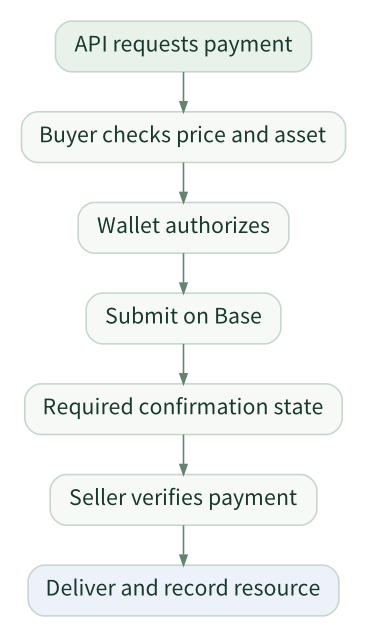
Conceptual purchase flow, not a network or payment test. The selected protocol determines the exact verification and settlement sequence.
Decide which confirmation your product requires
Base’s finality documentation distinguishes preconfirmation, L2 block inclusion, posting to Ethereum and L1 batch finality. It separately describes withdrawals to Ethereum. Those are different milestones, not interchangeable definitions of “instant.”
An API seller releasing a low-cost response may choose a different acceptance policy from a business releasing a large irreversible payout. State the chosen threshold in the integration contract and retain the observed state with the payment record. Do not let an optimistic UI animation become the accounting system’s definition of settlement.
The distinction also affects user expectations about moving funds away from Base. A fast payment within the network does not establish how quickly a particular withdrawal or bridge route completes. If the product depends on another network receiving funds, evaluate that route separately.
Estimate the whole execution cost
The network-fee guide describes L2 execution costs and L1 data-publication costs. Fees depend on the transaction and network conditions. This article does not promise a fixed per-payment price based on a homepage claim or an illustrative gas calculation.
For a paid API, track at least the resource price, network execution cost and any separate service or sponsorship charge in the selected stack. Then ask whether retries, approvals or account setup add operations. A fee sponsor can change who sees the cost; it does not make that cost disappear from the business.
Local payment policy still belongs in the buyer
Base’s paid-service guide demonstrates checking network, token and budgets before creating payment authorization. It also warns that production aggregate limits need durable enforcement across processes, rather than relying on an in-memory example.
For a multi-worker agent, our recommendation is to reserve a budget against the business request before signing and reconcile that reservation with the final outcome. The exact reservation mechanism depends on the wallet and protocol. Treat service responses as untrusted content: a purchased document should not be able to increase the buyer’s next allowance.
| Release decision | What should be explicit |
|---|---|
| Accepted payment option | Network, token contract, scheme and amount units |
| Authority | Wallet owner, signer and delegated limits |
| Settlement threshold | Required state before fulfillment |
| Failure recovery | How a paid-but-missing response is retrieved or disputed |
| Cost reporting | Resource charge versus execution and infrastructure costs |
Keep merchant lifecycle features separate from the chain
Base’s payments guide covers several flows, including escrow-based commerce and x402 APIs. It labels some demos as preview-network transactions or browser mocks. A feature appearing in that guide is not evidence that your chosen token, wallet and production contracts already implement it.
For the API purchase, the useful first result is a complete, narrow flow: the buyer rejects an invalid requirement, the seller verifies a valid payment once, and both sides can find the corresponding resource record. Base supplies the network layer underneath that workflow.
See the Base reference, x402 reference and payment idempotency guide.
FOLLOW THE SOURCES