AGENTWALLETS · INDEPENDENT PERSPECTIVES
Borderless Off-Ramps: Indicative Quotes and Bank Payouts
Read Borderless indicative quotes, fromAmount and toAmount, bank-rail selection and fee fields before choosing a stablecoin payout route.
Quick answer
Borderless coordinates stablecoin and local-payment providers. Its quote documentation describes indicative pricing rather than a guaranteed exchange rate. An executable payout also requires an eligible customer and recipient, the intended payment rail and evidence of the final bank outcome.
Suppose a cross-border platform receives stablecoins and wants to pay a supplier’s local bank account. It needs more than a destination currency: it needs the required identity checks, acceptable estimated pricing, a known funds path and evidence of bank payout. Borderless positions itself as an orchestration layer connecting stablecoins, ramp providers and local rails. Different providers may handle the underlying funds movement.
This example specifies no country, asset, network, rate or fee and no transfer took place. The official documentation says identity objects are created before payments and describes connections to providers. Creating an object does not mean every provider has approved the user.
Four stages of an off-ramp
| Stage | Platform responsibility | What cannot be assumed |
|---|---|---|
| Identity | Create payer and recipient information and check requirements | Every provider shares the same approval |
| Quote | Review currency, rail, estimated rate, fees and applicable limits | A quote is a completed conversion |
| Fund | Send the required asset under valid instructions | The bank receives money immediately |
| Outcome | Query processing and reconcile receipt | A completed payment proves commercial delivery |
The identity documentation and quote guide describe different interface concepts. Required documents, requests for information, limits and available rails depend on provider and transaction. Compare the expected net amount, charges, timing and assumptions, not just one exchange rate.
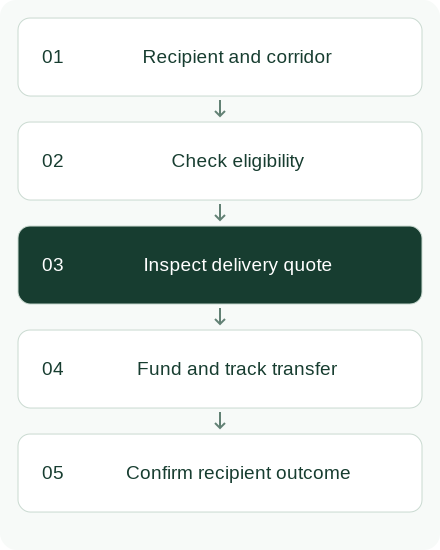
An indicative quote is not a locked exchange rate
The quote reference explicitly describes estimated rates, fees and output, and says the final execution amount can differ. A recent quote is therefore not evidence that an exchange rate is locked. In this article, checking whether pricing is still acceptable means applying the business’s approval conditions, not assuming a provider-guaranteed expiry or price lock.
The reference lets a request specify fromAmount or toAmount, but not both; it limits the described toAmount mode to US and EU countries. Those are different questions: spend a known source amount, or estimate the cost of a desired receipt. A null minimum or maximum in the returned limits means that bound is unset, not that the customer has universal eligibility.
Selecting paymentMethod also matters. The guide says an omitted method can use an available option whose order is not guaranteed. Two requests for the same currency can therefore be poor comparisons if one silently uses a different bank rail. Its fee model distinguishes the orchestration charge from partner charges and combines them in totalFee; current commercial values still require confirmation.
For the supplier, record the selected rail, input basis, estimated receipt and acceptable deviation. If the supplier requires an exact amount, establish how the actual execution will meet that obligation before sending funds. Do not promote an estimate into a guaranteed payout.
The cheapest quote may not be executable
Suppose two providers can quote a payout to the same supplier. Route A shows a higher estimated net amount, but the supplier has not passed that provider’s review or its bank account does not satisfy the rail’s requirements. Route B quotes less but its documentation and rail conditions are already satisfied. The platform cannot automatically choose A on price alone: a visible quote does not establish that this supplier can receive funds now. If review timing or later conditions are unknown, it also cannot assert that A will never be available.
A reusable comparison should record payer and recipient eligibility, asset and network, estimated net amount, pricing assumptions, expected processing conditions and refund path, marking unknowns as unconfirmed. Only after a route is executable and the current estimate meets the approval conditions can the business decide under its authorization policy whether to accept the lower net amount or wait. If a fresh quote arrives after document review, show it again rather than relying on an earlier estimate.
This is a teaching comparison, not a claim that Borderless exposes the same decision fields for every provider, automatically routes every case or guarantees the best price. Verify review, switching and execution in the actual integration.
Orchestrator and local provider
In the scenario, the platform chooses an eligible route, checks bank details and creates and tracks a transaction under the applicable withdrawal flow. The underlying provider’s compliance, liquidity and banking process may differ. Changing providers does not necessarily carry over an earlier identity approval or quote. Keep the internal order, Borderless transaction reference and any available provider or bank reference.
If stablecoins have been sent but the bank has not paid out, inspect the original transaction and current location of funds before sending again. A compliance hold, bank rejection and refund in progress deserve different customer messages. Whether a cancellation succeeds and when a return arrives depend on state and rail; ask whether network and banking charges are returned. Receipt of funds and delivery of the supplier’s service remain separate records.
Where agent authority should stop
An agent can prepare invoices or compare quotes, but the business must specify who may add recipients, submit funds, choose providers and accept rates. A recommended route is not payment authorization. Recheck changes to destination, amount or quote under internal policy. Do not place identity documents or API keys in ordinary chat history or logs.
Before launch, verify customer and geographic eligibility, assets and networks per route, all-in cost, execution-price behavior, notification verification, refund destination and support ownership. A sandbox can exercise state handling and retries, but simulation does not prove actual bank receipt.
Further reading: Stablecoin payments, Payment failures, Payment costs.
Sources reviewed November 6, 2026. Official-source explanation; no account, credential, API or payment test was performed.
FOLLOW THE SOURCES