AGENTWALLETS · INDEPENDENT PERSPECTIVES
Brale: Stablecoin Issuance, Transfers and Redemption
Follow a branded stablecoin design through Brale issuance, accounts and transfer fields, separating reserve arrangements from distribution and redemption operations.
Quick answer
Brale provides stablecoin issuance and money-movement APIs. Creating a branded asset and operating payments with that asset are separate jobs; reserves, customer accounts, distribution and redemption must all be specified.
A brand name does not create a payment network
Imagine a business platform considering a branded dollar token for payments among its users. The product team likes the idea of a consistent balance across applications. Finance asks who holds the backing assets, operations asks how users redeem, and merchants ask whether they can convert the token into money they already use.
Brale offers issuance and transfer infrastructure. Its API overview covers accounts, assets, movement and related workflows. The useful question is not only how to create a token, but what additional system is needed to make it usable. Our platform example is hypothetical; no stablecoin was issued and no reserve or redemption arrangement was audited.
Issuance and ordinary transfers solve different problems
Using an existing stablecoin starts with an asset somebody else already issues. Issuing a branded stablecoin creates a new product relationship: the asset’s issuer, reserve arrangements, holders’ rights and distribution all matter. The issuance guide describes Brale’s branded issuance offering and reserve-management role.
Do not convert that description into a guarantee that a new asset will be accepted everywhere. A technically valid token may have no market on a particular exchange, no support in a merchant’s checkout and no usable route for a customer in a particular country. A name and contract address solve identification; they do not establish demand or liquidity.
For the platform, first ask why an existing stablecoin is insufficient. If the only requirement is paying suppliers in digital dollars, a new issuance program may create work without solving a new customer problem. Branding is a product choice, not proof of better payment execution.
Follow one illustrative customer balance
Suppose a customer contributes a hypothetical 1,000 US dollars (USD) to obtain the platform’s branded balance under an approved program. The example deliberately omits a real token name and exchange quote. Before implementation, identify whose account receives the money, when the asset becomes available and what agreement governs conversion back.
The platform should not mark the customer funded merely because it created a deposit instruction. It needs the appropriate evidence for the selected funding method. The same distinction applies at redemption: requesting a conversion, removing a token balance and delivering fiat are separate events to reconcile.
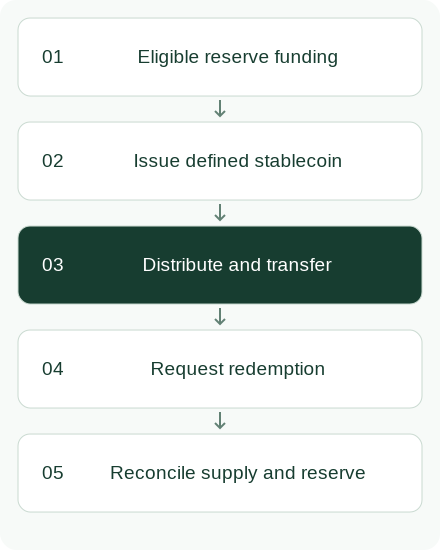
A product team can model the lifecycle as funding, asset availability, customer use and redemption. Each transition should have an owner and evidence. If the business cannot explain who handles a disputed funding source or a failed bank delivery, the program is not operationally defined even if token deployment is easy.
Read transfer fields as a funds route
The transfer documentation distinguishes the asset being moved from the rail or network used to move it. It also associates source and destination with address identifiers that can represent fiat or onchain endpoints.
In plain language, “what value” and “over which route” are different questions. Two instructions can reference the same stablecoin but use different networks; two bank movements can use different rails. A frontend that displays only the ticker leaves out information necessary to understand the transfer.
| Design field | Question for the platform |
|---|---|
| Customer/account | Whose money and entitlement are involved? |
| Asset | Which branded or third-party balance is being moved? |
| Route | Which network or fiat payment rail applies? |
| Destination | Which registered endpoint receives the value? |
| Business reference | Which funding, purchase or redemption does it satisfy? |
This table is an explanatory handoff, not a complete API request. Keep exact field formats and supported combinations in the versioned integration specification.
Avoid creating a second transfer while investigating the first
The transfer guide documents an idempotency key for creation requests and warns against reusing one with a different request. The application still needs a durable mapping from its business operation to the provider’s transfer record.
Suppose a redemption request is submitted but the response is lost. Creating another transfer with a new identity can create a second instruction. Changing the destination under the old operation is also a different decision, not a harmless retry. Resolve the original record and follow the documented behavior before issuing a replacement.
For customer support, keep funding, asset movements and redemption requests visible together. A customer asking “where is my money?” should not have to understand every internal identifier, but the operator needs enough linkage to answer accurately.
Reserves, supply and spendable balances are different views
The platform’s internal customer ledger, the asset’s onchain supply and the program’s backing arrangement describe related quantities. They are not interchangeable screens. A customer ledger may include pending activity that has not yet become an onchain holding, and a bank delivery may remain unresolved after a conversion request.
An editorial acceptance exercise is to reconcile a simple day: one customer funds, another transfers to a merchant, and a third redeems. Explain which records change at each step and which evidence proves completion. Introduce one interruption and verify that the same obligation is not counted as both available and already paid out.
This exercise is not a reserve attestation or financial audit. It helps product and engineering discover mismatched definitions before relying on an aggregate “balance” label.
Choose the program after defining redemption
Review eligibility, reserve and custody responsibilities, redemption rights, supported routes, service charges and any revenue-sharing agreement. No universal economics or redemption guarantee was established in this review. A published issuance description cannot replace the terms for a specific program.
Compare Paxos and Tether by the role they actually play rather than treating issuers, wallet tooling and transfer providers as equivalent. For foundational terminology, read how stablecoin payments work and refunds.
Brale reference. Sources reviewed November 6, 2026. This is official-source analysis with a fictional platform scenario, not an issuance, payment or reserve test.
FOLLOW THE SOURCES