AGENTWALLETS · INDEPENDENT PERSPECTIVES
Circle Gateway: A Unified Balance Is a Funding Model, Not a Universal Wallet
Understand Gateway deposits, per-asset crosschain balances, destination minting and the signature differences between standard transfers and nanopayments.
 Project reference · Circle Gateway ↗
Quick answer
Circle Gateway pools supported deposits into a unified balance for each asset and lets that same asset be accessed on supported destination chains. It does not convert between assets. Standard Gateway transfers and Gateway Nanopayments have different signing requirements, so smart-wallet support must be checked per route.
A service agent has enough USDC overall but not on the chain its next supplier accepts. Rebalancing just before every purchase adds delay and operational work. Circle Gateway addresses the placement of liquidity: an application establishes a unified balance and accesses the asset on a supported destination network.
Research boundary: official documentation reviewed November 1, 2026. We did not deposit assets, mint on another chain or measure transfer time. The example concerns funding architecture, not an investment recommendation.
The unified balance belongs to an asset
The Gateway overview describes deposits into Gateway Wallet escrow contracts and a separate crosschain balance for each supported asset. Gateway does not exchange one asset for another. The current documentation covers USDC and additional assets, but their network coverage differs.
For our supplier-payment example, start with the actual asset and destination chain. A sufficient balance in another currency does not resolve the problem. Likewise, a token with a similar ticker on an unsupported route should not be presented as usable liquidity. Consult the supported-network table for the exact combination.
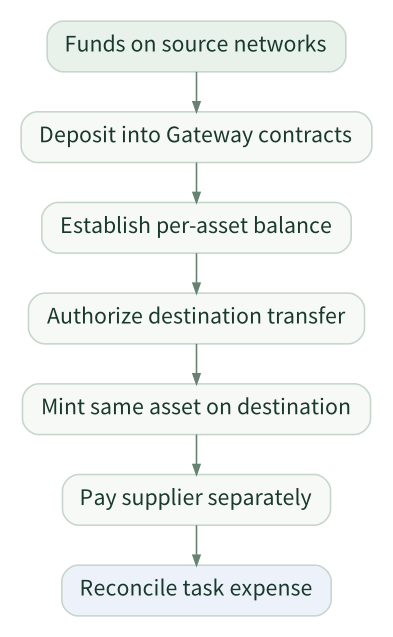
Conceptual standard Gateway funding path. Establishing a balance, moving funds and paying a supplier are separate steps; no live transfer is shown.
Fast access assumes the balance already exists
The overview’s rapid-transfer positioning applies after a balance has been established. That condition matters for a product’s first-use experience. A team should measure the complete path it intends to offer, including initial funding, availability checks and the final supplier transaction, rather than repeating only a component’s advertised transfer time.
Keep an operational ledger that distinguishes funds in the source wallet, deposits still becoming available, established Gateway balance and funds already minted elsewhere. Otherwise two concurrent tasks can both believe the same money is available to them. A unified user interface does not remove the need for reservation and reconciliation inside the application.
Smart-account compatibility differs by route
The ordinary Gateway documentation supports ERC-1271 contract signatures for standard transfers. The separate Nanopayments documentation states that its x402 batch-settlement path requires EOA signatures and does not support ERC-1271.
This distinction can change the architecture. Do not assume that a smart wallet working for a standard transfer can use the same signing path for every agent micropayment feature. If a different signer is required, explicitly review who controls it, what authority it receives and how it is revoked. Introducing an unrestricted key merely to make a demo work would change the security model.
Nanopayments also separates immediate resource delivery from later batched settlement. The purchased API result and the eventual settlement record need a stable relationship, just as they do in other deferred-settlement designs. A gas-free per-request interaction does not imply the entire funding lifecycle has no costs.
Non-custodial does not mean no recovery planning
Gateway documents signature-based control and a seven-day trustless withdrawal option. That is an important recovery property, but it is not the same as instant operational access in every failure condition.
A treasury owner should document which assets are deposited, who can authorize movement, how to initiate the applicable exit path and how the business will operate during the waiting period. Keep a separation between the agent’s normal task authority and the authority needed to manage the full reserve.
| Funding question | Design consequence |
|---|---|
| Which asset and networks? | Availability is checked against the exact supported route |
| Which signer? | Standard transfer and nanopayment paths are evaluated separately |
| Who reserves funds? | Parallel jobs cannot each spend the same apparent balance |
| How is an outage handled? | Recovery procedure and working capital need an owner |
Gateway and CCTP solve different routing problems
CCTP is a point-to-point crosschain transfer protocol; Gateway adds a pre-established unified-balance model. Neither should be treated as identical to Circle’s wallet offering. Wallet control, liquidity placement and payment execution are separate choices.
Our assessment is that Gateway is most useful to evaluate when recurring crosschain access justifies managing a deposited balance. For a single occasional transfer, compare the added balance-management work with a point-to-point path. The Gateway reference keeps the official route and product distinctions together.
FOLLOW THE SOURCES