AGENTWALLETS · INDEPENDENT PERSPECTIVES
Bridge: Moving Money Between Stablecoins and Fiat for an Agent Application
A treasury-oriented guide to Bridge customer eligibility, transfer instructions, asynchronous states and the controls an agent application must add.
 Project reference · Bridge ↗
Quick answer
Bridge provides stablecoin and fiat payment infrastructure, including transfer orchestration and custodial wallets. It can support an agent application’s funding and payout paths, but customer eligibility and payment-rail approval remain separate from agent authorization. Creating a transfer does not mean funds have arrived.
An operations assistant prepares a supplier payment. The business holds funds through one rail, while the supplier expects another. The assistant’s job is not complete when it drafts a plausible instruction: the customer must be eligible, the destination must be correct and the transfer must reach a verifiable outcome. Bridge is infrastructure for this money-movement layer.
Research boundary: official documentation reviewed November 1, 2026. We did not onboard a customer, submit identity information, create a bank instruction or transfer funds. The supplier scenario is illustrative.
Place Bridge below the business approval layer
The Bridge documentation covers stablecoin and fiat movement, custodial wallets, issuance and cards. That broad infrastructure scope is why it belongs beside agent payments, but not as an agent-specific authorization protocol.
In the supplier workflow, the application should approve the invoice and destination before calling a transfer tool. An API key capable of moving funds is not a safe substitute for that approval. Give the assistant a bounded operation, such as preparing a payment for an approved invoice, rather than unrestricted access to arbitrary transfer parameters.
Customer identity and rail access are separate checks
The onboarding guide distinguishes individuals and businesses and describes KYC/KYB, terms acceptance and endorsements for payment rails. Creating a customer record is therefore not the same as establishing that every desired route is available.
Store the applicable customer and route eligibility in a system that can be refreshed before payment. If the status changes, the agent should report the blocking requirement and hand it to the responsible person. It should not invent identity details, accept agreements on an unclear mandate or switch to another customer’s identity to make the transaction work.
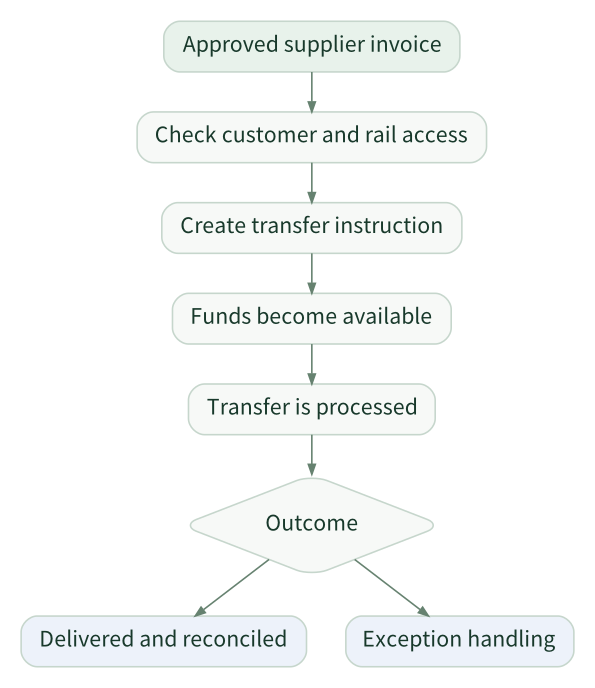
Conceptual application workflow, not an exhaustive Bridge state machine. No real customer or bank details are represented.
A transfer instruction is not a payment receipt
The transfer quickstart separates the source, destination, customer represented by the transfer and amount. It also shows a transfer waiting for funds and describes status tracking through API queries or webhooks.
For the assistant, the useful message may initially be “payment instruction prepared,” not “supplier paid.” Match the user-facing status to what is known. When a source deposit must still occur, show who needs to act and preserve the reference required to match incoming funds.
Avoid copying example account numbers or routing details from documentation into production instructions. The actual transfer response, verified through the authorized backend, must be the source of those details.
Reconcile the final state, including exceptions
Bridge’s state reference distinguishes submitted and processed payments, and warns that a hash at the submitted stage can be preliminary. It also defines return, refund and error paths. A successful create request cannot settle these later questions.
Our suggested accounting model links one approved invoice to its transfer attempts and final evidence. Process duplicate or delayed notifications without creating another payment. If an exception occurs, retain the original obligation until the appropriate delivery, return or refund outcome is established.
| Record | Why the agent workflow needs it |
|---|---|
| Approved invoice version | Explains who authorized the amount and beneficiary |
| Customer and route | Identifies whose funds and which eligibility apply |
| Transfer identifier | Supports recovery without making a replacement blindly |
| Final outcome and receipt | Supports bookkeeping and an accurate supplier update |
What Bridge does not decide for you
The payment platform does not decide whether a supplier invoice is genuine, whether a changed beneficiary was approved, or whether a model’s suggested transfer is commercially sensible. Those checks belong in the application’s finance workflow. A documented rail also does not imply that every country, customer or asset is eligible.
Evaluate Bridge when your agent product needs an accountable route between stablecoin and fiat systems. Compare the custody model, supported route, processing conditions and exception handling for the actual task. The Bridge reference provides official starting points; the agent’s permission to use those rails must still be designed and enforced separately.
FOLLOW THE SOURCES