AGENTWALLETS · INDEPENDENT PERSPECTIVES
HUMAN AgenticTrust: Let an Agent Read Without Automatically Letting It Buy
A merchant-side guide to AgenticTrust identification, activity permissions and trust levels, with deployment prerequisites and checkout boundaries.
Quick answer
HUMAN AgenticTrust adds agent visibility and activity permissions to supported HUMAN application-protection deployments. Merchants can distinguish reading from login, account changes and checkout for known agents. Access permission does not itself authorize a customer payment or guarantee an agent’s behavior.
A retailer wants shopping assistants to read product pages but does not want every automated visitor to create accounts or change saved payment details. Blocking all automation loses useful discovery traffic; allowing every action creates a different risk. HUMAN AgenticTrust addresses this merchant-side access decision.
Review scope: official documentation checked November 1, 2026. We did not install a Sensor or Enforcer, change a website policy or test detection accuracy. The retailer scenario is an architectural example.
It is an application-protection capability
The setup guide places AgenticTrust alongside Sightline Cyberfraud Defense or Bot Defender. It requires account enablement and supported Sensor and Enforcer versions. It is not a stand-alone wallet or an open payment protocol that an agent can adopt by itself.
That determines the buyer for this product: the site or application operator responsible for incoming traffic. Before evaluating policy behavior, confirm that the relevant application, edge or origin deployment is supported and that the account has the capability enabled. A dashboard screenshot from another account is not evidence of access in your own environment.
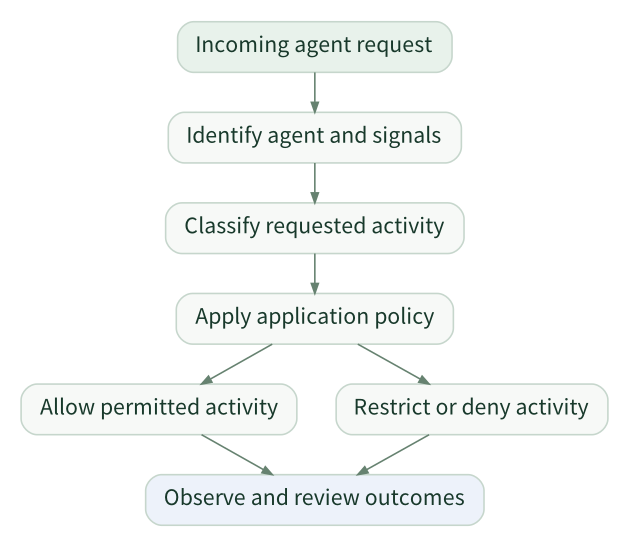
Conceptual merchant-side control flow based on public documentation, not a measured detection result or a change to this site’s security settings.
Reading and checkout are separate permissions
The permissions guide separates content access, engagement, account creation, login, account changes and checkout. It also describes session request-rate limits and notes that configurable agent permissions apply to agents known to HUMAN.
For the retailer, begin with the business interaction it wants to enable. Product discovery may require reading catalog pages without permission to enter account-management areas. An approved checkout workflow may need additional actions, but that should be a deliberate policy choice rather than a side effect of allowing the homepage.
A useful policy review follows a complete customer journey. If a legitimate assistant can read a product but cannot reach the required handoff page, the user may see a broken purchase. If the policy opens account changes merely to make checkout work, the grant may be unnecessarily broad. Test both paths with the applicable supported integration before rollout.
Trust levels are signals, not a purchase mandate
The trust-level documentation describes cryptographic identity, spoofability and behavioral signals among the inputs to HUMAN’s assessment. That assessment can inform defaults. It does not establish that a particular customer approved a particular order.
Keep site access, logged-in user authority and payment authorization separate. An agent recognized as legitimate can still be acting for the wrong account, using an expired session or attempting a purchase outside the user’s instructions. A merchant should not remove its own order validation because the incoming request received a favorable trust classification.
Defaults deserve an owner
The permissions documentation distinguishes provider defaults from settings explicitly chosen by the operator. For an important commerce workflow, record the policy you intend and who reviews changes. Do not rely on a default label without understanding which actions it currently enables.
| Merchant question | Review evidence |
|---|---|
| Which agent is recognized? | Identity signals and known-agent coverage |
| Which application is protected? | Sensor, Enforcer and deployment configuration |
| What is allowed? | Explicit activity permissions and rate limits |
| What still needs buyer consent? | Login, order and payment authorization controls |
| What happens to legitimate failures? | Support, review and recovery procedures |
Measure both unwanted activity and successful legitimate journeys. A lower request count alone is not proof of a better policy if it also prevents authorized customers from finishing purchases. Conversely, a higher conversion count should not excuse unauthorized account changes.
Position it beside identity standards, not in their place
Web Bot Auth concerns cryptographic request identity; AgenticTrust is an operational product that uses identity and behavior to support application policy. Trulioo KYA focuses on organizational and agent credentials. These are adjacent layers, not interchangeable products.
AgenticTrust is most relevant when a merchant needs to distinguish useful agent activity from unwanted automation while preserving clear action boundaries. Start from the HUMAN reference and evaluate the actual supported deployment. This article neither recommends weakening existing site protections nor claims that a named agent should automatically receive checkout access.
FOLLOW THE SOURCES