AGENTWALLETS · INDEPENDENT PERSPECTIVES
Trulioo KYA: Verify the Organization Behind an Agent Before Granting Access
Understand Trulioo’s Alpha Digital Agent Profile, signed attestations and A2A extension, including why identity verification is not transaction authorization.
Quick answer
Trulioo KYA connects a verified developer organization with an agent’s identity and scope in a Digital Agent Profile. The product is in Alpha. Its A2A extension requires verification of signed evidence rather than trusting display fields, and relying parties still enforce permitted actions.
A procurement platform receives a request from an unfamiliar agent claiming to represent a supplier. The request has a valid-looking signature, but the platform still wants to know which organization stands behind the software and whether the proposed action fits its declared scope. Trulioo KYA adds organizational and agent context to that decision.
Evidence boundary: official public materials reviewed November 1, 2026. We did not request Alpha access, verify a real business or exercise the live verification API. The procurement example is hypothetical.
The current product is a Digital Agent Profile in Alpha
Trulioo’s KYA page describes verifying the developer organization, assessing agent signals and connecting them in a Digital Agent Profile, or DAP. The page explicitly labels the release Alpha. Use the current name rather than treating older passport terminology as a separate product.
For our platform, this provides evidence about the party requesting access. It does not establish that a supplier invoice is genuine or that the buyer authorized its payment. Those decisions need their own records. A verified organization can still submit a mistaken request, and a legitimate deployment can still encounter malicious external content.
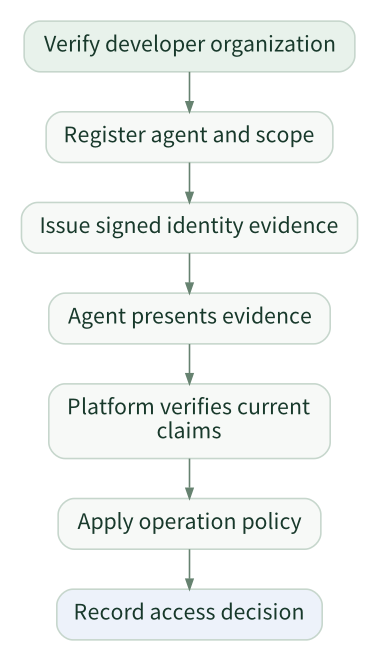
Conceptual KYA evaluation flow. Identity evidence informs a relying party’s policy; it is not a payment approval or a live verification result.
Verify the signed evidence, not the badge
The A2A extension specification distinguishes authoritative signed attestation from a convenience display object. It requires the verifier to check the signature and bind the agent fingerprint correctly. Allowed scopes are enforced by the relying party, not automatically by Trulioo.
This is a concrete integration boundary. A front end may show a friendly identity label, but the backend deciding access must not trust that label as an independent credential. Otherwise an attacker could alter presentation data without satisfying the verification rules.
Our recommendation is to expose the decision, reason and evidence reference to the application rather than distributing raw credentials to every downstream component. Preserve enough detail to explain a refusal, while keeping sensitive identity material out of ordinary conversational logs.
Freshness and audience change the meaning of a credential
A previously valid identity response is not necessarily sufficient for a later, higher-impact action. Before approving a supplier-account change, ask whether the evidence is still current, whether it represents the same agent instance and whether its scope covers that operation.
The integration should distinguish a failed verification from an unavailable verification dependency. Both may prevent a sensitive action, but they deserve different user messages and recovery paths. “Could not confirm now” should not automatically become “this organization is fraudulent.”
Where the chosen presentation flow uses a recipient-bound proof, verify it for the actual recipient and request. Copying a credential from a cached agent card is not a general replacement for the required presentation. The exact verification procedure should follow the current specification rather than a home-made interpretation of a decoded token.
| Platform question | Evidence and control to retain |
|---|---|
| Who stands behind the agent? | Verified organization reference and relevant status |
| Is this the same agent? | Binding between the presented evidence and agent identity |
| Is this action permitted? | Current scope mapped to the requested operation |
| What if evidence is revoked? | Refresh and refusal behavior at the execution boundary |
| Can support explain the result? | Policy version, evidence reference and decision reason |
A2A interoperability does not imply universal trust
The extension is published as a draft normative contract under its own identifier. It can carry KYA information within A2A, but not every A2A participant necessarily supports or requires that extension. Document what happens when the counterparty lacks the necessary evidence instead of silently downgrading to a weaker path.
Also keep Trulioo KYA separate from the independent KYAPay protocol. The shared “know your agent” vocabulary does not make their credentials, issuers or verification rules interchangeable.
Trulioo KYA is worth evaluating for platforms that need organizational accountability behind agent access. The Trulioo reference links to the current product and extension. Its value should be judged by the evidence your relying application can validate and enforce, not by the presence of a verification badge alone.
FOLLOW THE SOURCES