AGENTWALLETS · INDEPENDENT PERSPECTIVES
Open Wallet Standard: Agent Tokens and Signing Boundaries
Understand OWS through a local research-agent wallet: delegated tokens, owner access, policy checks, recovery and the limits of in-process key protection.
Quick answer
OWS standardizes local wallet access and signing. The reviewed reference implementation applies policies to agent-token requests but skips those checks for owner-passphrase access; local controls do not amount to a hardware security boundary.
The assistant needs a signature, not the owner’s password
Imagine running a research assistant on a workstation. It needs to pay for an approved data service, but you do not want to paste a private key into its prompt or give every tool the wallet owner’s password. You also want tomorrow’s command-line client to use the same wallet rather than create another incompatible file.
Open Wallet Standard, or OWS, addresses local wallet storage and signing interfaces. The overview describes encrypted storage, delegated access and policy checks around signing. This article explains that model with a hypothetical research wallet. No software was installed or funds moved for this review.
Separate three kinds of authority
A private key can authorize blockchain actions. An application access token grants access to a particular software interface. The wallet owner’s passphrase unlocks a different level of control. Treating all three as interchangeable “secrets” hides the most important design decision: what can the holder actually do?
The reference policy guide distinguishes owner-passphrase access from agent-token access. In the reviewed reference implementation, policy checks apply to the latter; the owner-passphrase path does not execute these policy checks. Consequently, giving the assistant the owner credential and writing “spend carefully” in its prompt does not reproduce scoped delegation.
For the research wallet, start with a job description: which wallet, which operation, which chain, which permitted destinations and what time window? Then verify which restrictions the selected implementation can express. A human sentence such as “only useful reports” is not automatically a machine-enforced purchase policy.
Follow one signing request
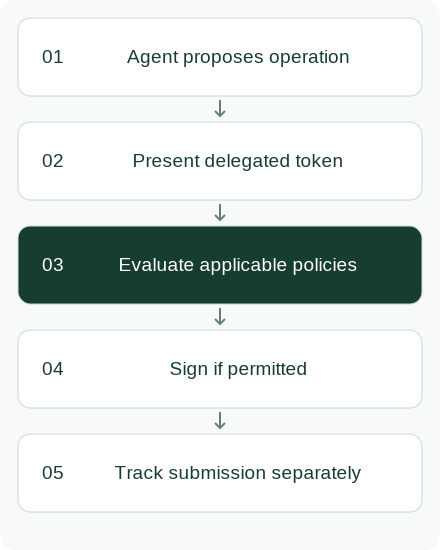
The assistant constructs a proposed operation and passes its delegated credential to the signing interface. The implementation checks the applicable access and policy conditions before using the wallet secret. The result is a signature or signed payload that another part of the application may submit.
This sequence explains why “the model never sees the private key” is useful but incomplete. A model with a broadly authorized signing tool may still cause harmful transactions. The real question is whether the operation it requests is constrained at a point the model cannot persuade or rewrite.
| Item in the design | Question to answer |
|---|---|
| Wallet scope | Can this credential access the research wallet only? |
| Operation | Is it a transfer, a contract call or a message signature? |
| Policy outcome | What evidence causes the request to be allowed or denied? |
| Submission | Who broadcasts the signed payload and tracks its result? |
| Recovery | Who can restore or replace credentials outside this path? |
These are design questions, not a claim that one default OWS configuration enforces all five.
A concrete budget exercise
Suppose the research job has a hypothetical budget of 20 USDC for one day. Keep the example on a chosen supported network, and account separately for gas or other charges. Before assigning a token, decide whether the control should limit each operation or the cumulative cost of the job.
A sequence of five permitted purchases can exceed the intended budget even when each purchase is small. Two parallel workers can also race against the same balance or spend allowance. The acceptance exercise should therefore include concurrent attempts, expired credentials and a request for an unapproved destination. Inspect actual behavior in the chosen version instead of assuming a policy name proves correct accounting.
A failed policy check should produce an understandable rejection. The assistant can explain that the task needs renewed approval; it should not switch to an owner credential, another wallet or a different signing tool to make the purchase succeed.
Local storage is not a hardware enclave
The key-isolation guide describes the current in-process model and distinguishes it from future isolation options. Memory handling and clearing secret material reduce exposure, but they do not justify a claim that a compromised host or process can never access secrets.
This changes deployment choices. If untrusted code can inspect wallet files, modify policies or control the process, the same-machine boundary needs explicit evaluation. Restrict filesystem and process access, separate administrative credentials and decide which software may run alongside the signer. These are deployment recommendations, not an independent security certification of OWS.
Revocation and recovery need different checks
Removing an agent’s access is about future operations. It does not reverse an already broadcast transaction, and it may not invalidate a payload signed before revocation. Track outstanding work before treating “access revoked” as “nothing can still happen.”
The wallet-lifecycle documentation is the starting point for reviewing backup and recovery. In a rehearsal, restore into a clean environment and confirm which credentials and policy settings survive. Keep that exercise separate from normal agent operation: recovery authority should not quietly become the agent’s fallback route.
How OWS fits with payment protocols
OWS works at the wallet-access and signing layer. x402 organizes payment requirements and proofs around a resource request. The two can participate in one application without being the same standard. Similarly, account permissions described in session-key guidance need their own enforcement analysis.
Choose OWS when local wallet interoperability and control over the signing deployment are relevant requirements. Compare it with hosted wallet infrastructure on key custody, operational responsibility, recovery and the actual permission boundary, rather than only counting supported chains. Start with the key-control guide and the OWS reference.
A local signing interface does not provide spending funds or eliminate operating costs. Budget for the host, backup and recovery work, network access and any transaction charges separately from the purchased service. Decide who maintains the signer when comparing it with a hosted provider.
Sources reviewed November 6, 2026. The website and linked reference implementation may evolve separately; pin the version used for any later test. This is a source-based explanation, not a conformance or payment test.
FOLLOW THE SOURCES