AGENTWALLETS · INDEPENDENT PERSPECTIVES
Solana Pay: Payment Links, Transaction Requests and Order Validation
Compare Solana Pay transfer requests and transaction requests through one order, with a checklist for mint, recipient, amount, reference and confirmation.
Quick answer
Solana Pay defines payment-request formats, not a complete merchant order system. A transfer request lets the wallet compose a transfer from URL parameters; a transaction request fetches a transaction from a server. In either case, the merchant must validate the actual payment against the order before fulfillment.
Suppose a store sells a digital design pack for 12 USDC on Solana. A customer scans its payment code and the wallet reports that a transaction was sent. The store still needs to answer a more specific question: did this order receive 12 units of the intended USDC mint at the correct destination, with sufficient confirmation?
That is the boundary between a payment request and order validation. Solana Pay’s overview describes a request layer connecting merchants and wallets. This hypothetical store is not a live merchant integration; the example assumes both sides support the selected Solana environment and token. Network fees are separate from the 12-USDC item price. The current official quickstarts use a beta package; pin the dependency version and verify its APIs rather than assuming older examples still match.
Two ways to ask for the same payment
A transfer request puts the payment instructions in a URL. The wallet reads parameters such as recipient, amount, token mint and reference, then constructs the transfer. A mint is the identifier of the particular token, not merely a ticker such as “USDC.” A reference helps the store locate the transfer associated with an order.
The transfer-request guide documents these fields. A simple payment link can be generated without a server dynamically constructing a transaction. That convenience does not remove the merchant’s need to retain an order and verify payment if it plans to deliver automatically.
A transaction request instead points to a service endpoint. The wallet obtains information and a prepared transaction from that endpoint. The transaction-request guide describes the request/response behavior. This route is useful when the merchant needs server-side logic, but it also means the wallet must inspect the returned transaction rather than assume it is a plain transfer.
| Design-pack order | Transfer request | Transaction request |
|---|---|---|
| Where the payment is described | URL parameters | Transaction returned by the endpoint |
| Who composes the transaction | Wallet from the request | Merchant-side service prepares it |
| Why choose it | A straightforward fixed transfer | Transaction construction requires server logic |
| What both still need | Order validation and fulfillment controls | Order validation and fulfillment controls |
The server’s order record is the comparison point
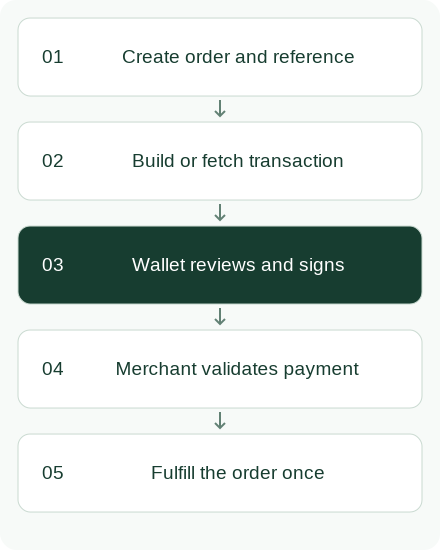
Before showing either request, our store creates order D-104 with its expected asset, recipient, amount and unique reference. These are illustrative business fields, not a prescribed Solana Pay database schema. They should be saved independently of the browser so refreshing a page does not produce an unrelated purchase record.
When a candidate transaction appears, compare it against that record. A returned signature is a way to locate a transaction; it does not establish that the transaction contains the expected transfer. A customer could paste a valid signature from a different purchase. Likewise, two customers can owe exactly 12 USDC, so amount alone is a weak order identifier.
The payment validation quickstart explains finding and validating transfers before granting the requested outcome. A practical check covers the network environment, token mint, recipient, amount, order association and the transaction’s successful confirmation. Choose the commitment level intentionally for the goods and risk involved; do not confuse a submitted transaction with your fulfillment threshold.
For an SPL token payment, inspect the intended token transfer and destination ownership through the appropriate validation tools. Looking only for the merchant’s address somewhere in a transaction is insufficient: an address can appear without receiving the amount owed. A “payment detected” status is a useful intermediate state while these checks finish.
What happens with the wrong amount or token?
Imagine D-104 receives 1.2 USDC. The order reference may match perfectly, but the amount is short by 10.8. The store should preserve the incoming payment record and route the order to its underpayment policy. It should not mark the order unpaid in a way that erases evidence of the 1.2 already received.
Now imagine the wallet sends 12 units of a different token carrying a familiar symbol. Matching a human-readable label would incorrectly unlock the design pack. Matching the expected mint prevents that substitution. The price is denominated in the chosen asset, not any token whose display name resembles it.
A third case is a late payment after the purchase link expires in the store’s application. An expired page does not make an on-chain transfer disappear. Decide whether to fulfill, review or arrange a refund, and preserve the association to the original order. A refund is a separate operational action; a reference does not create a card-style reversal mechanism.
These scenarios are proposed acceptance exercises, not tests performed by AgentWallets. The merchant must also prevent repeated delivery processing when a watcher or webhook reports the same transaction twice. For a downloadable file that might mean one entitlement record; for a physical shipment it should mean one shipping instruction.
Fees, wallet support and the signing boundary
A payment request is not a guarantee that every wallet supports the same request types. Confirm compatible wallets, library versions and the selected cluster. Test the exact token and recipient setup, including who pays transaction and any applicable account-creation costs. This article makes no live fee quote or settlement-speed promise.
With a transaction request, review every instruction returned for signing. An agent’s natural-language instruction to “pay 12 USDC” should not authorize arbitrary asset transfers or program actions merely because a familiar merchant endpoint produced them. Apply wallet policy to the actual transaction.
Use the Solana Pay directory entry for the request standards and sources. The existing Solana payment routes article covers the different question of choosing HTTP-oriented payment routes such as x402 or MPP. For this checkout, the first acceptance milestone is narrower: prove one order can be matched to one correct transfer and delivered only once.
FOLLOW THE SOURCES