AGENTWALLETS · INDEPENDENT PERSPECTIVES
Shopify Agentic Commerce: Keep Discovery, Checkout and Orders Separate
Follow Shopify UCP and MCP from product search to checkout handoff, including agent trust tiers, buyer escalation and post-purchase order tracking.
 Project reference · Shopify Agentic Commerce ↗
Quick answer
Shopify provides UCP-aligned commerce tools and MCP servers for discovery, carts, checkout and order tracking. Direct checkout completion depends on eligibility and checkout state; buyer handoff remains necessary when additional interaction is required. Universal Cart is a separate early-access capability.
A buyer asks an assistant to find running shoes in a specific size and have them arrive before a trip. A convincing recommendation is only the beginning. The selected variant must still be available, shipping must fit the deadline, and the merchant must recognize a completed order. Shopify’s agent-facing tools are best understood as a sequence of commerce states.
Research scope: official documentation reviewed November 1, 2026. No merchant account, checkout session or order was created for this article.
Product search is not a purchase commitment
Shopify’s agent overview describes UCP-compliant MCP services spanning catalog discovery, carts, checkout and orders. It also uses agent profiles and trust tiers to determine available access. These are product integrations with UCP and MCP, not new names for the protocols themselves.
For the shoes task, preserve the merchant and exact variant identifier, not just a product title copied into the conversation. Re-evaluate price, delivery options and availability as checkout becomes concrete. The assistant should tell the buyer when the final offer differs from the recommendation rather than treating an earlier search result as a permanent quote.
Expect a handoff, even when completion is supported
The checkout guide uses a merchant continue_url for buyer handoff. Eligible agents can also call complete_checkout when the checkout is ready, but a flow can still require escalation for interactive steps. Supporting direct completion does not justify promising that every purchase will finish without the buyer.
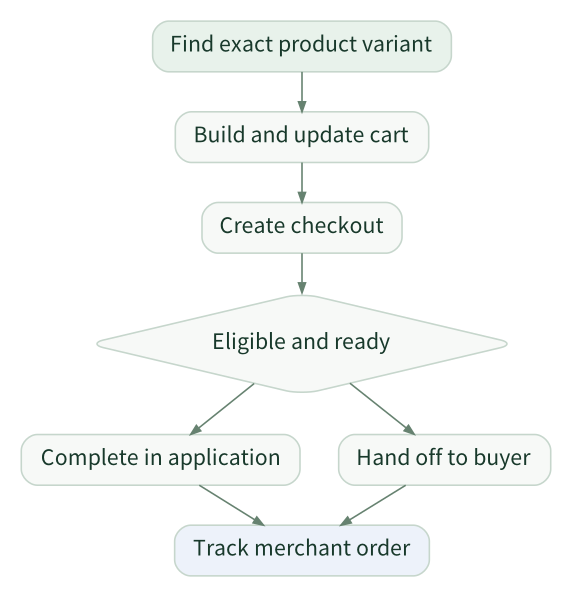
Conceptual commerce state flow. Direct completion and buyer handoff depend on the merchant and agent’s current capabilities; this is not an observed checkout.
In the travel example, a shipping choice or authentication challenge can make the buyer’s participation necessary. Treat that as a valid state, not as a failure to be bypassed. Preserve the checkout reference so the buyer continues the same purchase instead of receiving a newly created duplicate cart.
A profile establishes capabilities, not user consent
An authenticated agent can be recognized by the platform while still lacking permission for a particular buyer’s purchase. Keep the two decisions separate in application design: what this integration is allowed to call, and what this buyer has approved it to do.
A useful approval summary includes the seller, exact variant, quantity, delivery terms and final total. If the agent changes one of those material terms, the application should determine whether a new decision is needed. A high platform trust tier is not permission to disregard the buyer’s constraints.
The order survives the conversation
After the user leaves the chat, delivery, cancellation and support continue. The assistant needs an order reference that can be connected to the merchant’s state, not merely a transcript saying “done.” Design recovery around the existing checkout and order identifiers.
| State | A useful user-facing statement |
|---|---|
| Product found | This variant appears to fit; final terms are not confirmed |
| Checkout prepared | Review the current total and delivery details |
| Buyer action required | Continue the existing checkout to resolve the requested step |
| Merchant order created | Here is the order reference and current merchant status |
This table is an editorial UI recommendation, not an official Shopify response schema. Avoid labeling a created cart as a paid order, or a completed payment as proof that goods have shipped.
Universal Cart has a separate access boundary
The reviewed overview invites users to an early-access waitlist for Universal Cart. Do not extend that capability to every current integration simply because it appears beside generally documented tools. A cross-merchant shopping plan also introduces separate seller obligations, delivery promises and cancellation paths even when the interface looks unified.
Shopify is relevant here as merchant commerce infrastructure. It is not a general-purpose autonomous wallet. Evaluate it when your agent needs structured product and checkout interactions with participating commerce surfaces, and use the Shopify reference to keep current access conditions close to the architecture decision.
FOLLOW THE SOURCES