AGENTWALLETS · INDEPENDENT PERSPECTIVES
Mastercard Agent Pay for Machines: Vouchers First, Settlement Later
Read Mastercard machine payments as a pilot-stage voucher and settlement system, with pre-authorized budgets and a clear distinction from consumer Agent Pay.
Quick answer
Mastercard Agent Pay for Machines is a pilot-stage machine-payment offering. Its documented flow lets an authorized agent present a signed voucher to a service provider, which can deliver service and redeem vouchers later. A verified voucher is not the same event as completed settlement.
A business agent buys a data extract, then several bursts of model inference. If each small interaction needs a separate checkout, payment overhead can dominate the workflow. If every service receives unrestricted authority, convenience comes at an unacceptable control cost. Mastercard’s machine-payment proposal separates the rapid service interaction from later settlement.
Source boundary: reviewed November 1, 2026. Public product pages and the October demonstration explain the proposed operating model. We did not join the pilot, inspect private APIs or measure settlement performance.
The current status is a pilot, not general availability
The early-access page explicitly says the offering remains a pilot and is not commercially available. The October announcement opens developer early access after end-to-end pilots. These statements should travel with any description of the product; a public demonstration is not a promise that every developer can deploy it today.
For a procurement team, the immediate decision is whether the pilot matches a real workload and whether participation terms are acceptable. Do not put an unconfirmed integration date into a customer commitment. Ask for the actual API access, supported counterparties, settlement terms and operational support available to your organization.
A voucher bridges two timelines
The October explanation describes a service returning HTTP 402, an agent issuing a digitally signed payment voucher within an approved limit, and the provider verifying it before delivering. Providers can aggregate vouchers for later redemption. It builds on x402, but the voucher’s payment assurance and its redemption are distinct events.
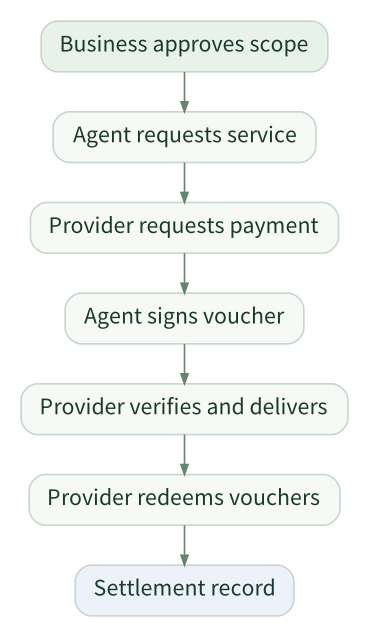
Conceptual voucher lifecycle from public materials, not a pilot transaction. Delivery may precede redemption and settlement.
In the hypothetical inference workflow, keep three ledgers linked: approved spending authority, consumed service units and redeemed payment obligations. Counting only settled transactions can understate already committed spending. Counting every retry as a new purchase can overstate it. The application’s budget model needs to say when an obligation reserves capacity and when that reservation is released.
These are design questions we infer from deferred settlement, not claims about unpublished Mastercard APIs.
Payment assurance needs its own terms
The product page describes upfront permissions, off-chain cryptographic verification and Mastercard-backed settlement assurance with multiple rails. That is the provider’s stated model. Its practical scope depends on program terms, eligibility and which transactions meet the required conditions.
A merchant should ask who bears a loss when a voucher is expired, duplicated, disputed or outside the agreed authorization. It also needs to know what happens if the verification service is unavailable. “Guaranteed” in a product description should not replace a review of the conditions under which the guarantee applies.
| Question for the pilot | Why it affects the design |
|---|---|
| When does a voucher reserve budget? | Concurrent agents must not promise the same remaining funds |
| How is a repeated request recognized? | A network retry should not become another service purchase |
| When can the provider redeem? | Cash-flow timing differs from API response timing |
| What happens after revocation? | Future authority and existing obligations may have different treatment |
Do not merge it with consumer Agent Pay
Mastercard Agent Pay addresses a broader agentic-commerce context. Agent Pay for Machines specifically targets paid digital services and machine-to-machine interactions. Keeping them separate makes the directory useful: a merchant building a card checkout and an API operator selling compute are evaluating different integration problems.
This offering is worth tracking when rapid, repeated service purchases need accountable authorization and delayed settlement. It is not evidence that every Mastercard merchant already accepts machine vouchers or that an existing x402 client automatically meets all pilot requirements. Use the machine-payments reference to follow official access updates, and keep any production decision conditional on documented program terms.
FOLLOW THE SOURCES