AGENTWALLETS · INDEPENDENT PERSPECTIVES
Tempo: Evaluating a Stablecoin Settlement Network for Agent Payments
Separate Tempo the blockchain from MPP and the Tempo Wallet CLI, then examine funding, fees, authorization and reconciliation for an API marketplace.
 Project reference · Tempo ↗
Quick answer
Tempo is a payments-focused layer-1 blockchain with stablecoin-oriented transaction capabilities. It is one settlement option for MPP, not the protocol itself, and it is separate from Tempo Wallet CLI. A production evaluation should connect the network to the exact asset, wallet, funding route and merchant workflow.
An API marketplace wants buyers to pay in stablecoins and sellers to receive usable balances. A fast transfer is only one part of that journey. The operator also needs to fund wallets, authorize agent activity, collect receipts and decide how sellers move funds into the accounts they actually use.
Research boundary: official Tempo product pages, developer index, network repository and MPP overview reviewed November 1, 2026. Several deep technical-document links were unavailable to our retrieval tool, so this article avoids unverified implementation details. We did not operate a node, create an account or test a paid API call.
Distinguish the network, the protocol and the wallet tool
Tempo’s official FAQ describes a payments-focused EVM-compatible layer-1 network. Its mainnet and Moderato testnet are separate environments. This article covers that settlement layer, rather than the command-line wallet already covered in our Tempo Wallet CLI analysis.
MPP defines an extensible machine-payment interaction for web services. Tempo can be one settlement choice within that interaction. A merchant adopting MPP has not thereby committed every buyer to the same blockchain, and a wallet connected to Tempo does not automatically understand every merchant’s payment challenge.
For the marketplace, record these as separate decisions: payment protocol, settlement network, wallet implementation and service that verifies payment. It should be possible to explain which component needs changing when one of those decisions changes.
Follow the complete stablecoin journey
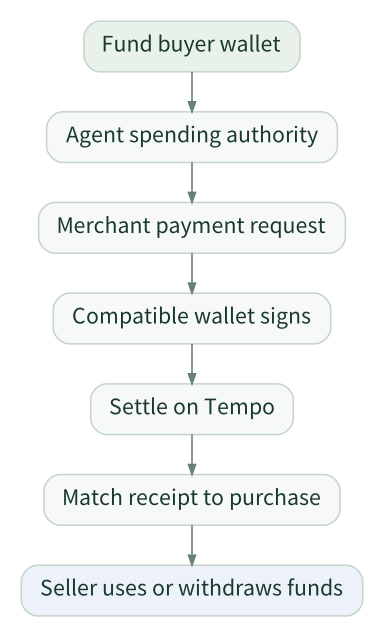
Conceptual marketplace flow, not a payment test. Funding and withdrawals may depend on providers outside the network.
Tempo’s developer index separates account operations, payment integration and routes between networks. That separation is helpful for procurement: a working chain connection is not evidence that a particular fiat or cross-chain route is available to your seller.
Start with the asset the seller will actually accept. Confirm its production identifier and the receiving provider’s support. Then work backward to how the buyer obtains it. If the marketplace must convert another balance along the way, expose the quote, fees and failure state as a separate step rather than calling the entire journey one transfer.
Payment-oriented features still need an integration match
Tempo’s open-source network repository is the implementation entry point for its blockchain. The broader official developer materials describe a stack built around payment operations. Such capabilities are useful only when the selected wallet and SDK expose the operations the application intends to use.
For example, do not infer from an EVM-compatible account address that an existing wallet integration understands every Tempo-specific transaction capability. Ask for a documented support matrix and validate the exact SDK version, account type and network. Keep the ordinary transfer path working before adding batching or other advanced behavior.
This is an implementation recommendation, not a claim that unsupported wallets can be repaired by changing only the RPC URL. A valid signature is necessary but may not be sufficient for the transaction form the network expects.
Agent limits and network fees are separate concerns
Tempo’s agentic-payment page describes access-key spending limits and expiry, as well as fee sponsorship. It explicitly asks integrators to check which controls their wallet supports. A platform should therefore inspect the actual authority granted to each agent instead of assuming all compatible wallets offer the same permission experience.
For the marketplace, distinguish what an agent can buy from who pays the network fee. A sponsored transaction can still purchase an expensive resource. A limited spending key can still be unusable if the required fee arrangement is missing. Display and log those conditions separately.
The network FAQ describes fees paid in supported stablecoins. That does not mean any stablecoin balance on any network can fund execution without conversion. Confirm the fee asset and sponsor arrangement for the selected integration, then include resource charges and any separate service costs in the buyer’s budget.
Reconciliation is where the marketplace becomes operable
| Marketplace event | Record the operator should be able to retrieve |
|---|---|
| An agent receives permission | Wallet, scope, expiry and revocation owner |
| A service quotes a price | Resource, accepted payment option and validity |
| A payment is submitted | Business request and transaction identifiers |
| The service returns data | Receipt and delivery outcome for that request |
| A seller withdraws | Destination route, provider status and associated costs |
Our recommendation is to preserve these relationships before increasing volume. A chain explorer can establish transaction facts, but it will not know which customer support case, failed inference or disputed invoice belongs to that transfer unless the application records the mapping.
A useful acceptance exercise is a dropped response after successful payment. The seller should find the original entitlement, and the buyer should avoid paying again merely to discover whether the first attempt worked. Include provider outages and unavailable withdrawal routes in the operating plan too.
Our assessment
Tempo is worth evaluating when stablecoin settlement and machine payments are central to the product. The evaluation should be based on the actual asset and provider path, not a general performance slogan or assumptions imported from another EVM network. This article makes no independent throughput, finality or cost benchmark claim.
See the Tempo reference, MPP reference and payment idempotency guide. The useful end state is a traceable buyer-to-seller payment journey, with a clear owner for every step outside the chain as well as within it.
FOLLOW THE SOURCES