AGENTWALLETS · INDEPENDENT PERSPECTIVES
Utila Wallets: Approvals, Signing and Payment Retries
Explain Utila approval and signing flows, requestId versus externalId, validation versus simulation, and reconciliation of supplier payments and sweeps.
Quick answer
Utila combines enterprise wallet operations with transaction requests, policies, approvals and signing. A retry request identifier and an external business reference serve different purposes. Operators must distinguish validation, approval, signature and network outcome before retrying or reconciling a payout.
Suppose a business pays several suppliers in stablecoins each week. Operations prepares the list, finance verifies amounts and another authorized person approves. The business might ask an agent to summarize invoices without allowing it to change destinations or bypass approval. Utila provides enterprise wallet and funds-operation tools; the key question is how requests, policy, signing and reconciliation fit together.
This is a conceptual example without a real wallet or payment, and no network, asset or fee is assumed. Utila’s product page describes multi-party computation (MPC) wallets, payments, approvals and connections to liquidity and ramp partners. MPC is a signing technique. Its name alone does not tell a customer who can change policy, recover an account or whether every transaction requires human approval.
A batch of supplier payments
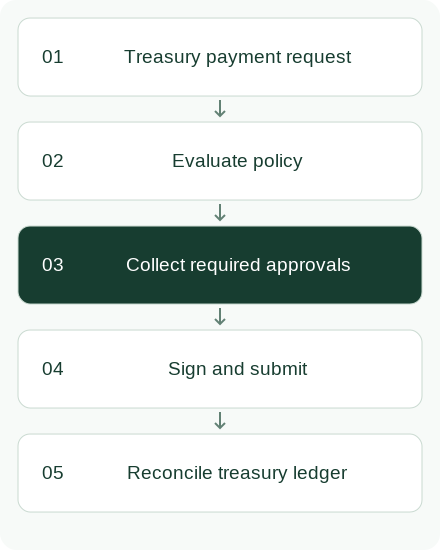
| Stage | What an owner checks | Possible state or result |
|---|---|---|
| Prepare | Invoice, supplier, destination, asset and network | Payment request created |
| Policy and approval | Rules and required approvers | Awaiting checks, approval or rejection |
| Sign and broadcast | Required signing components are available | Signed, submitted or failed |
| Reconcile | Transaction, balance and business order match | Confirmed, pending or investigated |
The API overview describes wallets, transaction initiation, notifications and automated co-signing. A sweeping guide shows that a particular workflow can wait for approval or signature. Do not apply one flow’s states to every transaction and configuration. Approval does not mean a transaction was broadcast, and broadcasting does not prove the supplier fulfilled its contract.
Who can do what?
Separate the authority to propose a payment, approve, participate in signing, change policy and recover an account. An agent may prepare a draft, but whether its service account can initiate or automatically sign depends on the business’s configuration. If one credential can both change a recipient allowlist and execute payment, an approver’s name in a screen is not enough evidence of effective control. Check the assets, networks, destinations, token approvals and batch operations covered by the policy.
A retry identifier is not an invoice identifier
The InitiateTransaction reference gives requestId and externalId different jobs. requestId lets the server recognize a retried request; the documented duplicate protection lasts at least 60 minutes after the first request. externalId correlates the transaction with an outside system and must be unique within the vault. Neither should be treated as a substitute for every other identifier.
Suppose finance submits one supplier payment and loses the response. Preserve the original request identity and inspect the resulting transaction under the documented retry rules. Generating a fresh request identity every time a screen is refreshed defeats that relationship. Conversely, using the same invoice reference for a changed destination does not turn the change into an identical request. The time window also should not be interpreted as indefinite duplicate protection.
The same reference distinguishes validateOnly, which validates without creating the transaction, from runSimulation, which requests estimated execution effects from a blockchain node. Passing validation or receiving a simulation estimate does not prove that approvers have consented or that the network has executed a transfer.
Keep these results separately in the operator’s view: request checked, transaction created, approvals obtained, signed and network outcome. That gives support a concrete place to resume after interruption. No API request was sent for this review.
Two approvers and a treasury sweep
Suppose an operator creates two supplier payouts under a policy requiring two finance approvers. After the first approval, the system should still show that the second is pending rather than recording execution. If the second person rejects one payout, preserve the other payout’s state separately. Which approval combinations are configurable depends on Utila and the enterprise setup; this scenario is not a capability guarantee.
On the same day, the business sweeps several deposit wallets into treasury. A reconciliation record should distinguish each source wallet, sweep transaction, destination wallet, asset and network, network fee and business owner. If one sweep completes and another waits for signature, a batch total cannot establish that every transfer completed. Inspect the original transaction before handling the remaining item; do not resubmit completed transfers.
Useful separation-of-duty checks include whether an operator can change the approval rule, whether an approver can approve their own request, whether policy changes are recorded and how pending operations continue after a service account is disabled. Verify actual controls and records in the configured environment; we did not test them.
Partners and exit paths
The product page describes connections to ramp, trading and liquidity partners. A wallet and approval layer does not imply Utila itself supplies a bank account or conversion in every jurisdiction. If a supplier needs fiat, verify the actual partner’s eligibility, quote, rail, refunds and bank receipt. Reconciliation should connect the internal order, wallet transaction, partner payout and bank result while keeping their states distinct.
Ask about MPC share and recovery arrangements, access during an outage, audit of approvals and policy changes, network coverage, total cost and support ownership. Test rejection, timeout and recovery without real funds in an authorized environment; we did not do so.
Further reading: Key control, Session keys, Reconciliation.
Sources reviewed November 6, 2026. Official-source explanation; no account, credential, API or payment test was performed.
FOLLOW THE SOURCES