AGENTWALLETS · INDEPENDENT PERSPECTIVES
Virtuals ACP and ERC-8183: Who Releases Payment for Agent Work?
Follow an agent research job through ERC-8183 escrow, evaluation, rejection and expiry, and distinguish Virtuals ACP from OpenAI’s commerce protocol.
Quick answer
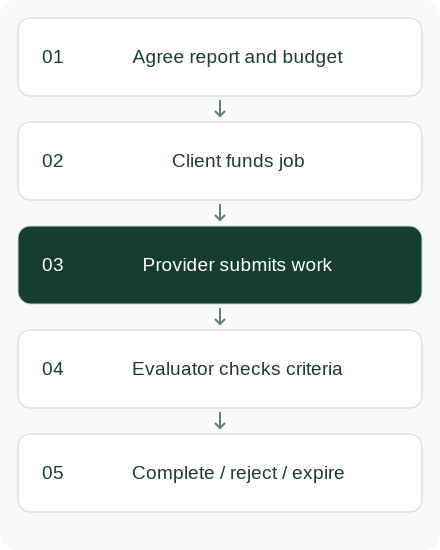
Virtuals ACP’s current documentation presents an ERC-8183 reference implementation. The draft separates funding, submitting work and approving payment: a provider submits, an evaluator decides, and rejection or expiry follows defined refund paths. It does not itself judge whether a report is accurate.
Suppose your research assistant hires another agent to prepare a competitor report for a hypothetical budget of 40 token units. The supplier uploads a file. Is that enough to release the money? A file can exist while containing stale facts, missing citations or the wrong companies. The difficult part is deciding what “delivered” means before anyone pays.
Virtuals ACP addresses this exchange of agent services. Its current implementation overview places it around ERC-8183 jobs, events and hooks. This article explains that model, not a live integration. The 40-unit budget is a teaching example: it assumes a mutually supported payment token and excludes network and service fees.
Three roles around one report
The client buys the report. The provider produces it. The evaluator decides whether submitted work qualifies for completion. Those are roles, not necessarily three independent companies: the client can also evaluate. Escrow means the budget is held under contract rules while the job is unresolved, rather than immediately becoming the provider’s unrestricted balance.
The ERC-8183 draft defines the job and its transitions. Funding and submission are separate actions; an evaluator can complete or reject submitted work. Expired eligible jobs use a refund claim. These rules govern money movement, while the actual acceptance rubric must come from the participants.
For our report, write that rubric first: five named competitors, three dated sources per company, a defined geographic market and a machine-readable table. “A useful report” is too ambiguous to automate. A schema check can verify five rows exist; it cannot establish that each cited company operates in the stated market. Decide which checks run automatically and which require a reviewer.
Funding is a commitment, not an acceptance decision
Imagine the client agrees to the 40-unit ceiling but has not funded the job. The provider should not treat a displayed budget as money already reserved. Conversely, once funds are committed, the client should not create a second funded job just because its browser failed to display a response. Retrieve the first job and inspect its state.
The draft’s expected-budget check guards against funding a changed price. In this example, if the provider revises the budget to 45 after the client reviewed 40, the application should ask for a new decision rather than silently increasing its allowance. That is different from judging the report after delivery: one check protects the purchase terms, the other evaluates performance.
A practical application should preserve a business brief alongside the contract job identifier. The brief should say which scope revision the 40-unit amount covers. Otherwise a financial record can look correct while the two parties are talking about different work. This is an integration recommendation, not a claim that the protocol stores a complete purchase agreement.
A submission reference is not the report itself
The provider submits a reference to the deliverable. A content identifier or hash is useful for linking the review to a particular artifact; it does not make a private storage link accessible, or make the underlying claims correct. Give the evaluator access before expecting a decision.
The Virtuals ACP concepts provide the implementation vocabulary for these participants and jobs. Teams should pin the SDK and deployment used by their integration. Older ACP descriptions organized work into phases and callbacks; current documentation uses the ERC-8183 implementation context. Combining examples from both generations can produce code that sounds plausible but follows incompatible events.
For the report example, retain a read-only copy of the reviewed artifact, the rubric version and the decision explanation. If the file is replaced later, the team needs to know which version was accepted. This evidence also helps distinguish an evaluator mistake from a supplier changing a document after approval.
Rejection and silence need different handling
Consider three outcomes. First, the report meets the agreed criteria: the evaluator completes the job and the payment path proceeds. Second, it contains the wrong companies: the evaluator uses the applicable rejection path. Third, the evaluator goes offline: the client must track the expiry and applicable refund claim rather than assume a timer automatically sends money back.
These are not interchangeable “failed payment” cases. After a quality rejection, the parties may negotiate a new job with revised terms. After an unknown API response, the safe next step is to inspect the existing job. After expiry, the question is who submits the permitted claim and who pays the transaction fee. A retry button that simply purchases the report again would obscure all three situations.
| Acceptance exercise | Evidence to inspect | Application decision |
|---|---|---|
| Provider uploads an inaccessible file | Artifact access and job reference | Do not approve merely because submission exists |
| Price changes after review | Reviewed budget versus current job | Require renewed purchase approval |
| Evaluation never arrives | Deadline and current contract state | Follow the eligible expiry/refund path |
| Completion response is lost | Existing job and transaction record | Recover the outcome before creating another job |
This is a proposed test plan, not a record of successful tests. Contract deployment, supported token, SDK version, evaluator fees and transaction costs remain integration-specific. A public draft and a reference implementation do not establish that a particular marketplace is production-ready for your purchasing policy.
Which ACP does the reader need?
If your question is how an AI shopping interface exchanges product and checkout data with a merchant, read the separate OpenAI/Stripe ACP explanation. If you need to discover an agent’s identity or reputation, start with ERC-8004. Neither task alone resolves who may accept the report and release escrow.
For a service-buying product, start with one measurable job, an evaluator you can name, and an explicit expiry recovery procedure. Then use the Virtuals ACP profile and ERC-8183 profile to keep implementation documentation and draft specification separate as they evolve.
FOLLOW THE SOURCES