AGENTWALLETS · INDEPENDENT PERSPECTIVES
Reap Agentic Payments: From Stored Card to Approved Order
Trace a Reap purchase from card enrollment and mandate to a shipping-inclusive quote, user action and merchant order, with current documentation limits.
Quick answer
Reap Agentic Payments connects a stored card, approved purchase terms, a current merchant quote and checkout. Enrollment alone does not authorize a purchase. The lifecycle documentation allows checkout to skip a fresh prompt under a previously approved mandate; this is different from unrestricted unattended purchasing.
Suppose a shopping assistant finds a desk lamp listed at $40. The customer permits a one-time purchase up to $50. Standard shipping adds $6 and tax adds $3, producing a hypothetical $49 total. Express shipping would raise it to $55. Which amount should the assistant compare with the customer’s limit?
The final quote, not the search result. This example is useful for understanding Reap Agentic Payments because card storage, permission, pricing and merchant order creation are separate resources. No purchase was executed for this article, and the figures are teaching assumptions rather than Reap fees or a merchant offer.
A stored card is only the starting point
An enrollment connects one stored card to an owner reference. The setup guide describes a hosted step and the need to read the resulting status. An enrollment must be ACTIVE before charging. Returning to an app after entering a card is not a substitute for checking that resource.
The owner reference matters when a business has many users. Our assistant must locate this customer’s card enrollment, not whichever card was most recently created in the database. The product should also show the chosen payment method before asking for purchase approval, so the user can notice an unintended card.
Reap’s resource and actor explanation distinguishes the application, cardholder, Reap and merchant. The application drives requests and retains its terms/privacy acceptance records; Reap provides hosted card and approval surfaces and coordinates pricing and checkout. Card infrastructure elsewhere in Reap’s catalog is not proof that every card source is available in this agentic flow.
Permission has a ceiling and a scope
A mandate records approved purchase terms. For a one-time purchase, the purchase guide describes a single-charge arrangement with an amount ceiling and merchant scope. The ceiling is a maximum, not an instruction to spend the entire amount.
Our lamp’s $49 total fits the hypothetical $50 ceiling; $55 does not. The assistant should offer standard shipping or ask for changed approval, not quietly remove tax from its comparison. Nor should it treat an unused dollar as permission for an unrelated second purchase. A one-time mandate and a reusable stored card have different lifetimes.
A subtle documentation boundary matters here. The actor overview says the user approves each charge, while the lifecycle page explicitly allows a checkout under previously approved terms to proceed without a fresh hosted step. We therefore interpret approval as a required authority trail, not a promise that every checkout displays another button. Implement the returned nextAction and verified mandate state; confirm the enabled flow with Reap before designing an unattended experience.
Search price, quote and final amount serve different purposes
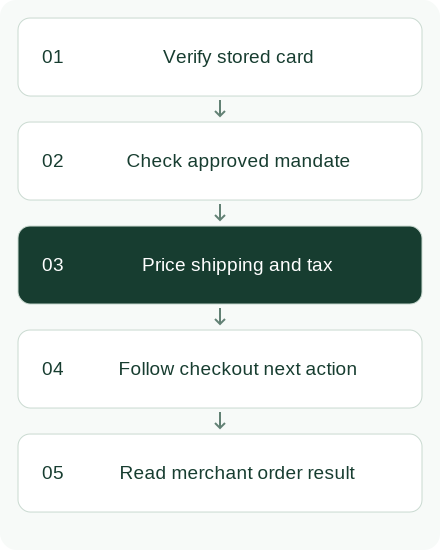
A search result helps choose a product. A variant identifies the actual selected option, such as the lamp’s color or configuration. A quote adds the merchant’s current shipping options, tax and total. A checkout then attempts the purchase under the selected enrollment and approval conditions.
The $40 listing is useful for discovery, but it cannot support a final spending decision. Save the chosen variant, shipping option and quote with the business purchase reference. If the user changes to express shipping, the old approval comparison is no longer enough; recalculate the decision against the resulting total.
Quotes expire. When the lamp quote is stale, obtain a new one rather than edit its amount in your own database. If the replacement still fits $50 but delivery changes from two days to two weeks, a good shopping interface should expose that material change too. Price permission is not evidence that every other purchase condition remains acceptable. This is a product-design recommendation, not an additional documented mandate field.
A return URL does not prove an order exists
After a hosted approval, retrieve the checkout. If it is processing, continue observing it. Once completed, retain the merchant order reference and final amount. The lamp is now ordered, but that is still different from being dispatched or delivered.
For a failed or expired checkout, the lifecycle documentation calls for a new quote and checkout. Do not apply that rule to an unknown result: a network timeout might hide a completed order. Inspect the original checkout first. Otherwise, the customer could receive two lamps even though each API call appeared to have its own reasonable purpose.
| Situation in the lamp example | What to inspect | Next decision |
|---|---|---|
| Browser returns from card setup | Enrollment status and owner | Continue only with the intended active card |
| Express shipping exceeds $50 | New total and mandate ceiling | Change shipping or obtain revised approval |
| User returns from approval | Checkout status | Wait or record the merchant order |
| Checkout result is unknown | Existing checkout identifier | Recover its outcome before another purchase |
| Checkout is explicitly expired | Expiry and current quote | Start the documented fresh purchase attempt |
These are suggested acceptance cases. They also give support staff a vocabulary: “card stored,” “purchase authorized,” “order placed” and “delivered” should not be collapsed into one green success badge.
What to verify before promising the feature
Current documentation marks recurring purchases and some card-source capabilities as coming soon. It also describes mandates while marking the mandate-creation endpoint as forthcoming. Establish how your integration obtains an approved mandate; do not invent a currently available creation call from the resource name.
Merchant access, countries, card eligibility, commercial pricing and refund support need confirmation for the contracted integration. A public purchase walkthrough is not a universal acceptance guarantee. Budget separately for the goods and the provider’s applicable commercial costs, and test the enabled API version in a supported environment.
The Reap directory profile keeps these boundaries visible. Compare PayOS when the question concerns payment-credential handoff rather than this catalog-to-order flow. For Reap, the useful first milestone is one correctly scoped purchase whose approval, quote and merchant order can all be traced to the same customer decision.
FOLLOW THE SOURCES