AGENTWALLETS · INDEPENDENT PERSPECTIVES
BitGo Wallet Policies: Withdrawals, Approvals and Recovery
Examine BitGo through an agent-assisted treasury flow: wallet roles, withdrawal policies, recovery authority and why an API credential is not a complete spending boundary.
Quick answer
BitGo wallet authority depends on the selected custody and signing model. Its documented withdrawal policies apply to transactions involving BitGo; recovery using user and backup keys can follow a different path.
The treasury assistant should not inherit recovery authority
Imagine a company allowing an assistant to prepare routine supplier payments. Finance wants an approval step for unusual transfers, while the security team retains emergency access if normal systems fail. Both requirements are reasonable, but they describe different paths to the same assets.
BitGo provides wallet infrastructure with multiple control arrangements. Its wallet overview is the starting point for choosing a model. This article examines where a withdrawal policy is enforced and what happens outside that path. It is a hypothetical treasury design, not an independent BitGo integration or security test.
Start with the selected wallet model
Do not begin by asking whether BitGo is simply “custodial” or “non-custodial.” Ask which wallet configuration is proposed, who holds each relevant key or share, who can initiate a request, who approves it and which service participates in producing a valid transaction.
An API credential is only one part of that arrangement. It may permit an application to request operations, while separate keys and approvals govern execution. Conversely, a person holding sufficient recovery authority may be able to move funds without following the application’s usual approval screen.
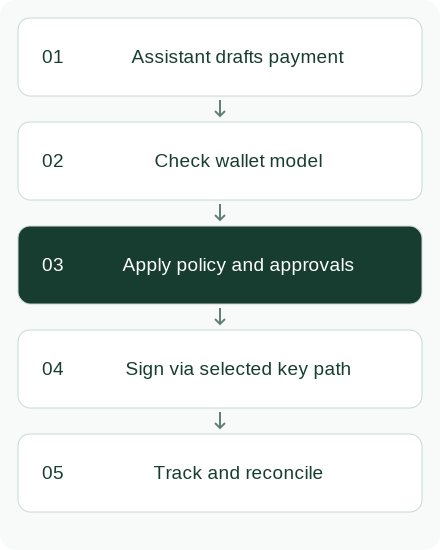
For the supplier assistant, write these roles in separate columns. The assistant drafts the request; the application checks its business context; authorized people approve when required; the configured signing path executes. Combining all of them in one broad service credential would defeat the reason for having separate controls.
What a withdrawal policy checks
The policy overview describes rules based on destinations, initiators, amounts, balance percentages and activity over time. Rules can require additional approval or determine whether an action proceeds. The useful question is which rule applies to this withdrawal in this wallet configuration.
Consider an illustrative payment of 200 USDC to a previously approved supplier on a selected supported network. The amount is not a BitGo limit or fee quote. A business might decide that this amount can proceed through its routine workflow, while a new destination requires a second approver. The configuration must express that distinction and the approver must see the actual destination, asset and purpose.
A rule permitting a destination does not prove the invoice is legitimate. A rule limiting each withdrawal does not necessarily implement the total daily business budget. Keep invoice validation, payment limits and signing policies related but distinct.
Separate operating funds from reserves
BitGo’s custody starter architecture describes custody, standby and deposit/withdrawal wallet roles. The pattern separates reserves from more accessible operational funds, with different controls on movement between them.
The design implication for an assistant is limited exposure. If it can operate only a deliberately funded working wallet, the available balance becomes one part of the control. But replenishment matters: an assistant that can also refill that wallet freely has not truly been confined to the initial balance.
| Treasury activity | Authority to review separately |
|---|---|
| Prepare a supplier payment | Access to invoices and beneficiary records |
| Spend operating funds | Selected wallet permissions and withdrawal rules |
| Refill the operating wallet | Transfer authority over standby or reserve funds |
| Change a policy | Administrative control, outside ordinary payment work |
| Recover the wallet | Emergency key access and recovery procedure |
This is an editorial review model, not a mandatory BitGo configuration.
Recovery is the boundary that is easy to miss
The policy documentation explicitly notes that withdrawals involving BitGo are subject to its applicable policies, while recovery using the user and backup keys can bypass them. This does not mean recovery is inherently wrong. It means the policy’s scope must be described accurately.
In the example, an assistant denied a supplier transfer must not gain access to recovery credentials as a workaround. Similarly, an employee able to approve routine withdrawals should not automatically be able to export or assemble emergency access. Those are separate responsibilities even if the software interfaces are operated by one team.
Ask where recovery material is stored, who can use it and what evidence of that use is retained. The answers are part of the wallet’s control model. They cannot be inferred from a screenshot showing that a normal transaction required approval.
Test denial, not only the happy path
A useful non-funded rehearsal starts with an approved supplier request, then changes one condition at a time. Replace the destination, exceed the intended amount, submit several smaller requests, attempt to change a policy and request reserve replenishment. For each case, record the expected decision and which independent actor can authorize an exception.
Next, describe an outage without performing an emergency transfer. Who decides recovery is necessary? How are pending normal-path transactions reconciled before recovery proceeds? Could the same invoice be paid from both paths? A recovery plan that ignores outstanding requests can introduce duplicate payments during an incident.
These questions add value beyond counting chains or advertising MPC. They establish whether the proposed system has a coherent authority boundary. See the key-control guide and spending-limit guide for the underlying concepts.
Compare the operational responsibility, not a security adjective
Compare BitGo with Dfns, Fireblocks and Utila using the same hypothetical treasury task. Ask who signs, who can change rules, what happens during service interruption and how recovery affects existing permissions.
The commercial scope still needs confirmation: entity eligibility, wallet type, supported assets, service charges, network costs and support for the required operations. This review does not establish a single price or recommend one custody model for every business. BitGo’s documentation tools also should not be mistaken for a ready-made autonomous payment agent.
BitGo reference. Sources reviewed November 6, 2026; no wallet, API or recovery transaction was tested.
FOLLOW THE SOURCES