AGENTWALLETS · INDEPENDENT PERSPECTIVES
Fordefi: Who Approves an API-Initiated Transaction?
Understand Fordefi API initiators, ordered policy rules, custom API Approvers and message-signature controls through a supplier-payment example.
Quick answer
Fordefi separates initiating a transaction, evaluating policy, approving it and producing a cryptographic signature. A custom API Approver adds business checks and approves or aborts; it is not the signer. Message signatures need type-aware rules because their policy amount and recipient semantics differ from ordinary transfers.
Suppose an operations agent prepares a 300-USDC supplier payment. Finance has approved the supplier’s address, but the invoice record is still marked disputed. A wallet rule that checks only “below 500” would miss the business reason not to pay. Fordefi’s policy and API Approver model gives the team places to make these different decisions explicit.
This is a hypothetical workflow on a mutually supported network, excluding network fees. No Fordefi account, approval server or payment was tested. The focus is who can authorize a transaction, rather than a generic comparison of enterprise wallets.
Four responsibilities that should have separate names
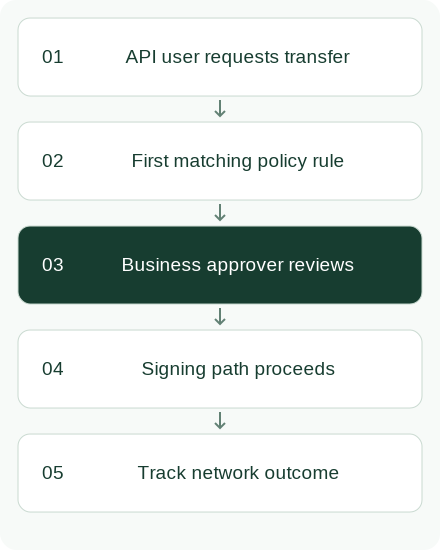
The initiating API user asks for a transaction. Policy evaluation determines which approval route applies. An approver can accept or abort the request. The signing infrastructure subsequently produces the signature needed for the applicable chain operation. A successful API authentication is not itself evidence that all the later checks passed.
Fordefi’s authentication documentation describes the request-access layer. Its policy overview describes approval before signing and broadcasting. Keeping these layers distinct helps a product explain whether a payment is merely requested, waiting for review or actually submitted to the network.
| Responsibility | Supplier-payment question | Evidence the team should retain |
|---|---|---|
| Initiator | Which application requested 300 USDC? | API identity and request record |
| Policy | Which rule matched the vault and destination? | Effective policy and decision |
| Business approver | Is the invoice eligible to pay? | Invoice reference and review result |
| Signing and execution | Was the authorized payload signed and sent? | Transaction outcome and network record |
Rule order changes the outcome
Fordefi evaluates an ordered policy and uses the first matching rule. That means a broad allow rule placed above a more specific restriction can prevent the restriction from ever deciding the request. A policy is not a set of independent warnings that all get added together.
For the supplier example, define which API initiator and vault may use the path, then narrow the destination and amount. Route payments requiring invoice review to the relevant approver. Unknown destinations should fall through to an intentional block or review decision, rather than accidentally inherit broad permission.
The policy best practices recommend restrictive fallback behavior and both per-transaction and periodic controls. Their periodic counters have configurable scope and calendar-period behavior. “500 per transaction” does not mean “500 per day”: ten approved 300-unit requests can create very different exposure. The example amounts are application design choices, not Fordefi defaults or quoted product limits.
A custom approver checks the invoice, not just the address
A custom API Approver can query the company’s invoice system and inspect transaction details. The API Approver guide is explicit that this component approves or aborts; it does not cryptographically sign the transaction. Its credentials and webhook verification still matter because a compromised decision service can authorize something the company intended to stop.
In our example, the approver should retrieve invoice INV-208 from a trusted internal record and compare the approved beneficiary, asset and amount with the transaction payload. Accepting “the invoice was approved” as text supplied by the requesting agent would let the requester supply its own evidence.
If the invoice service times out, define whether the request remains pending or is aborted. A missing answer should not silently become an approval. After recovery, re-check the current invoice status before deciding; a dispute may have been opened while the request waited. These are recommended business controls, not built-in invoice features claimed for Fordefi.
Why a low-value message can still be sensitive
A message signature may authorize something that happens later rather than moving funds immediately. Fordefi’s message-policy documentation distinguishes personal/non-EVM messages, general typed-data messages and recognized Permit/Permit2 allowance messages.
For personal and non-EVM messages, the policy representation uses zero amount and no ordinary recipient. General typed data instead has unknown amount and may identify a verifying contract; an amount condition will not match it. Recognized Permit and Permit2 messages receive allowance-specific handling. Therefore “all signatures under 500 are safe” is not a sound policy conclusion.
The company should separately decide whether this supplier-payment agent needs message signing at all. If it does, identify the permitted domain, contract, message type and business purpose. A request to pay one invoice should not become a blanket ability to sign unrelated trading orders. Test each message family against the intended policy rather than relying on how its wallet preview looks.
A focused acceptance plan
Start with four proposed exercises. Change the supplier address while keeping the amount at 300; the request should take the intended rejection or review path. Submit repeated valid-looking payments; inspect the actual periodic counter scope. Make the invoice service unavailable; confirm the approver does not default to approval. Finally submit a message signature through the same initiator and check which policy rule actually handles it.
Retain evidence from these exercises before assigning production authority. Also identify who can change policy, rotate API credentials, disable the approver and recover signing access. Limiting the transaction initiator is insufficient if the same compromised identity can rewrite its own restrictions.
Commercial access, supported chains, custody configuration and fees require separate confirmation with Fordefi. Budget for the wallet service, transaction execution and the operational availability of your own approval service. No network or subscription price is assumed here.
The Fordefi profile links the underlying sources. For a different product’s transaction-request and reconciliation model, read Utila. Fordefi’s distinctive question in this article is narrower: can the organization explain, for one request, who initiated it, which rule selected its reviewers and why those reviewers allowed signing to proceed?
FOLLOW THE SOURCES