AGENTWALLETS · INDEPENDENT PERSPECTIVES
Circle CPN: From USDC Settlement to Local Bank Payout
Follow an institutional payout through Circle Payments Network: quotes, participant responsibilities, USDC settlement and local bank delivery.
 Project reference · Circle Payments Network ↗
Quick answer
Circle CPN coordinates stablecoin payment services. In its institutional fiat-payout flow, an originating institution settles USDC and a receiving institution delivers local currency; those are separate completion events.
The supplier asks about their bank balance
Imagine a business asking its payment provider to pay an overseas supplier. The business has approved the invoice. The supplier wants local currency in a bank account, not a transaction hash or instructions to create a crypto wallet. The provider might use USDC between institutions, but the supplier judges success by the agreed amount arriving.
That difference is the main reason to understand Circle Payments Network, or CPN. This is an institutional payment scenario, not a worked payment test. We have not opened a CPN account, obtained a commercial quote or moved funds. The example explains responsibilities rather than promising a particular corridor.
What CPN adds to holding USDC
Circle’s overview describes a network for accepting, converting, moving and settling funds. It distinguishes self-managed operations from managed services. In the former, the customer retains responsibility for its stablecoin lifecycle; managed services allocate more of the custody and operational work to Circle.
For a product team, the first question is therefore organizational: who is operating the service? A provider that already manages wallets and compliance may want different components from an application that intends to remain in fiat. A product label alone cannot answer who controls funds, approves the payment or investigates a return. Record those responsibilities before choosing an API integration.
Two institutions, two different jobs
The fiat-payout documentation names an Originating Financial Institution, or OFI, and a Beneficiary Financial Institution, or BFI. The OFI works with the sender; the BFI handles local delivery to the receiver. CPN coordinates participants, quotes and payment processing between those sides.
In our supplier example, “pay the invoice” is an instruction to the sender’s provider. The local receiving institution may still need beneficiary details before agreeing to process it. A valid wallet address says little about whether a bank account number, recipient name and purpose of payment are sufficient for that corridor.
| Checkpoint | What the business needs to understand |
|---|---|
| Payment proposal | Intended recipient, currency and invoice reference |
| Quote selection | Sender cost, recipient amount and acceptance conditions |
| Participant approval | Whether the proposed transfer can proceed |
| USDC settlement | Whether the institutional transfer was confirmed |
| Local payout | Whether the agreed bank delivery was completed |
These checkpoints are an editorial explanation, not literal API status names.
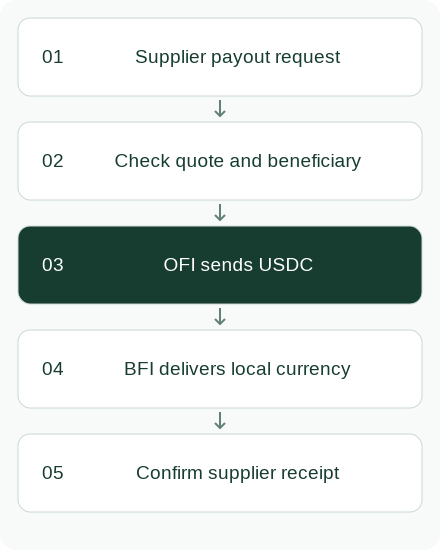
Follow the invoice through the handoffs
Start with the invoice’s actual obligation. Does the supplier need an exact local-currency amount, or is the sender authorizing a maximum debit? Those produce different acceptance criteria. If the team cannot answer, an apparently attractive conversion quote can still leave the invoice underpaid.
Next, obtain the applicable quote and required beneficiary information. In the documented flow, institutions coordinate approval before the originating side signs the onchain transfer; the receiving side handles fiat delivery after confirmation. The sender’s application should preserve the connections between invoice, quote, payment record and settlement evidence.
Consider a hypothetical invoice requiring 10,000 units of the supplier’s local currency. This is a teaching amount, not a quote. If the price changes before approval, the interface should show what changed: sender cost, recipient amount, fees or validity. Quietly substituting a new price would make the original user approval difficult to interpret.
Why a chain confirmation is not the final receipt
Suppose the institutional USDC transfer is confirmed while local delivery remains unresolved. Showing “supplier paid” would claim more than the system knows. Showing “payment failed” would also be misleading if money has already moved between institutions.
An application should retain an intermediate explanation, such as settlement completed and local delivery under investigation, when supported by the evidence it receives. The operational team needs to know which participant owns the remaining step. Re-sending the invoice payment without resolving the first attempt can create a second liability rather than solve the first.
A reversal or refund deserves its own record. A support request is evidence that someone is investigating, not that money is back. Readers unfamiliar with this separation can start with payment failures and stablecoin refunds.
CPN, CCTP and Gateway answer different questions
The directory separately covers CCTP and Gateway. CCTP concerns moving USDC between supported chains. Gateway addresses access to balances across chains. Neither function, by itself, identifies the institution responsible for depositing local currency into this supplier’s bank account.
CPN belongs in the payment-service discussion. These components can appear in a broader architecture, but names in the same company’s product family do not establish compatibility for a selected implementation. Ask which component is actually used in the proposed funds flow and what evidence it returns.
Decide with an operational rehearsal
Before a funded integration trial, have product, engineering and finance walk through three variations of the same invoice. In the first, the beneficiary information is incomplete. In the second, the quote is no longer acceptable. In the third, settlement has occurred but the supplier reports no receipt. Each role should identify the next permitted action and the evidence needed to close the invoice.
The commercial review should establish account eligibility, enabled corridors, liquidity arrangements, all conversion and payout charges, and support ownership. This review has not established a public all-in price or universal availability. The useful output is a responsibility map and a recoverable payment process, not a general claim that stablecoin payments are always instant or cheaper.
See the CPN reference for its place in the directory. Sources reviewed November 6, 2026; official-source desk research, with no payment test.
FOLLOW THE SOURCES