AGENTWALLETS · INDEPENDENT PERSPECTIVES
Coinflow: Checkout, Merchant Settlement and Delivery
Understand Coinflow through a software-credit purchase: checkout parameters, settlement destinations, duplicate notifications and the merchant’s delivery ledger.
Quick answer
Coinflow separates how a customer pays from where merchant proceeds settle. The merchant must protect checkout terms and reconcile provider payment events with its own order and delivery records.
The customer buys credits, not a settlement architecture
Imagine a software service selling usage credits. A customer pays by card and expects the credit balance to increase. The merchant may prefer a platform balance, a bank sweep or an enabled wallet destination for the proceeds. The customer’s payment method and the merchant’s settlement choice are related, but they are not the same decision.
Coinflow provides checkout and payout infrastructure. Its product documentation covers traditional payment methods and optional crypto rails. This article follows a hypothetical credit purchase to explain the merchant integration. We have not opened an account, run the SDK or processed a transaction.
Choose the settlement destination deliberately
The settlement guide distinguishes a Coinflow Balance from advanced settlement to a supported merchant wallet or approved contract. These choices determine where the proceeds go and which operating responsibilities the merchant takes on.
For the software service, ask what the funds are needed for next. A business paying ordinary bank invoices may have different requirements from one funding an onchain application. Receiving funds into a wallet can introduce key management and network-specific accounting; receiving a platform balance introduces a different provider and withdrawal relationship.
Do not infer that a card-paying customer must own a crypto wallet, or that selecting a wallet destination converts every payment into an irreversible crypto-only sale. The customer payment instrument still has its own rules and possible disputes. Settlement location does not erase the commercial agreement.
Lock the order before showing checkout
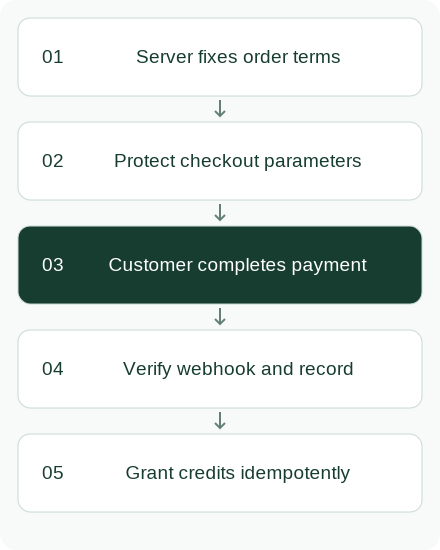
Suppose the customer buys a hypothetical 100-credit package for 20 US dollars (USD). Credits are an application entitlement, not a blockchain token. The server should establish the package identifier, price, currency and customer before preparing the checkout.
Coinflow documents signed checkout parameter tokens. Their purpose is to protect payment parameters from manipulation as they pass to the client. The source uses both “signed JWT” and “encrypted” wording; this review has not verified whether the actual token is encrypted. In a design review, distinguish integrity from confidentiality: the existence of a signature is not a reason to place arbitrary private information in a token or assume nobody can read its fields.
If the browser is allowed to change the subtotal from 20 dollars to 2 while still requesting 100 credits, the problem is already present before settlement. The trusted order must remain the reference. An assistant recommending a package should not also be the authority that silently rewrites its price.
Four records prevent misleading success screens
A useful merchant design connects the order, provider payment, settlement and entitlement records. Each answers a different question.
| Record | Example question |
|---|---|
| Order | Did this customer agree to buy 100 credits at this price? |
| Payment | What did the provider report about collection? |
| Settlement | Where did the merchant proceeds arrive? |
| Entitlement | Were exactly 100 credits added once to the correct account? |
This table is an editorial data model, not a copy of Coinflow’s API schema. The important relationship is traceability. A payment can succeed while the entitlement update fails. Conversely, a bug can grant credits even though the payment has not reached the required confirmation state.
Decide the release condition explicitly. Which provider event permits granting credits, and what later exceptions can still occur? That decision must match the enabled payment method and contract. A generic frontend success callback is not a universal financial-finality signal.
Duplicate notifications should not duplicate credits
The webhook guide warns that events may arrive more than once and recommends fast acknowledgement with background processing. It also directs integrators to authenticate notifications and validate their format.
In the example, a notification arriving twice must still grant only 100 credits. Deduplicate using a stable relationship between the provider event or transaction and the business operation. Simply recording that the HTTP endpoint was called once will not help when a later delivery repeats the same outcome.
Now consider a crash after credits are added but before the event is marked handled. On restart, the system needs evidence that the entitlement was already applied. This is why idempotency belongs in the business update, not only at the network boundary. A queue improves processing reliability; it does not by itself make granting credits exactly once.
Refunds must consider already consumed value
Suppose the customer spends 40 of the 100 credits and then asks for a refund. The payment provider cannot decide the application’s usage policy from a transaction receipt alone. The merchant needs to establish what is refundable, whether unused access should be removed, and how to record the returned money.
Likewise, statements about fraud or chargeback protection must be checked against the enabled product and contractual conditions. This review does not establish unconditional coverage. Read chargebacks and authorization versus settlement to keep customer disputes separate from where funds were delivered.
A useful acceptance test for the merchant
Before a funded trial, rehearse a changed checkout amount, a repeated notification, a crash between payment and entitlement, and a refund after partial consumption. For each case, product and engineering should agree on the customer message, ledger update and permitted retry.
Commercial evaluation should cover merchant eligibility, payment-method availability, all-in collection and settlement fees, payout terms and any protection exclusions. Coinflow’s role is merchant payment infrastructure; it does not supply the customer’s agent with spending authorization. Pair that question with the agent authorization guide when building an agent purchase flow.
See the Coinflow reference and MoonPay Commerce for a neighboring merchant option. Sources reviewed November 6, 2026; all scenarios are explanatory, not payment tests.
FOLLOW THE SOURCES