AGENTWALLETS · INDEPENDENT PERSPECTIVES
Modern Treasury: Reconciling a Multi-Leg Stablecoin Payment
Explain Modern Treasury stablecoin orchestration through funding, conversion and disbursement, with separate payment status, reconciliation and retry decisions.
Quick answer
Modern Treasury models a stablecoin on/off-ramp as multiple funding and payment legs. Conversion and disbursement use separate Payment Orders, each with its own outcome and reconciliation. A completed conversion does not prove the supplier was paid, and a completed payment order does not automatically mean it has been reconciled.
Suppose a platform has a USD balance and owes a supplier 800 USDC. Its interface shows one “Pay supplier” button. Behind that button, money may need to enter a dollar account, be converted and then leave a stablecoin account for an external wallet. If the last step fails, should the platform restart everything?
Usually it first needs to determine which steps actually happened. Modern Treasury’s stablecoin orchestration guide treats conversion and disbursement as separate Payment Orders. This article uses that distinction to design a reconciliation worksheet. The 800-USDC obligation is hypothetical; exchange terms, network and fees must be confirmed, and no API call or payment was executed here.
One customer action can have several money records
A Payment Order is an instruction to move money. It is not the supplier invoice, and it is not necessarily the final ledger evidence for the entire business operation. Funding may arrive as an incoming payment or be initiated through an appropriate collection flow; do not assume every route has exactly three outgoing orders.
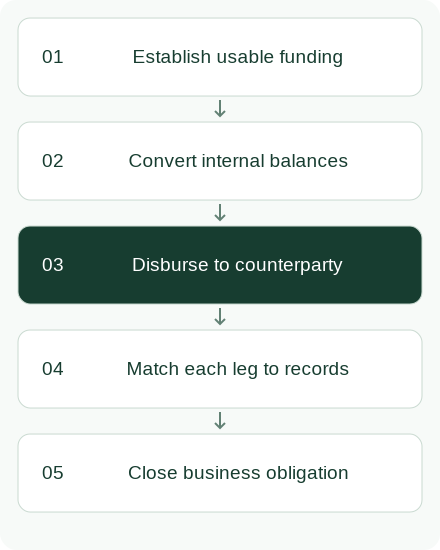
For a USD-to-stablecoin route, the conceptual sequence is funded USD account, conversion between internal accounts and external stablecoin transfer. In the reverse direction, the off-ramp guide describes receiving stablecoins, converting and originating a fiat payment. The business operation groups these legs, but each leg can progress independently.
Our platform should create one internal supplier-payment reference, such as SP-801, and associate the relevant provider identifiers with it. SP-801 is an illustrative application identifier, not a required Modern Treasury field. Its purpose is to let support answer “what happened to this purchase?” without treating every movement as a separate purchase.
Accounts and counterparties define where funds belong
An internal account represents the funded side of an operation; a counterparty and its external account identify the other party and destination. The on-ramp guide connects verified legal entities, account activation, counterparties and payment orders. Its illustrated setup uses different legal-entity references for customer USD accounts and organization stablecoin accounts, so an integration must inspect actual account ownership instead of assuming every balance is a customer-owned wallet.
That is consequential for the supplier example. A display labeled “customer balance” may be the application’s obligation to its customer, while the underlying stablecoin account has a different legal/operational holder. Keep the business liability record and the provider account record consistent, without merging their identities.
Before converting, check that the account is active and the intended amount is available. Before disbursing, confirm the counterparty wallet and network match the stablecoin account’s supported route. A correctly entered address does not resolve an unsupported network combination.
Track execution and reconciliation separately
The Payment Order reference has separate fields for lifecycle and reconciliation status. It explicitly says completion does not imply reconciliation. Therefore a green “completed” badge on the conversion cannot be used as the final answer to the supplier.
Consider this teaching worksheet; its labels are business explanations rather than an API response:
| Leg for SP-801 | Question about execution | Question about reconciliation |
|---|---|---|
| USD funding | Is the intended funding usable? | Which incoming record explains the balance? |
| Conversion | Did the conversion finish? | Are source debit and destination credit accounted for? |
| Stablecoin disbursement | Did the intended transfer reach its required result? | Which provider/network record matches the supplier payment? |
Suppose conversion succeeds and disbursement is rejected before transfer. The money may now be in the stablecoin account, while the supplier remains unpaid. Starting the whole process again could convert another amount unnecessarily. The recovery decision should start from the last established balance and outcome, then address the failed leg.
Conversely, if the transfer was sent but the response was lost, creating another disbursement risks paying twice. Recover the existing order and its associated records first. These are two different recovery states despite both appearing as an error to the original button click.
Do not count internal movements as new revenue
For bookkeeping, the incoming funding, conversion and payout are movements serving one obligation. Counting each credit as revenue would overstate business activity. A reconciliation model should preserve currency units and fees so that an apparent difference is explainable rather than hidden by a forced equality.
For example, the obligation is 800 USDC, but the USD amount needed to acquire and send it depends on pricing and costs. Do not write 800 USD into every row merely because both assets use a dollar reference. A quote, fee record or agreed funding rule should explain the source amount. If fees are billed separately, the supplier payment can be reconciled while an associated expense still needs its own record.
The same care applies to integer amounts. The API reference describes currency-specific smallest units. A field representing USD cents cannot be copied unchanged into a stablecoin amount field with different precision. Conversion between display values and API units should be tested explicitly with small and fractional amounts.
What should the first test demonstrate?
A useful test harness should recover SP-801 after a simulated interruption between conversion and disbursement. It should display that the supplier remains unpaid, locate the converted funds and avoid a second conversion. Another exercise should replay the same completion notification and verify that the application does not post another expense or initiate another transfer.
These are proposed exercises, not observed results from Modern Treasury’s sandbox. Also test onboarding rejection, account activation delays, wrong-network destinations and a payment that later receives a return event. A business operation should retain its history when a downstream outcome changes.
Modern Treasury’s payments overview distinguishes product arrangements such as its payment-service offering and orchestration connected to existing financial relationships. Confirm the arrangement, supported assets, eligibility and commercial fees before treating a documentation recipe as available in your account.
Use the Modern Treasury profile for current source pointers. Request Finance addresses the invoice and accounts-payable workflow; this article addresses the multiple execution records underneath a payment. The integration is understandable when support can point to every leg, explain where funds currently are and identify the single next action that remains necessary.
FOLLOW THE SOURCES