AGENTWALLETS · INDEPENDENT PERSPECTIVES
MoonPay Commerce: Pay Links, Charges and Order Delivery
Use a digital-report purchase to distinguish MoonPay Commerce Pay Links, Charges, payment evidence and fulfillment, including QR underpayment and overpayment.
 Project reference · MoonPay Commerce ↗
Quick answer
MoonPay Commerce provides merchant crypto checkout. Pay Links can be reused; Charges create single-use checkout sessions for individual purchases. Merchants still need to match payment evidence to an order before delivery.
A reusable link is not a customer order
Imagine selling a digital industry report. A person opens the payment link from your website, while a purchasing assistant might reach the same product from a recommendation. Both want one copy, but you still need to know which customer paid, which edition they bought and whether download access was delivered.
MoonPay Commerce provides merchant crypto checkout. Its introduction lists payment links, checkout components and developer integrations. This article focuses on the relationship between one order and its payment, using a hypothetical report purchase. It does not describe a completed checkout test.
Place Commerce in the MoonPay product family
Commerce is the merchant-facing payment surface. MoonAgents concerns agent-side wallet tooling, while Enterprise addresses a different range of financial infrastructure. A merchant using Commerce does not thereby receive an autonomous purchasing agent, and an agent wallet does not automatically supply order management.
The current documentation index identifies Commerce as formerly Helio. Some integration names still use Helio. Treat those names as part of one product’s documentation history, not evidence of two independent providers. For a broader comparison, see the MoonPay Enterprise explanation.
Pay Link and Charge have different identities
The Charges guide distinguishes reusable Pay Links from single-use Charges generated for an individual checkout. A successful Charge cannot simply be reused for the next purchase. The guide also explains attaching order-specific information.
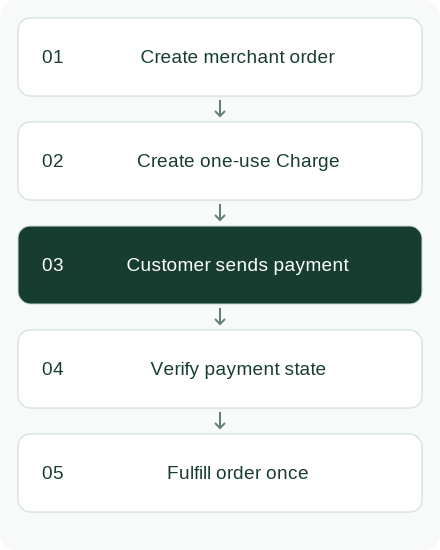
For our report seller, the reusable link describes the payment entry point. The application’s order identifies the buyer, report edition and commercial terms. The Charge identifies a particular checkout attempt. Keeping those identifiers separate prevents a common mistake: treating everyone who opened the same link as the same purchase.
| Record | The question it should answer |
|---|---|
| Product/payment link | What is being offered through this entry point? |
| Merchant order | What did this customer agree to buy? |
| Checkout Charge | Which payment attempt belongs to that order? |
| Payment evidence | What amount and asset arrived through the selected route? |
| Fulfillment record | Did the customer receive the correct report access? |
This is an application design model, not a claim that Commerce creates every record for you.
Build the purchase around an immutable order
Suppose the report price is a hypothetical 15 USDC on a selected supported chain, before any applicable charges. The server should establish the product edition, amount, currency and order reference before issuing checkout details. The customer should be able to see the exact asset and network being requested.
If the merchant changes the report price tomorrow, today’s order still needs a clear agreement. Decide whether an unpaid checkout remains valid or must expire under your terms. A new price should not silently turn an old customer approval into permission to pay more.
When payment evidence becomes available, associate it with the original order and validate the required amount and destination. Only then should the application grant the report access specified by that order. The developer guide provides integration entry points; this explanation deliberately does not invent an untested SDK call or callback schema.
QR payments make amount errors visible
The Charges guide describes a deposit-style QR flow: an underpayment requires the remaining amount, while an overpayment forwards the deposited amount to the merchant. These are materially different customer-support situations.
If the buyer sends 14 instead of the hypothetical 15 USDC, the report application should not grant access merely because it sees a transfer. It also should not forget the partial payment and tell the buyer to send the entire amount again. The payment record needs to preserve what has already been received and what remains outstanding.
If the buyer sends 16, the merchant needs a policy for the extra unit. Do not invent automatic refund behavior from the existence of a payment product. Confirm supported handling, identify the authorized recipient of any refund and keep the refund separate from the original sale. Amount examples exclude network and provider charges and are not current commercial terms.
A closed browser does not prove failure
Imagine the buyer pays and closes the page before seeing the download button. Opening another checkout immediately could create confusion or another payment attempt. The application should first look up the existing order and its payment evidence, then restore access if the purchase was already completed.
Likewise, delivering the same payment notification twice should not produce two separate entitlements or refund actions. Design processing around the underlying transaction and order, not the number of browser redirects or notifications. A request to refresh a page is not a new purchase authorization.
For the conceptual separation, read authorization and settlement and stablecoin refunds. These responsibilities remain relevant even if the buyer is an agent instead of a person.
What to verify before choosing the checkout
Start with the merchant’s actual customer flow: required assets and networks, eligible merchant entity, settlement destination, total fees, and refund handling. Public documentation does not establish that every checkout option is enabled for every merchant. A payment link is also not evidence of compliance with every agent-commerce protocol.
A useful rehearsal includes one successful purchase, one incomplete QR deposit, one overpayment and one paid order whose download fails. Ask support staff to identify the exact evidence needed to resolve each case without requesting a second payment. This tests the design’s completeness; a later sandbox or funded trial must be described separately.
See the Commerce reference and compare the merchant flow with Coinflow. Sources reviewed November 6, 2026. No merchant account, checkout or transaction was tested.
FOLLOW THE SOURCES