AGENTWALLETS · INDEPENDENT PERSPECTIVES
Lightspark Grid: Funding, Quotes and Cross-Border Payouts
Follow a business supplier payout through Lightspark Grid customer verification, internal funding, external accounts, quote acceptance and exception handling.
Quick answer
Lightspark Grid exposes payment primitives across fiat, stablecoins and Bitcoin. A payout combines an eligible customer, funded source, valid destination and accepted quote; an API response alone does not prove recipient receipt.
The supplier’s account is outside your ledger
Imagine an accounts-payable application preparing a payment to a supplier abroad. The customer’s balance is held in the application’s payment arrangement, while the supplier expects funds in an external bank account. The application needs to connect those two worlds without confusing a balance debit with proof of receipt.
Lightspark Grid provides payment infrastructure across fiat and digital assets. Its overview describes primitives that applications combine into financial products. This article follows a hypothetical supplier payout. It is not a claim that we executed the documented quickstart or verified a particular commercial corridor.
Keep the platform, customer and recipient separate
The payout quickstart illustrates a platform serving a customer with an internal funding account and an external recipient account. It also distinguishes completing a hosted know-your-customer (KYC) verification interaction from receiving the actual verification decision.
For the accounts-payable application, this means that returning to a success URL after onboarding is not sufficient evidence to enable transfers. The application must use the provider’s decision for the relevant customer and flow. Otherwise, the user interface can appear ready while the payment API correctly rejects the operation.
The supplier is another important record. Saving bank details creates a destination to evaluate, not proof that an invoice or a specific payment is approved. The business should maintain the connection between the supplier record and its approved destination independently of the assistant’s conversation.
Funding and quoting answer different questions
An internal balance tells the platform what funds are available under the selected arrangement. A quote describes the proposed conversion and transfer terms. One does not replace the other: a funded customer can still lack an acceptable quote, while a valid quote does not ensure the customer has supplied the required money.
Suppose the customer authorizes a hypothetical maximum debit of 500 US dollars (USD). Product and finance must decide whether that cap includes all charges and whether the supplier expects a fixed local-currency receipt. Those requirements can conflict if fees or exchange terms change. The interface should expose the conflict before the customer accepts, not repair it by quietly paying less.
In a design handoff, record source currency and amount, destination currency and amount, known fees, quote validity and the business approval reference. Use the API’s documented units rather than assuming every asset represents amounts like a two-decimal currency.
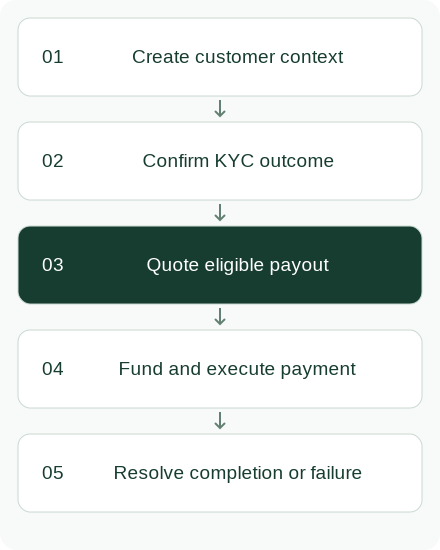
Walk the instruction through its checkpoints
| Checkpoint | What the application verifies |
|---|---|
| Customer readiness | Required verification and enabled capabilities |
| Source funding | The chosen account can fund the intended operation |
| Recipient setup | Required details match the approved supplier |
| Quote acceptance | Amounts, fees and validity match the authorization |
| Execution tracking | The resulting payment is tied to its original request |
| Receipt reconciliation | The reported destination outcome satisfies the invoice |
These are explanatory checkpoints, not literal Grid status values. They give an assistant a disciplined way to report progress: it can describe the evidence at each point instead of converting every successful API call into “paid.”
After submitting a payment, retain the original quote and transaction references. If the customer later asks what happened, those records are the starting point. Reconstructing the request from chat text may lose the exact destination or commercial terms originally accepted.
Expired, conflicted and uncertain are different outcomes
The error-handling documentation distinguishes expired quotes, insufficient balances, conflicts and other failures. These categories need different application responses. Requesting a new quote can resolve expiry, but it does not grant approval for changed economics.
A conflict may require inspecting an already existing operation rather than submitting another. A connection failure leaves uncertainty about what the remote system did. The appropriate action is to reconcile the original request using the documented mechanisms, then choose a supported recovery path. Do not infer that all errors are safe to retry with new identifiers.
For the 500-USD example, imagine the original quote expires and the replacement would debit more. A correct user experience requests a decision or finds an authorized alternative. It should not claim the old budget still covers the new payment simply because the supplier name is unchanged.
Settlement needs a corridor-specific definition
The Grid transaction terms qualify services by enabled capabilities, jurisdiction and payment route. They also define settlement in relation to the applicable partner arrangement. That is a reason to document what a reported completion actually means for the selected corridor.
If the business obligation is that the supplier receives a particular amount, confirm which evidence demonstrates that outcome. A transaction record, partner handoff and beneficiary bank credit may not be identical events. The application should show the strongest supported statement without promising a universal instant bank receipt.
Refunds or reversals require similar care. Determine who initiates the process, which references link it to the original payment and how fees or exchange differences are handled. This review does not establish those commercial terms for an individual customer.
Grid is not another name for Lightning or L402
Grid is a provider platform. Lightning is associated with a different network layer, and L402 concerns payment-gated access to resources. A shared company or Bitcoin-related context does not make their integrations interchangeable.
Choose the comparison that matches your task. For supplier payouts, compare source accounts, recipient routes, operational responsibilities and exception handling with Conduit or Borderless. For paid API calls, start from the protocol comparison instead.
Before launch, rehearse incomplete verification, expired pricing, an ambiguous response and a recipient reporting no funds. Review eligibility, supported corridors, total costs and support ownership, then run a separately recorded sandbox test. Lightspark Grid reference. Sources reviewed November 6, 2026; no account, API or payment was tested.
FOLLOW THE SOURCES