AGENTWALLETS · INDEPENDENT PERSPECTIVES
Payman AI and Genie: Banking Agents and Payment Approval
Distinguish Payman’s institutional banking offering from Genie, then follow an invoice request through identity, beneficiary checks, approval and execution evidence.
Quick answer
Payman’s current institutional offering concerns governed banking agents; Genie is a separate connected financial assistant. In both cases, interpreting a request must be distinguished from authority to move money through the enabled provider.
“Pay the invoice” leaves important questions unanswered
Imagine a small business owner telling a banking assistant to pay a maintenance invoice. The assistant can identify an amount and a supplier name from the document. That is useful extraction work, but it does not establish that the supplier’s bank details are approved, that the owner can authorize this account or that the payment has actually executed.
Payman AI is relevant to this boundary between conversation and financial action. Its current institutional site focuses on banking agents for financial institutions, with policy and audit controls. This article uses a hypothetical invoice to explain that layer. We have not accessed a bank integration, tested Genie or verified the provider’s security claims.
Separate the institutional product from Genie
The institutional offering is presented as software deployed for banks and credit unions. Genie is a separate application connecting a user’s financial services and assistants. Its product page describes bank, card, crypto and machine-payment connections under user-defined rules.
These are different integration decisions. A bank evaluating its own customer experience needs institutional deployment and operating responsibilities. A person connecting an assistant needs to understand the particular accounts, permissions and provider connections being authorized. Neither case should be described merely as an unrestricted “AI payment API.”
The directory groups the offerings under Payman while making the distinction explicit. Treat capabilities shown in a consumer application as evidence about that application, not automatic proof that the same feature is available in every institutional deployment.
Is Payman safe for a bank to use?
That question cannot be answered from product pages. Safety depends on the deployment: which accounts the agent can reach, who approves a payment that falls outside policy, how beneficiary changes are verified, and what evidence the bank retains after execution. Payman describes policy and audit controls for its banking agents and publishes illustrative safety scenarios. We have not reviewed a deployment, tested Genie or independently verified security claims, so treat the product description as the start of due diligence rather than an assessment of a particular bank’s control environment.
Turn the invoice into a proposal first
For the maintenance invoice, a well-defined proposal identifies the source account, supplier record, amount, currency, due date and purpose. The assistant can prepare that proposal, but the application should resolve account and beneficiary identifiers from trusted records.
Suppose the document contains a new bank account and a sentence saying the supplier has changed payment details. The assistant may extract this as a requested change. It should not treat the sentence itself as evidence that the change is authorized. The authority to update a beneficiary is different from permission to pay an existing one.
This distinction prevents convenience features from silently becoming account-maintenance privileges. A user who approves an invoice amount may not have reviewed a changed bank destination hidden in the document. The approval screen must show the economically meaningful details, not only a friendly summary.
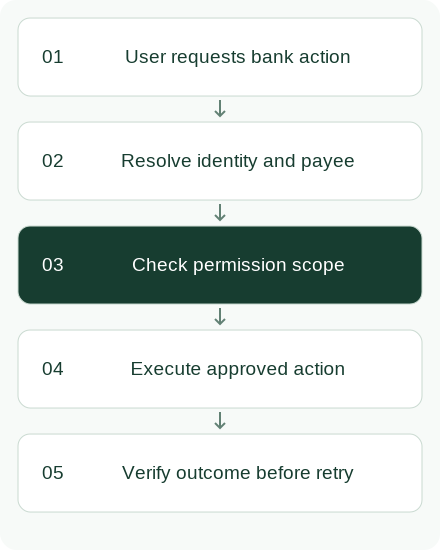
Identity, policy and execution form separate checks
Payman’s banking safety material uses illustrative attack scenarios to explain risks from untrusted documents, ambiguous rules and approval confusion. These are vendor-authored examples, not reported incidents or independent tests. Their useful lesson is to evaluate the boundary outside the model’s conversational reasoning.
| Stage | Evidence needed in the invoice example |
|---|---|
| Request | What the user asked the assistant to prepare |
| Identity | Which authenticated person is acting for which account |
| Beneficiary check | Which approved supplier destination will receive funds |
| Approval | What amount, currency and destination were authorized |
| Execution | What the financial provider reports about the resulting payment |
The table is an editorial acceptance model. It does not claim the public website exposes these exact APIs or records.
An approval should stay attached to its payment
Use a hypothetical maintenance bill of US$300. If the supplier, account or amount changes after the user approves it, the system needs to decide whether the original approval still applies. That question should be answered by the defined policy and integration, not by the assistant’s impression that the change is probably harmless.
For a recurring task, distinguish “remind me each month” from “execute this permitted payment each month.” Scheduling a conversation does not itself create a durable financial mandate. The product should show the conditions, expiry and cancellation path for any continuing authority it actually supports.
A useful review asks the team to point to the exact evidence linking the payment request to the approval. If the only evidence is a sentence saying “the user agreed earlier,” the design has not established which version of the request was approved.
An uncertain result needs provider evidence
Now imagine the assistant sends the approved request but loses its connection before receiving the outcome. Rephrasing “pay it again” does not resolve whether the first instruction already moved money. The application needs the original reference and a way to reconcile against the provider’s record.
Genie’s page describes checking uncertain outcomes before retries. That is a provider statement, not behavior measured in this review. An evaluator should reproduce the uncertainty case in an approved test environment, examining whether the assistant distinguishes submitted, pending, completed and rejected operations without inventing a receipt.
The same caution applies when access is revoked. Disabling a connection can stop future requests, but the handling of already accepted instructions must be confirmed. A stop control should explain its actual scope to the user.
Evaluate the product with a concrete handoff
For an institutional evaluation, define a single task and ask for a responsibility map: account provider, identity authority, policy administrator, payment executor and support owner. For Genie, document which provider connection is being granted and which actions the selected account permits. Review commercial terms, geographic eligibility and provider charges separately; the reviewed pages do not establish a universal tariff or availability.
Then rehearse an altered beneficiary, an expired approval, a disconnected response and a revoked connection with outstanding work. This is a proposed evaluation, not a completed test. Compare the distinction between a token and a completed purchase in Link Agent Wallet and the broader authorization guide.
For background on malicious documents, read prompt injection and payments. The Payman reference links the separate offerings. Sources reviewed November 6, 2026; all outcomes here are hypothetical or attributed provider descriptions.
November 12, 2026 review: added the bank-safety question and the limits of product-page evidence. No deployment, bank integration or payment was tested.
FOLLOW THE SOURCES