AGENTWALLETS · INDEPENDENT PERSPECTIVES
NOAH Automated Payouts: Freezes, Refunds and Reversals
Follow a NOAH automated payout through compliance review and a later bank return, linking the original deposit, reversal credit and on-chain refund records.
Quick answer
NOAH distinguishes a compliance refund from a bank reversal after settlement. In the documented bank-return flow, the original payout remains recorded and separate transactions represent the internal credit and crypto return. Applications must correlate those records before telling the user that funds reached their wallet.
Suppose a customer sends 1,000 USDC to fund a local-currency payout. The application later reports success. Several days afterward, the receiving bank returns the payment. If the app has permanently closed the record at “settled,” support cannot explain where the money is or whether it has returned to the customer’s wallet.
NOAH’s automated-payout product documentation describes deposit-triggered conversion and payout routes. The interesting implementation question is what happens when that intended route is interrupted or reversed. Our 1,000-USDC example is hypothetical, excludes a promised fiat amount and assumes an eligible customer, supported asset/network and enabled payout corridor. No funds were moved for this article.
Start by distinguishing a pause from a return
A compliance review can pause progress before the intended conversion and payout finish. That does not mean the bank already received the money, or that a refund already exists. The interface should represent the review and any requested information without automatically submitting another payment.
NOAH’s transaction-event reference separates the main transaction status from optional review details and request-for-information data. A pending state alone is not enough to infer the exact cause. Read the applicable details rather than replacing every delay with “payment failed.”
For the customer, the meaningful message is operational: what is awaiting review, who must provide information and where updates will appear. For the engineering team, keep the original deposit and payout identifiers available. A support conversation should not require reconstructing the transfer from a customer’s screenshot.
A refund before settlement is not a bank reversal
The freeze, refund and reversal guide distinguishes compliance-triggered refunds from later banking returns. Refund destinations depend on the funding path: a prefunded-balance payout and a customer-deposit payout do not necessarily return funds to the same kind of location.
For this example, the customer supplied crypto from a sending wallet. The application must follow the return records for that route rather than merely watch its own business balance. If the app instead uses a prefunded dashboard balance, apply that route’s documented destination and accounting. “Refund sent” is incomplete without stating where it was sent.
The same guide distinguishes payin refund statuses from payout transaction/refund statuses. Avoid building one shared enum from a mixture of both. In a support UI, you can use consistent human language, but the underlying mapping must preserve which resource and flow supplied the evidence.
A settled payout can acquire new linked records
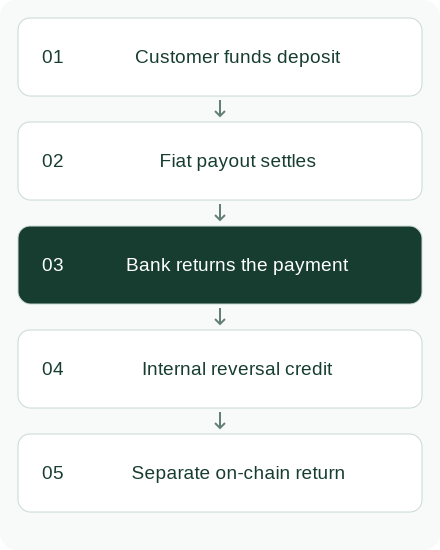
Now return to the later bank-return scenario. The original payout remains part of the history. NOAH documents a separate internal reversal linked through Reverses, followed by an on-chain return using AdjustmentFor. An OffNetwork credit is an internal record, not evidence of a blockchain transfer to the customer.
Here is a teaching ledger using invented identifiers. It is not a live webhook payload:
| Record | Role in this case | Correlation to retain |
|---|---|---|
| D-1 | Original customer crypto deposit | Original funding record |
| P-1 | Original local-currency payout | The customer’s payment obligation |
| R-1 | Internal reversal credit | Reverses points to P-1 |
| C-1 | On-chain crypto return | AdjustmentFor.AdjustedTransactionID points to D-1 |
The important distinction is that the two return records do not point to the same original leg. If a database has room for only “refund of P-1,” it can lose the association to D-1. Where provided, the shared orchestration execution identifier also helps group the related legs; it should supplement, not erase, their individual identities.
Tell the user what has actually returned
When R-1 arrives, the app has evidence of an internal reversal. It should not yet display a blockchain receipt for C-1 if that transfer has not been observed. When C-1 arrives, retain its network reference and match the return to the original sending wallet and deposit.
For accounting, do not delete P-1 and pretend the payment never occurred. Preserve the original event and add the corrective records. That lets support explain why the supplier once appeared paid, why the bank subsequently returned funds and why the wallet return happened at another time.
The final crypto amount may differ from the original 1,000 units because the documented process can involve return fees, conversion at the later rate and network costs. Do not force the numbers to equal each other or advertise a fixed refund amount before the actual records exist. A useful customer breakdown explains the original deposit, returned fiat value where available, applicable adjustments and final crypto return.
Event replay is different from starting another transaction
A webhook can be delivered again, and the same business payment can have several legitimate transactions. The app needs both deduplication of repeated processing and retention of new related records. Deduplicating everything by the business invoice alone would wrongly discard R-1 or C-1; treating each repeated event as new money would over-credit the customer.
NOAH’s idempotence documentation distinguishes a transactional Nonce from a reusable business ExternalID. When retrying the same uncertain transaction, preserve its nonce and recover the existing result. A genuinely new transaction needs its own identity. Neither field is a reason to create an extra payout when an automated return event arrives.
For this case, use the event to update the existing operation and its linked records. If a bank has returned the supplier payment, a later decision to pay that supplier again is a new business decision, with updated beneficiary details and authorization. It should not be an automatic side effect of receiving a refund.
Four acceptance exercises for this flow
In a supported test setup, simulate review without a refund and confirm the UI does not claim funds were returned. Replay R-1 and ensure it does not credit twice. Deliver C-1 after R-1 and verify that the app finds D-1 as well as P-1. Finally, omit the on-chain return record temporarily and check that the app reports the internal credit without inventing wallet receipt.
These are proposed tests, not completed NOAH sandbox results. Confirm your contracted customer model, corridor, supported source wallets, limits, fees and escalation procedure. Automated processing does not guarantee every customer or destination is eligible, and a product overview’s speed claims do not establish the time for a reviewed or returned payment.
The NOAH profile links the source trail. SpherePay’s article explains basic customer, instrument and transfer objects. This article’s extra requirement is a return-aware history: every correction remains connected to the funding and payout it adjusts, and the customer sees only outcomes supported by actual records.
FOLLOW THE SOURCES