AGENTWALLETS · INDEPENDENT PERSPECTIVES
SpherePay: Customer Instruments and Transfer States
Follow a customer’s stablecoin-to-bank transfer through SpherePay verification, instruments, deposit instructions, delivery and returned-payment handling.
Quick answer
SpherePay connects verified customers, their bank or wallet instruments and transfer records. Funding a transfer and delivering money to its destination are separate events that the application must reconcile.
The bank payout has more than one owner
Imagine a contractor with a stablecoin balance who wants the proceeds paid into a bank account. A platform’s assistant can collect the instruction, but the instruction must identify whose money is moving, whose bank account will receive it and which payment route is actually available. “Convert my balance” leaves all three questions open.
SpherePay is an API-based platform for moving between fiat and stablecoins. Its introduction organizes integration around customers, registered instruments and transfers. This article uses a hypothetical cash-out request to explain that model, rather than repeating a general stablecoin introduction. No account or transfer was tested.
Customer, instrument and transfer are different objects
The customer record establishes the individual or business behind the request. An instrument identifies a bank account or crypto wallet associated with that customer. A transfer connects a source to a destination for one intended movement.
This separation matters when the platform has many users. A valid bank account identifier must not be borrowed from another customer simply because its currency matches. Similarly, creating a wallet record does not prove that the customer has completed every verification required to use a specific route.
Before letting an assistant prepare payment instructions, the application should resolve the customer and allowed instruments from its own records. Text in a conversation is a request to select or change those records, not proof that the selection is permitted.
Confirm the corridor before requesting money
SpherePay’s supported-rails reference describes specific source and destination combinations, with additional conditions for some local rails. A list containing both a stablecoin and a fiat currency does not imply every network combination works in both directions.
For the contractor, determine whether the transfer is to their own account or another legal entity. The third-party-flow guidance treats movement involving downstream customers or other entities as a distinct integration concern. That choice affects onboarding and the design of the funds flow; it should not be guessed after funds arrive.
Use a corridor worksheet: customer type, country, source asset and chain, destination currency and rail, beneficiary relationship, and verification requirements. Leave unsupported or unconfirmed combinations blocked in the product rather than hiding them behind a generic “global transfer” button.
Follow one hypothetical cash-out
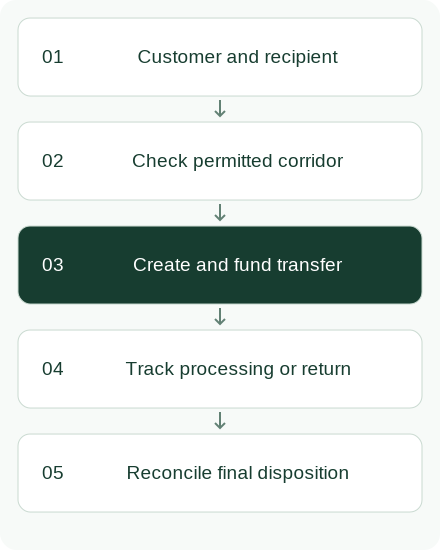
Suppose the customer proposes converting 500 USDC from a selected supported network into their verified bank account. This amount is illustrative, not a current quote or a promise of 500 dollars received. The interface should show the source amount, destination currency, conversion terms and any charges it has actually obtained.
The application creates the transfer through the enabled flow and presents its funding instructions. The lifecycle guide explains that off-ramp deposit instructions identify the address, network, currency and amount. These are a set: copying the address while dropping the chain context can produce an unusable instruction.
After the customer sends funds, retain both the platform’s transfer identifier and the relevant funding evidence. The assistant can explain progress, but it should not declare bank receipt merely because it sees a blockchain confirmation.
| Evidence | Safe interpretation |
|---|---|
| Transfer record exists | A movement has been requested |
| Funding instructions shown | The customer knows where and how to fund it |
| Provider received funds | Processing can advance; bank delivery is not proved |
| Destination delivery confirmed | The original payout has reached the reported outcome |
| Return or refund record | An exception has its own recovery process |
A returned payout is not an instant refund
The lifecycle reference distinguishes waiting for funds, processing, success and return-related outcomes. Its descriptions make a crucial operational distinction: a bank return can initiate refund handling, and further information may be needed. An application must not turn that into an immediate promise that the customer already has their money back.
If the contractor asks the assistant to try a different account after a return, first resolve the original payment and the status of its funds. A new beneficiary record is not permission to duplicate an outstanding payout. Keep the failed delivery and any replacement payment connected in the audit history.
The reference also uses terminal-status language alongside refund descriptions. Confirm with the provider how refund progress is represented for the selected integration instead of assuming a failed transfer object must later mutate into a refunded state. That is a concrete integration question, not a reason to invent a lifecycle.
Design the operations screen before automation
Give support staff a view that answers five questions: who owns the transfer, what route was selected, whether funding arrived, what destination outcome was reported, and which action is currently required. Store the business order reference beside the provider reference so the conversation can be reconstructed without exposing identity documents in an agent prompt.
For an unfunded request, the next step may be to remind the customer or cancel under the documented rules. For funds already received, the next step is usually investigation of the original record, not asking the customer to send the same amount again. For incomplete refund information, route the required collection through an approved interface.
Decide whether the model matches your business
SpherePay is worth evaluating when customer-linked bank and stablecoin movements are the problem. It is not a substitute for an agent’s purchase authorization or a merchant’s delivery system. Review eligibility, exact routes, quote behavior, all-in costs and the ownership of exception handling before implementation.
A desk rehearsal should include a mismatched customer instrument, an unavailable rail, a funded transfer with no bank receipt and a bank return requiring more information. Proceed to sandbox testing only with explicit expected outcomes. Compare the funds path with Bridge and Borderless, and read payment idempotency before designing retries.
SpherePay reference. Official sources reviewed November 6, 2026; no payment or onboarding test was performed.
FOLLOW THE SOURCES