AGENTWALLETS · INDEPENDENT PERSPECTIVES
Ripple Payments: Wallet Funding vs Invoiced Payments
Compare Ripple Payments ODL wallet funding with invoiced funding using one supplier obligation, while separating payment service, RLUSD asset and network.
Quick answer
Ripple Payments ODL documentation distinguishes prefunding a supported stablecoin wallet from making payments under approved invoicing and credit terms. These models change when the business supplies funds, not whether the beneficiary has received the payment. Product version, supported asset, credit eligibility and billing terms must be confirmed separately.
Suppose a business owes a supplier $5,000 and wants its payment system to schedule the transfer. Before discussing how quickly money moves, finance needs to know when its own funds must be available. Does the business deposit stablecoins first, or does it pay an invoice after the payment is processed?
Ripple documents both approaches within Payments ODL. This article stays within that funding documentation; it does not combine its fields with Payments Direct API examples. The supplier obligation is hypothetical, no payment was tested, and $5,000 is not a quote for the stablecoin amount, exchange rate or fees required for a particular corridor.
First separate the service, asset and network
Ripple Payments is the payment-service context. RLUSD is a stablecoin product, documented separately in Ripple’s RLUSD overview. A blockchain network is the infrastructure where a supported asset transfer may occur. These names answer different questions: who provides the route, what value is transferred and where a particular transfer is recorded.
That distinction prevents a common inference: a company offering its own stablecoin does not mean every payment route necessarily requires that token. The funding guide tells customers to verify their supported stablecoin and chain. We do not assume RLUSD, XRP or a specific blockchain for this example.
The funding-method comparison also limits its guidance to the customer’s contracted arrangement. Treat the agreement and onboarding decision as inputs to product design, rather than choosing a funding option solely because it appears in a public table.
Wallet funding moves the cash decision earlier
With wallet funding, the business supplies supported stablecoins before making payments. The wallet-funding instructions say to confirm the asset and chain with the Ripple liaison and obtain the appropriate wallet address. They also direct balance-refund requests through that contact.
For the $5,000 supplier obligation, finance therefore needs a funding plan before the transfer is scheduled. The required stablecoin amount depends on the actual route and commercial terms. “We have $5,000 in a bank account” is not evidence that the supported wallet is funded and cleared for use.
The application should distinguish a planned deposit, a deposit observed on-chain and funds recognized as usable in the payment arrangement. If the deposit is still being checked, repeatedly creating supplier payments does not resolve that funding state. Assign an operator who can trace the funding reference without changing the supplier obligation.
Invoicing moves the funding obligation later, within limits
Under approved invoicing, payments can be processed within the customer’s underwritten credit capacity and billing terms. The T+1 invoicing guide describes credit prerequisites, repayment expectations and multiple invoice schedules. Do not interpret the product label as a universal 24-hour grace period for every customer and holiday.
For our example, the business might process its supplier payment and later receive the applicable invoice. That invoice is a new obligation to the service provider, not a second supplier purchase. Accounting should link the invoice line to the original payment reference so paying it does not create a duplicate expense in operational reporting.
Available credit is also a constraint, not another wallet balance. A bank account may have ample cash while the service’s current credit capacity is insufficient for the requested payment. The appropriate response is to reconcile capacity and outstanding invoices, not keep retrying the same request as though a network error occurred.
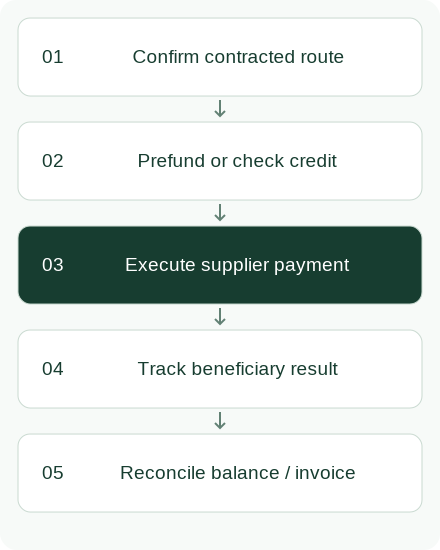
Two timelines for one business obligation
| Checkpoint | Wallet funding | Approved invoicing |
|---|---|---|
| Before execution | Confirm supported prefunding is usable | Confirm eligibility and available credit |
| Supplier payment | Track its own execution outcome | Track its own execution outcome |
| Provider billing | Reconcile the applicable separate fee billing | Reconcile payment amounts and included charges under the invoice terms |
| Unused capacity | Inspect the actual funded balance | Inspect the credit arrangement, not a token balance |
The public comparison describes separate fee invoicing for wallet funding and invoice-included fees for the other method, with jurisdictional qualifications. Obtain the actual schedule before calculating operating cost. Prefunding may tie up working capital; invoicing creates a repayment obligation. Which fits the business depends on treasury constraints and contract eligibility, not an assumption that one is universally cheaper.
A useful internal worksheet for the $5,000 obligation has separate columns for supplier amount, funding transaction, provider payment reference, conversion amount, fees and provider invoice. Those are business bookkeeping columns, not claimed Ripple API field names. They make it possible to explain why a token transfer, supplier payment and later invoice payment can all concern the same underlying purchase.
Funding success does not close the supplier invoice
Imagine the wallet deposit is accepted but the beneficiary details fail validation. The business has supplied funds, yet the supplier remains unpaid. Closing the supplier invoice at the deposit stage would hide the outstanding obligation. Conversely, a supplier payment can be processed while the invoiced customer still owes Ripple repayment.
Build an acceptance exercise for both situations. In the first, verify that the application keeps the supplier obligation open and can trace the funded balance. In the second, verify that it tracks the separate provider invoice without sending the supplier another payment. A third useful case is an unknown response during payment submission: retrieve the original operation before creating a replacement.
These are proposed tests, not observed Ripple behavior from a production account. Also confirm how the selected product reports beneficiary status, returned payments and balance refunds. Do not import status names from another Ripple product merely because both documentation sites use the word “Payments.”
The Ripple Payments profile records the source scope and related asset boundary. Circle Payments Network covers a different provider/network context. For this integration, the first deliverable should be a funding-and-billing timeline that finance can reconcile, with the exact contracted route, asset, chain, fees and repayment terms written beside it.
FOLLOW THE SOURCES