AGENTWALLETS · INDEPENDENT PERSPECTIVES
Sponge Wallet and Gateway: API Payments and Card Checkout
Compare Sponge Wallet and Gateway through a paid data request: API route pricing, session billing, card checkout and matching payment to service delivery.
Quick answer
Sponge Wallet gives agents payment tools; Gateway lets API providers price access through x402 or MPP. Buyers must authorize spending, while sellers choose exposed routes and billing units. Payment evidence still needs to be matched with the upstream service result.
Suppose a research agent needs paid data from an API and a software subscription from a conventional website. Both require money, but the API may return a payment requirement while the website needs a card credential its checkout accepts. Sponge Wallet is positioned as a wallet and toolset for agents; Sponge Gateway is for providers that want to add charges to APIs. The payer and service provider have different responsibilities even if both use the same ecosystem.
This is a teaching example: no asset, network, rate or geography is assumed. We did not create a wallet, obtain a card or make a payment. The wallet documentation describes stablecoins, virtual cards, bank transfers and x402/MPP calls; eligibility and configuration need confirmation for the actual account.
Two payment paths
| Step | Paid data API | Software subscription |
|---|---|---|
| Find the requirement | Service publishes or returns payment terms | Merchant checkout presents an order and amount |
| Prepare | Check protocol, asset, network and price | Check card eligibility, merchant and renewal terms |
| Authorize | Apply the task budget and policy | Use credentials under the card program and user consent |
| Verify | Match payment to data delivery or error | Check authorization, order and later charges |
This is a conceptual division, not a tested configuration. x402 and MPP define payment interactions rather than wallet balances. A card is another kind of credential and does not mean a merchant receives stablecoins directly. A wallet can help initiate payment; it cannot guarantee data quality or delivery.
Price the API route, then restrict what it exposes
The Gateway guide distinguishes fixed-price endpoints, request-dependent pricing and session billing. For a data business, these sell different units: one report, a number of pages, or time inside a running service. Choose the unit before promising a task budget. A successful payment for one report does not authorize unlimited use of a session.
The guide also says imported routes that manage accounts, keys, billing or settings start disabled. That matters when an OpenAPI file contains both public data and administrative operations. Importing the file is a configuration step, not a decision that every route should be sold. Review which method and path are exposed, the upstream authentication used, and the data each response can reveal.
In the research example, keep the paid report route separate from the endpoint that changes a customer’s API key. A caller’s ability to meet a price is not proof that it should administer an account. These are application review questions; we have not checked a deployed Gateway configuration.
What Gateway changes for the provider
Suppose the data business already operates an API and wants to charge for requests. The Gateway documentation describes putting an upstream API behind paid x402 and MPP endpoints. The provider still decides what is sold, the billing unit, access terms and operation of the upstream service. The caller needs its own payment method. A Gateway integration does not imply that every caller has funds or authorization.
Put the budget into the task
A subscription introduces time. Approval of the initial purchase does not necessarily cover later renewals, and canceling a card does not necessarily terminate the merchant’s contract. Show the merchant, renewal period and cancellation route, then check later card charges and service termination separately. If a card is declined, do not silently switch to another card or increase the budget without the relevant user authorization.
The API provider has a different acceptance checklist: how its charge maps to an upstream request, how the right response is delivered after payment, and how customers get support when the upstream service fails. Ask about usage limits, refunds and linking payment and service records through a business reference. These are integration questions, not extra guarantees about the current Gateway.
Reconcile one request on both sides
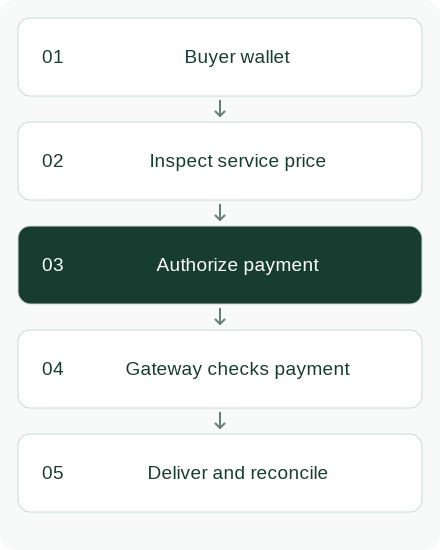
Suppose the research agent’s wallet reports payment for a data request, but the response never arrives. The agent should retain its task ID, request reference, payment reference and payment state. The data provider needs to associate the Gateway charge with its upstream API request and delivery record. These are separate records: success on one side does not establish delivery on the other.
A reusable investigation sequence is to look up the original request using a reference both parties recognize, match the amount, currency and payment state, then inspect the upstream result and delivery. If payment is confirmed but the service outcome is unknown, use the provider’s lookup or support process first. If payment is unconfirmed, follow the particular implementation rather than assuming another attempt is free. Whether a second API request incurs a new charge depends on the service’s billing terms, even when the wallet has payment-level duplicate protection.
This two-ledger example is an application design, not a claim that Sponge supplies a universal order ID, automatic refund or end-to-end trace for every upstream service. Before integration, verify which references the parties can exchange and who investigates a mismatch.
Before integrating, confirm account and card eligibility, supported assets and networks, key control and recovery, service charges and network costs. The task budget should identify which of these charges it includes. Use the wallet selection guide for the broader procurement checklist; this article concentrates on matching the payer’s purchase to the seller’s billed API route.
Further reading: Agent wallet, x402, Payment failures.
Sources reviewed November 6, 2026. Official-source explanation; no account, credential, API or payment test was performed.
FOLLOW THE SOURCES