AGENTWALLETS · INDEPENDENT PERSPECTIVES
Sequence Wallets and Trails: From Sign-In to Cross-Chain Purchase
Separate Sequence wallet sign-in from Trails destination intents, route selection, swaps or bridging, and confirmation of the purchased item.
Quick answer
Sequence embedded wallets provide account access and signing. Trails starts from a destination intent, inspects balances and coordinates any required conversion or bridging before the target action. A completed login, submitted route and delivered purchase are different outcomes.
Suppose a user signs in to an onchain app with email and wants a digital item on a target network, but holds assets on another network. The app must provide wallet access, identify funds, quote a route, obtain authorization and verify the target outcome. Sequence’s embedded wallets and Trails payments address different parts of that journey. Public documentation supports a wallet and payments-infrastructure description; it does not establish a ready-made autonomous agent wallet.
The example specifies no asset, network or fee and was not tested. The embedded wallet documentation describes wallet integration compatible with the Ethereum Virtual Machine (EVM) for applications. Trails describes cross-chain payment routing. Sign-in, control of a wallet and moving funds are different events.
Roles in a purchase
| Step | User or application | Wallet and payment components |
|---|---|---|
| Access | User signs in through the app | Wallet provides account access and signing |
| Quote | App specifies the item, asset and network | Routing component presents applicable conditions |
| Authorize | User reviews costs, destination and actions | Applicable signer confirms execution |
| Deliver | App checks the order and target outcome | Related transactions are tracked to a verifiable result |
This is a conceptual flow. Signatures, network coverage and recovery behavior depend on the integration and version. The Sequence documentation home lists wallets and cross-chain payments as different SDKs. Connecting a wallet is not approval of a payment; a single-confirmation experience does not erase underlying swaps, bridging or destination operations.
Trails begins with a destination intent
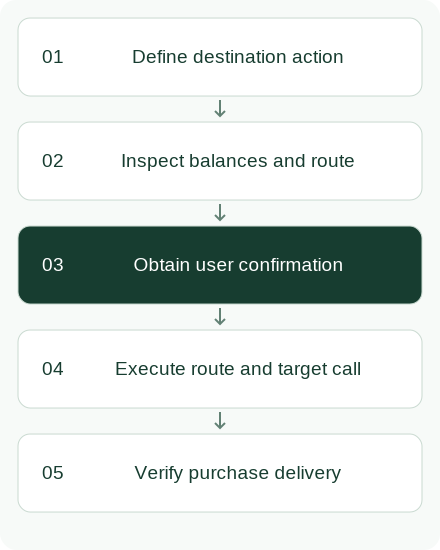
The Trails overview describes an intent as the destination chain, target contract or call, and desired amount or currency. Trails inspects balances and proposes a route; if conversion is unnecessary, the documented flow can use a passthrough path. Otherwise it coordinates the required swaps or bridges before the target action. This is more specific than showing a user’s combined wallet balance.
Consider the same digital-item purchase in three situations. Funds are already usable on the destination chain; funds need conversion on that chain; or funds must also move from another chain. The commercial order may be identical, but the operations, fees and failure points differ. The application should preserve which route the user actually accepted rather than treating all three as one generic transfer.
The overview describes one user confirmation and support for embedded or external wallets. That does not establish an autonomous spending policy: the application still needs to show the target action and establish who can approve it. Network coverage and exact execution behavior require the selected integration’s documentation.
Use Halliday’s deposit explanation for a different starting question: getting the required asset into an application. Here the focus is how wallet access and a destination call participate in a purchase.
Between quote and delivery
After the user selects the source asset, a route can involve conversion, bridging and a destination action. Before confirming, show the source and destination assets and networks, expected debit and output, fees and quote validity. If the price changes or funds are insufficient, prompt for a fresh quote rather than promising the old estimate. Transaction success and delivery of the item should also be verified separately.
A cross-chain route can wait for confirmation or fail in one step. Preserve the order and each transaction reference while the interface shows progress; do not ask for another signature merely because a screen timed out. Refunds, recovery and whether network fees can be returned depend on the route and providers. Review wallet recovery, contract upgrade authority and supported networks independently.
A wallet session and a cross-chain transaction end differently
Suppose a user signs in with email, confirms a cross-chain purchase and closes the browser. The application or wallet session can end while a transaction already signed and submitted is still being processed by a network. Conversely, staying signed in does not mean the source transaction, bridge step and destination action have completed.
An application can keep session identity, purchase order, source transaction and destination outcome as separate records. After the user signs back in, restore a queryable order view and inspect each stage using the route provider’s status. If the source is confirmed but the destination is unknown, do not simply reset the button to “pay again”; establish whether an effective transaction and a recovery path already exist. Transaction references and login credentials or keys should not be treated as the same kind of sensitive information.
This is a reusable state design. Sequence session lifetime, reconnection and route recovery must be tested for the specific SDK, version and wallet configuration. We did not verify behavior after closing a browser or establish identical recovery across all routes.
What an agent application still needs
An agent can help choose an item or prepare a route, but the application must specify what it can read, whether it may request a signature, who confirms the final destination and amount, and how to stop the task. Generic wallet components do not automatically supply the correct budget and approval policy for every agent. Ask about asset control, recovery, networks, quote fees, outage handling and exportable records. Easy sign-in is not a complete funds-governance model.
Further reading: Wallet selection, Funding and recovery, Total cost.
Sources reviewed November 6, 2026. Official-source explanation; no account, credential, API or payment test was performed.
FOLLOW THE SOURCES