AGENTWALLETS · INDEPENDENT PERSPECTIVES
Fipto: Connecting a Business Euro Account to Stablecoin Payments
Follow a euro-funded USDC supplier payment through Fipto account access, beneficiary checks, conversion quote, request authentication and payout reconciliation.
Quick answer
Fipto connects business fiat accounts, asset wallets, conversion quotes and beneficiary payouts. A euro balance does not itself pay a USDC invoice: the company must confirm access, the exact asset/network, conversion terms and payout authority. An accepted payout request is not the same as completed receipt.
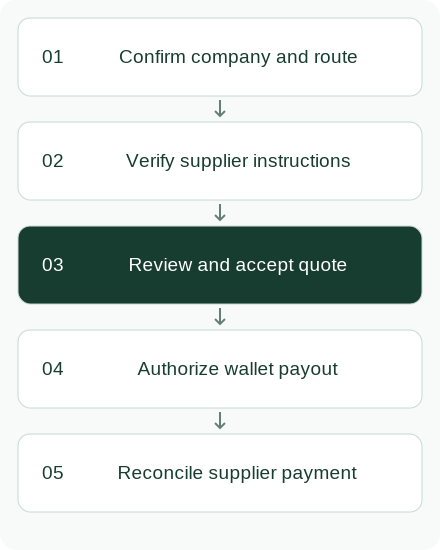
Suppose a company holds euros and receives a supplier invoice for 1,000 USDC on Ethereum. The finance team wants to pay without manually coordinating a bank transfer, an exchange account and a separate wallet. Fipto exposes business account, conversion and payout capabilities through an API, but “one API” does not mean there is only one decision.
The supplier must receive the correct asset on the agreed network, the company must know its euro cost, and someone must authorize the payment. This is a teaching scenario, not a live Fipto test. The invoice amount excludes fees, and no EUR/USD conversion rate is assumed.
Start with the business account and enabled route
Fipto’s API introduction describes a business platform for receiving, holding, converting and paying across fiat and digital assets. It also lists authorization groups and rules. Access is an enterprise onboarding question; a public API reference does not establish that an individual can immediately open a consumer account.
For this supplier payment, identify the company whose euro balance will be used and the wallet that will fund the outgoing asset. Record who is allowed to request a conversion and who is allowed to authorize a payout. Those responsibilities may be separated in the organization even when one application orchestrates the sequence.
The supported-currency reference lists assets with network-specific codes and distinguishes wallet assets from some local payout currencies that are converted at payout time. For our example, confirm the enabled Ethereum USDC route for the company. “USDC supported” is not enough to justify sending through an arbitrary chain, and a network appearing elsewhere in the catalog does not make every token available on it.
A beneficiary is more than an address string
The supplier’s payment instructions should identify the recipient, asset, network and invoice. An Ethereum-style address by itself does not prove which network the supplier expects or whether the address belongs to the named business. Use a verified supplier record and follow the required beneficiary-data flow before funding the payout.
If the supplier changes the address shortly before payment, obtain independent confirmation through the company’s established process. Do not let the invoice-extracting agent treat every new string as an approved destination. The amount can be correct while the money goes to the wrong recipient.
For euro bank payments, Fipto separately documents euro-beneficiary verification. That should not be described as a proof of ownership for the crypto address in this example. Different rails have different validation mechanisms; a check available for SEPA does not automatically apply to a stablecoin transfer.
Convert toward the obligation, not a guessed exchange rate
The business owes 1,000 USDC, not “about 1,000 euros.” A conversion decision must specify which amount is fixed and how much of the other asset is required. Fipto has separate quote creation and quote confirmation references. Obtaining pricing and accepting it are distinct steps.
Save the quoted source amount, destination amount and applicable costs with the invoice reference. Compare the euro debit with the company’s authorized budget before accepting the quote. If the quote changes, do not silently apply a new rate because the supplier’s nominal USDC amount is unchanged.
After confirmation, inspect the conversion result and usable asset balance before attempting the payout. If conversion has completed but the beneficiary check fails, there may already be USDC in the company’s wallet. Starting a new conversion is not a remedy for an invalid beneficiary. The recovery owner needs to decide how to handle the converted balance and the still-unpaid invoice separately.
Request authentication and spending approval are different
The authentication guide documents RSA-SHA256 HTTP signatures. This signature helps authenticate an API request; it is not the supplier’s receipt and should not be confused with a blockchain transaction signature or an internal finance approval.
An agent integration should therefore separate extracting invoice facts, preparing the request and holding credentials with payment authority. If the same worker can invent an invoice, change its beneficiary and authorize the resulting payout, adding a signed HTTP request does not repair that business-control problem.
The payout endpoint initiates a payment from a wallet to a beneficiary and returns an accepted response. Treat acceptance as the beginning of an observable operation. Preserve its identifiers and retrieve or receive subsequent outcome evidence before closing the supplier invoice.
A worksheet for the 1,000-USDC invoice
| Record | What it establishes | What it does not establish |
|---|---|---|
| Company euro balance | Potential source funds | Correct final conversion cost |
| Confirmed quote | Agreed conversion terms | Supplier receipt |
| USDC wallet balance | Assets available at that point | Approval for this beneficiary |
| Accepted payout | Request received for processing | Final destination outcome |
| Reconciled payment | Matched funding and payout evidence | Delivery of the supplier’s separate service |
This is an editorial worksheet, not a reproduction of Fipto’s status enums. It keeps the product’s wording aligned with the actual stage. If the response disappears after payout submission, recover the existing operation before attempting a new one. If a webhook repeats, update the same record rather than post another supplier payment.
What to test and price before launch
Test an unsupported asset/network combination, an unapproved beneficiary, a changed quote and a response lost after submission. Also check that the approval process cannot be bypassed by the API identity used by the agent. These are proposed acceptance cases; AgentWallets has not run them against a Fipto sandbox.
Obtain company-specific availability and a commercial cost breakdown covering account services, conversion, payout and network-related charges. Confirm whether the supplier receives a fixed net amount and how fees are billed. No universal price or promised settlement time follows from this tutorial, and the public currency list is not an account-level entitlement.
The Fipto profile links the reviewed material. Conduit’s infrastructure article covers a broader enterprise payment route, while Monerium’s EURe flow explains euro issuance and redemption. Fipto’s role in this example is the account-to-conversion-to-beneficiary path, with each permission and amount checked against one supplier obligation.
FOLLOW THE SOURCES