AGENTWALLETS · INDEPENDENT PERSPECTIVES
Monerium: From a SEPA Transfer to EURe in a Wallet
Trace a euro bank transfer into EURe and back through SEPA, separating account onboarding, wallet linking, API access and redemption signatures.
Quick answer
Monerium connects euro bank payments with EURe electronic money on supported blockchains. Incoming funds can produce an issue order; an authorized redeem order converts the wallet-held EURe back into an outgoing payment. API authorization and the wallet signature are separate requirements, and integration-plan capabilities differ.
Suppose a euro payment app wants a customer to receive €100 through a bank transfer, see the corresponding EURe in a linked wallet, and later send €30 to a supplier’s bank account. The app is not asking the customer to buy dollars or choose a speculative trading position. It is connecting a euro-denominated bank flow with euro electronic money on-chain.
That is the role Monerium describes in its getting-started documentation. This article uses a hypothetical flow to explain issuance and redemption. It assumes eligible users, supported bank details and a supported blockchain. The €100 and €30 amounts exclude applicable service and network costs; no real onboarding, bank transfer or token operation was tested.
An IBAN and a wallet identify different destinations
An IBAN identifies a bank-payment destination. A blockchain address identifies the linked wallet. The integration must associate both with the correct approved user rather than treat them as interchangeable account numbers. Linking the wrong wallet could make a perfectly valid incoming transfer appear in the wrong on-chain location.
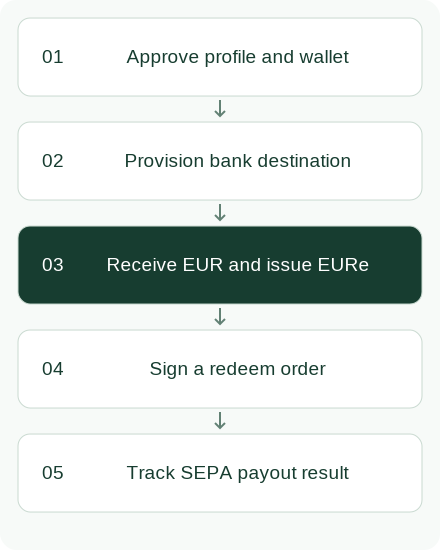
Monerium’s Whitelabel guide describes customer onboarding, wallet ownership proof and dedicated IBAN provisioning. In that plan, an application can manage the user lifecycle through its own experience. The diagram below follows this conceptual dedicated-account route; it is not a promise that all plans offer the same account setup.
Our app should record the customer profile, account provisioning outcome and linked address before displaying deposit instructions. If the customer merely starts verification, the app should not imply that an approved payment account already exists. A bank transfer is not a workaround for incomplete identity or account setup.
Receiving €100 is an issuance flow
When a supported incoming euro payment is matched and processed, EURe can be issued to the associated wallet. The issue order links the external money movement to the on-chain result. The app should retain that linkage so support can explain the difference between a payment being sent by a bank and tokens being available in the wallet.
For the teaching example, a successful €100 funding flow is intended to produce the corresponding euro-denominated electronic money, subject to the actual product terms. Do not show the available wallet balance merely because a customer uploads a bank-transfer screenshot. Wait for the relevant provider and chain evidence for the chosen integration.
The sandbox guide provides a simulated incoming-payment path and test EURe. It is useful for checking the application’s sequence without transferring real euros. A simulated funding event does not establish production banking timing, eligibility or uninterrupted access, and test-network gas is not production funding.
Sending €30 requires a new authorization
To pay the supplier, the application prepares a redeem order. In the documented SEPA path, EURe is burned from the linked wallet and the corresponding outgoing euro payment is directed to the specified bank counterpart. Redemption is therefore different from transferring EURe to another blockchain address.
The OAuth integration guide describes an order-specific wallet signature for redemption. API access lets the application interact with the user’s authorized Monerium resources; it does not replace that signature. A token allowing an app to read payment data should not be described as unrestricted power to spend the wallet.
For our €30 invoice, show the amount, recipient bank details and purpose before signing. Check those same values against the order submitted. If an agent rewrites the supplier’s IBAN after the user reviewed it, the product must not treat the previous approval as approval for the new destination.
After submission, record the order result separately from the blockchain event and the beneficiary’s banking outcome. A burn event is a useful link in the lifecycle, not a reason to invent a bank-credit timestamp that the application has not observed. The remaining wallet balance and the outstanding supplier obligation should be derived from their actual records.
Choose the integration around the user journey
| Plan | Primary user journey | Design consequence |
|---|---|---|
| Whitelabel | Application manages customer lifecycle through APIs | Build onboarding and supported event handling into the product |
| OAuth | User authorizes through a Monerium portal | Design the redirect, backend token storage and wallet-signing handoff |
| Private | Access to the holder’s own Monerium account | Do not design it as customer-account onboarding infrastructure |
The plan comparison currently lists webhooks for Whitelabel and Private but not OAuth. The OAuth guide instead describes chain-event-triggered order lookup. Do not copy a Whitelabel webhook design into an OAuth application and assume identical capabilities.
There is also a documentation inconsistency worth resolving before launch: the comparison table labels OAuth IBANs shared, while its detailed guide describes dedicated provisioning. This article does not promise either account model for an OAuth contract. Confirm the plan-specific entitlement rather than selecting the more convenient sentence. Production partner review is also separate from successfully creating a sandbox application.
Failure cases that reveal whether the linkage works
First, link a different wallet in a safe test account and verify that the app does not display obsolete deposit instructions as current. Second, interrupt the user before the redeem signature and confirm no “supplier paid” state appears. Third, replay an order notification and ensure the balance or payment record is not counted twice.
A fourth exercise is a successful token-side event with an unresolved bank-side result. The product should show what is known and preserve the provider order for investigation. Do not automatically initiate another €30 redemption merely because the supplier has not yet confirmed receipt. These are suggested tests, not results observed by AgentWallets.
Confirm supported chains, user countries, bank-transfer eligibility, operational fees and gas requirements for the chosen plan. EURe’s euro denomination does not remove access restrictions, transaction costs or the need to reconcile events across systems.
The Monerium profile is the source index. For a business converting euros into a different settlement asset, see Fipto. For infrastructure used to create a separate branded stablecoin, see Brale. Monerium’s specific question here is how one approved euro payment becomes wallet-held electronic money and how a separately authorized redemption returns it to a bank-payment flow.
FOLLOW THE SOURCES