AGENTWALLETS · INDEPENDENT PERSPECTIVES
Halliday Explained: Funding Routes, Owners and Recovery
Follow Halliday funding from source to destination, distinguish the designated owner from the sending wallet, and investigate an unfinished deposit.
Quick answer
Halliday coordinates funding routes so an application receives the required asset at its destination. The funding source, designated owner and destination have different roles. Its published owner recovery model needs to be checked for the selected integration; a source debit alone does not establish delivery.
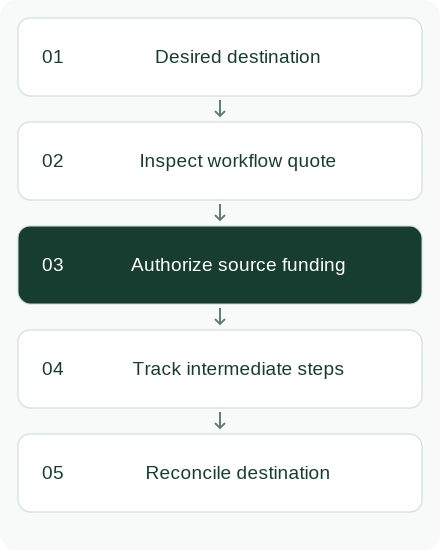
Suppose a user holds assets in a wallet on one chain and wants to fund an application on another. A bridge button alone is insufficient: the user needs a source asset, destination asset, quote, authorization and proof of arrival. Halliday presents multiple funding and withdrawal methods through an interface or API and coordinates the selected route. It is not the user’s bank or the sole provider of every underlying payment rail.
This is a teaching scenario without a specific network, asset, amount or fee; no service was tested. Halliday’s site describes aggregated fiat ramps, exchange transfers, swaps and cross-chain deposits. Actual availability depends on location, providers, assets, networks and integration.
From another chain to the target balance
| Step | User reviews or performs | Application tracks |
|---|---|---|
| Select source | Wallet, exchange or available fiat method | Source and destination eligibility |
| Review quote | Assets, networks, estimated output, fees and expiry | Quote and corresponding order |
| Send | Confirm or initiate the requested transfer | Whether funding arrived |
| Convert and deliver | Wait for swap or bridge processing | Each stage and target receipt |
The site shows selecting a method, reviewing and sending, then delivering on the destination chain. It also describes a deposit address controlled through signatures by a specified owner address, and says a stalled order can be recovered or retried by that owner. These are the vendor’s design descriptions; conditions, support and actual results need verification for the current integration. They are not a guarantee that every failure is automatically refunded.
Three addresses can belong to different roles
Halliday’s published integration example separates the destination address from the owner interface used to obtain an address and request signatures. Its product explanation connects the owner to control of the deposit address. Those roles deserve explicit labels before a funding order is created.
| Role in the example | Question to settle before funding |
|---|---|
| Funding source | Which wallet, exchange or fiat provider sends value? |
| Designated owner | Who can provide the signatures required by the documented control or recovery path? |
| Destination | Which application account or address should receive the output? |
A transfer from an exchange illustrates the distinction. The exchange may send funds on the user’s behalf, but an exchange withdrawal record does not establish that the customer controls the designated owner key. Similarly, receiving the output at the right destination says nothing about whether the app has retained the information needed to request recovery of an unfinished order.
Before presenting a recovery button, identify the owner and required signing interaction. If that authority is unavailable, support must investigate the applicable options; do not promise that a new login or destination address can substitute for it. This is a design implication of the stated roles, not a tested recovery procedure.
Unlike the Sequence and Trails purchase flow, this article stops at delivery of the required funding asset. A later trade or purchase needs its own authorization and completion evidence.
Why a route can involve more than one transaction
A source asset may need a swap, a bridge and then delivery on the destination network. One confirmation in an interface can cover a sequence of underlying states. A quote is an estimate, not evidence that funds arrived. Exchange rates, network charges, spreads and provider fees affect net output. Compare routes by estimated receipt, timing and risk, not one fee in isolation.
Source debited, destination not yet credited
Suppose assets have left the source chain but the destination application still shows zero. The app should first mark the order as awaiting destination confirmation and retain the original order, source transaction hash, target asset and network. It should neither show unconditional success nor immediately create a second deposit. The user, application operator, route service and underlying partners can each hold different records, so identify a support entry point and the time of the latest status.
Next, verify final confirmation of the source transaction and determine whether the route is in conversion, bridging or destination delivery. If there is a destination transaction, reconcile it with the application’s credit. Before recovery, confirm the designated owner, signing method, available action and possible fees, then let an authorized user decide under the actual product flow. Refund availability and responsibility depend on the specific partners and order state.
This is an instructional investigation checklist. Halliday’s site describes owner recovery or retry, but we have not tested it and cannot establish that the app, user or Halliday can unilaterally recover every failure.
Aggregator versus a single on-ramp
A single provider offers its own payment methods and geographic coverage. An orchestration layer attempts to combine providers and asset routes into one experience. That can reduce integration work, but identity checks, pricing, eligibility and disputes may still be handled by the particular partner. Halliday describes its design as non-custodial; the application must still examine signing control, destination, third-party charges and actual terms.
For an agent, user authorization should identify the asset, network, maximum debit and destination. A proposed route is not unlimited signing authority. Before launch, test expired quotes, mismatched destinations and recovery of each state in an authorized environment, and tell users where to get help. We did not run those tests.
Further reading: Funding, Payment failures, Payment costs.
Sources reviewed November 6, 2026. Official-source explanation; no account, credential, API or payment test was performed.
FOLLOW THE SOURCES