AGENTWALLETS · INDEPENDENT PERSPECTIVES
PayOS Agent Tokens: From Saved Card to Authorized Checkout
Follow a PayOS shoe purchase from PaymentSheet and passkey consent to a network credential, changed-order checks and separate merchant checkout.
Quick answer
PayOS connects a stored card and approved purchase instruction to a card-network credential for a designated agent. PaymentSheet prepares that credential; merchant checkout happens separately. Changed order terms need an authorization check before execution, and available cards and regions depend on the participating program.
Suppose a customer asks a shopping agent to buy shoes within a budget. After finding the item, the agent needs a credential the merchant checkout can process. PayOS connects a saved card, identity verification and scoped consent to an agentic credential issued through a card-network program. This token is a card-payment credential, not a blockchain token or a stablecoin balance.
This is a teaching example; no card was added and no purchase made. PayOS’s product description says a cardholder uses a passkey to approve an instruction, the designated agent receives a network credential, and the agent separately checks out with the merchant. Credential generation and purchase are different steps.
From consent to checkout
| Stage | What happens | What it does not establish |
|---|---|---|
| Identity | The user completes applicable verification and adds a card | Every card qualifies for a network program |
| Instruction | The user reviews merchant, amount and scope and uses a passkey | The item was purchased |
| Credential | An applicable network program issues a credential to the designated agent | The merchant or issuer will approve |
| Order | The agent checks out; network and issuer process the payment | Delivery or a refund is guaranteed |
The wallet terms say the issuer must participate in the relevant network program and some cases can require 3D Secure. Not every card qualifies and the service is geographically limited. Broad product-page coverage language does not override the actual merchant, network and issuer decision.
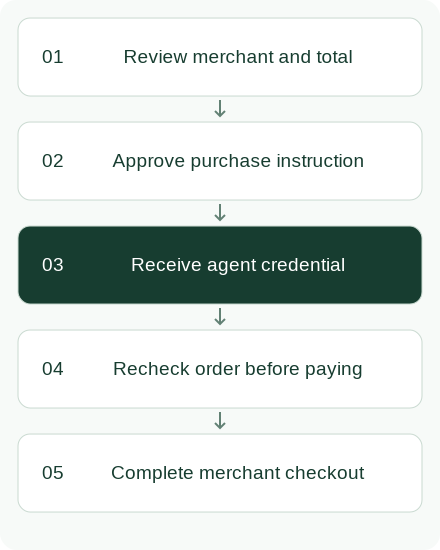
What PaymentSheet hands back to the agent
The PayOS product page describes a PaymentSheet that handles phone verification, card entry or selection, passkey approval and credential handoff. It explicitly places merchant checkout outside that component. PayOS also describes a headless option using its card and passkey components; a custom interface must still coordinate those steps.
For the shoe purchase, the handoff should leave the application able to connect the approved instruction, chosen card reference, designated agent and resulting merchant order. This is an application record design, not a claim that those are literal response fields. Receiving a credential should change the screen to ready for checkout, not shoes purchased.
A passkey proves completion of an authentication ceremony. The product must separately bind that ceremony to the purchase instruction shown to the user. An authenticated customer can still cancel the purchase, and an authenticated request can still encounter an issuer decline. Keep the token out of ordinary chat logs and show a non-sensitive reference for support.
These responsibilities distinguish credential preparation from the card-program operations discussed in the Rain explanation. They are related layers, not interchangeable products.
Passkey, scope and card authorization
A passkey authenticates the cardholder; the application must record which purchase instruction was approved. Authentication does not judge whether the shoes fit or remain in stock. Before confirmation, show merchant, item, total, currency, fees and validity. If the price or merchant changes, follow the actual reapproval flow rather than applying old consent to new terms. PayOS describes network controls over merchant, amount and time; their precise scope and rejection behavior need verification for the participating network and integration.
Checkout can still be declined, require additional authentication, fail at an unsupported merchant or encounter a changed price. Do not label credential creation “order complete.” After a timeout, inspect both the merchant order and card transaction before retrying, to avoid duplicate purchases. Cancellation, refund and disputes follow the merchant and card program. Revoking a credential does not automatically undo an already completed transaction.
What if the user changes the order amount?
Suppose the customer approves an instruction for a merchant and the checkout total later changes because shipping is added or the customer selects a different size. The application cannot decide based only on whether a credential already exists. Compare the original merchant, currency, amount limit and validity with the new order, then determine under applicable network, issuer and PayOS rules whether a new intent or authentication is needed.
A reusable flow retains the link between the original instruction and credential, displays the complete changed total, and associates the user’s decision with the new order version. If coverage is uncertain, pause for appropriate confirmation. Do not assume the system automatically rejects the request, increases the limit or invalidates the old credential. Once a credential has already been used, changing the order or canceling a new request does not necessarily reverse the prior card transaction.
Acceptance scenarios should separately cover a lower price, higher price, changed merchant and interrupted confirmation, then inspect the actual credential and order states. This is an integration design to verify, not a promise about a particular network rule or PayOS outcome.
Questions before integrating
Determine who stores the original card, what the agent receives, credential lifetime, how consent is recorded, supported cards and regions, and how platform or agent access is revoked. Verify fees and controls by network and program; do not log full card numbers or sensitive authentication data. The application still checks the product and budget, and a card authorization is not proof of delivery.
Further reading: Payment authorization, Virtual cards, Authorization and settlement.
Sources reviewed November 6, 2026. Official-source explanation; no account, credential, API or payment test was performed.
FOLLOW THE SOURCES